17 minutes ago
Foreign Policy analysis: Serbia strong Russian-Chinese ally in dialogue with Kosovo
Periskopi(4 years ago)
(4 years ago)US and its European allies must encourage Serbia to focus on itself, not its neighbours. In this direction, Western policymakers would be wise not to expect some progress in Kosovo-Serbia status negotiations, which has become an empty dialogue that only keeps Kosovo out of institutions [...]
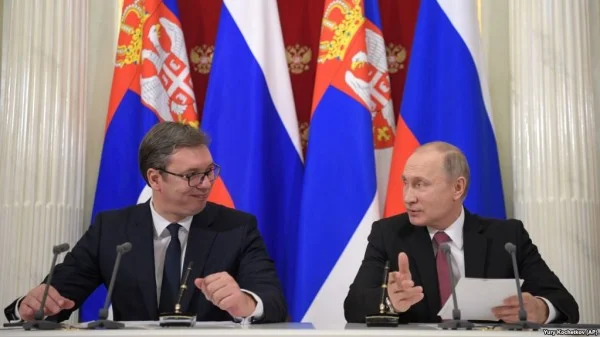
He wrote about Foreign Policy, that it's time to say frankly what the Republic of Serbia is: A strong Russian and Chinese ally led by a semi-inquisite government that actively follows the ideologically identistic territorial expansion in the Western Balkans. Today's Serbia poses a threat to regional and transatlantic security. Under President Aleksandar Vucic's Serbian Progressive Party (SNS), the Serbian government is rapidly building its army, openly supporting ultranationalist provocations in neighbouring states, strengthening Belgrade's ties with Moscow and consolidating partnerships with the People's Republic of China (PRC).
According to Kremer as an integral part of its efforts to actualise the ideology of “Greater Serbia”, the leadership of the Orthodox Church of Serbia and Russia co-operate closely and in harmony with their political counterparts, adding that without a significant change in its orientation towards the West, Serbia will continue in an authoritarian transition in line with US opponents.
Contemporary “Serbia presents a stir for American and European strategists and policymakers. A truly democratic and Euro-Atlantic-oriented Serbia was requested by Brussels and Washington. However, decades after the violent breakup of Yugoslavia and interventions of the North Atlantic Treaty Organisation (NATO) in the 1990s, most Serbs refuse co-operation with NATO and are indifferent to the European Union (BE). Consequently, the US and its democratic allies in Europe are less capable of using future memberships as a tool for transatlantic integration. A further complication of relations with Serbia is Aleksandar Vucinqi's open embrace with Beijing and Moscow. The depth of Serbia's growing dependence on those powers threatens the security of the US and Europe on many fronts. The continued support of ultranationalist narrators from the Vucic government and their subversive suppliers continues to intensify disagreements in Bosnia and Herzegovina, Montenegro and North Macedonia. Its military strengthening is extremely disturbing; Belgrade answers only with false explanations. The country's growing support of Russian oil and gas as client and transit state for Gazprom, Russia's state energy giant, puts it at odds with Brussels, Washington and several Central-Lindorian European capitals. Economic, technological and increasingly military co-operation in Belgrade and Beijing accelerates as the Chinese Communist Party (PKK) is further strengthened in Southeast Europe. As a summary: Serbia's growing expansion with authoritarian powers and regional anti-democratic forces reflects its nonliberal outlook and inadequacies of national victimisation. Western policymakers are constantly approaching authorities in Belgrade with the conviction that, with the right incentives, Serbia will begin to pursue a moderate policy, democratise and gradually integrate into transatlantic institutions. This assumption is wrong. It diminishes and probably even excludes the need for the Serb people to face their past. Like post-war Germany, with Willi Brandt, Serbia needs a bold and fair leadership to admit past sins and move the nation forward. For example: An event like Kniefall von Warschau could spur a sincere discussion among Serbian peoples about atrocities committed during the breakup of Yugoslavia. Whatever the catalyst, a broad acceptance of past crimes against humanity is necessary if Serbia ever becomes a democratic and open society. Without it, Serbs will remain disproportionately vulnerable to the irredentist internal forces fed by malicious foreign powers that want to keep the Western Balkans away from the Euro-Atlantic community”, the author wrote.
Until such a national confrontation, Western decision-makers, according to him, should adopt a more pragmatic approach to relations with the Belgrade government, which ignores true transatlantic partnerships.
“As long as pan-Serbian ultranationalistism is considered by Serbia's leaders as acceptable in political discurs, those real democratic values and institutions fed in the Euro-Atlantic community will remain incomplete. Therefore, the US and its European allies must encourage Serbia to focus on itself, not its neighbours. In this direction, Western policymakers would be wise not to expect some progress in Kosovo-Serbia status negotiations, which has become an empty dialogue that only keeps Kosovo out of international institutions and other benefits of recognised citizenship. A revised approach should also disrupt the postponement of an inefficient process of EU integration, as Serbia's main means of democratic transformation”, it has written.