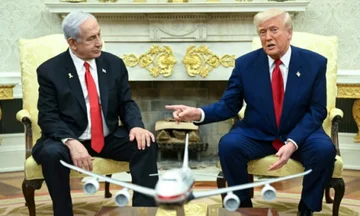
CNN: Netanyahu seeks emergency meeting with Trump amid mounting tensions over negotiations with Iran
 4 minutes ago
 (4 years ago)
In March 2014, shortly after Russian troops annexed the Ukrainian Crime Peninsula, German Chancellor Angela Merkel spoke with American President Barack Obama about the first instance of annexing a territory in Europe since the end of World War II. Earlier that day, Merkel had talked to the Russian president, [...]
In March 2014, shortly after Russian troops annexed the Ukrainian Crime Peninsula, German Chancellor Angela Merkel spoke with American President Barack Obama about the first instance of annexing a territory in Europe since the end of World War II.
Earlier that day, Merkel had talked with Russian President Vladimir Putin, and during her call with Obama she was sharing details of that conversation with the Russian leader.
Putin is “in another world”, Merkel reportedly told President Obama, referring to what analysts describe as an alternative view of the Russian president, whom some describe as paranoid, of political events a thought the US says is responsible for many of the country's disasters.
Eight years later, while Russia has surrounded Ukraine on three sides with over 130,000 troops, in what US officials have warned that there may be preparations for the biggest invasion in Europe in more than 75 years, Putin, who turns 70 years in October, is likely even more divided from reality, analysts estimate.
Russian military forces close to Ukrainian borders
Insulated, mainly in its residences in the outskirts of Moscow and in the Black Sea town of Sochi, protected by measures taken due to the pandemic COVID-19, Putin is deciding on his future moves probably the most important in Europe in decades and is taking the opinion of a small number of his close advisers, who share his conservative and conservative view of the world, officials and former Western officials and analysts say.
The close circle, which includes Security Council Secretary Nikolai Pattrusev; Federal Security Service Director (FSB) Viktor Bortnikov; Defence Minister Sergei Shoigu; Foreign Intelligence Service Chief (SVR) Sergei Naryskin; and the chief of the Committee for Investigations, Alexandr Bastry Bastkin, has narrowed further since 2014, as Putin's disappointment with the West is increasing, analysts say.
The future of Ukraine may depend on a man who is on a bubble that even fuels his aggression, but it also protects him from the consequences of this” aggression, said an article published this month in Foreign Affairs, Adam E. Casey associate at Michigan University's Weisser Centre and Seva Gunitsky, professor at the University of Toronto.
Russian political analyst Tatyana Stanovaya wrote in May 2020, in the period when the pandemic had just begun, that the elite grouping that was developing, which she called “the defender”, was increasingly becoming more influential in Putin.
It described “defenders” as an alliance between those in favour of greater depression within Russia and those pushing forward conservative ideology as a way to ward off the challenges, which members of this alliance claim mainly coming from abroad.
The protector's <x0Ideology, shamelessly based on conspiracy theories, requires that to mobilise society against foreign threats and push forward the idea of stricter control over the private life of Russians and political life”, Stanovaya said.
A specific example of such a conspiracy claim appeared during tensions over Ukraine: Shoigu, 66, confirmed last December that American mercenaries were moving “to an unknown chemical compound” in the region of Donbas, where Russian-backed forces have been battling Ukrainian government forces since 2014. He gave no evidence to support this claim.
The defence minister, Shoigu, who has accompanied President Putin to several mountain and fishing trips to Siberia, these that have also appeared on state television, is a “from the few personal friends Putin has in Government”, is said in the book “Mr. Putin”, written by Fiona Hill, a specialised economist for Russia who has been adviser to former American president Donald Trump.
When Putin came to power in late 1999, he first surrounded himself with a series of advisers from liberal economists to his former colleagues from secret services.
However, he changed access in 2012, the year he returned to the presidency after a period as prime minister amid unprecedented protests against his rule.
He accused the United States of orchestrating the protests that began in 2011, which were partly prompted because of his decision to return to the Kremlin, and began to suppress the instability, civil society and opposition, which would increase steadily since then.
“to re-consolidate power, Putin was repositioned as a conservative, stressing the importance of spiritual ties and traditional values that were missing in the Western decadent”, Stanovaya wrote in the report published in May.
In 2013, Putin had signed a legislation supposedly targeting “protecting children from information that needs to deny traditional family values” so-called Law “homosexual propaganda”. The signing of this law, according to human rights organisations, increased the social enmity of the LGBT community.
When protesters took to the streets of Ukraine later that year to protest the president's refusal, Viktor Yanukovych, a trade agreement with the European Union in favour of closer ties with Russia, Putin again pointed his finger at Washington and the West.
After Yanukovych left for Russia, Putin sent troops to take over the Crimea, and Moscow backed separatist forces east of Ukraine.
Putin's actions are widely seen as the reason Ukraine is moving further from Russia's orbit and having strengthened the Ukrainian people's desire for integration with the West something Western officials say he and his close advisers have failed to understand.
Of course, he has not publicly accepted this, rather he has accused the West in an article published in July, where he has written about the division of Russians and Ukrainians, which he has called “a people”.
People who have worked with Putin say his controversial view of the world has been shaped during the years when he was a Soviet KGB officer. Some of his closest associates, who are of the same age, come from a similar past and in many cases from the same city, Leningrad, now known as St. Petersburg.
“Sic often claims in public and in private, he believes there are plots and conspiracies from the United States and the West towards him and Russia”, wrote in an article published in 2016, Fiona Hill, an expert on Russia, which during the Trump administration served at the National Security Council.
The “Such a conspiracyal way of thinking is in line with his ~x1> logic, Hill wrote. The “Commet have meaning with regard to its reference framework as seen through its Cold War filters, as long as it was KGB operative in East Germany in the late 1980s and the prevailing political views of Russian conservative circles”.
Nikolai Pattrusev, 70, is one of Putin's closest associates throughout his years in power. He's a hardline conservative and former KGB officer. Born in Putin's hometown of Leningrad, he served as FSB chief from 1999 to 2008 and then passed to the Security Council.
It is reportedly behind the new National Security Strategy, which was released last year. This strategy led to a new level of criticism against the West, claiming that “cultural sovereignty” Russia's is in danger and that traditional “values are actively under attack by the United States and its allies”.
Sergei Naryskin, 66, is another person from Leningrad who first met Putin after graduating from the KGB Middle School. He, without giving any evidence, has claimed that Western intelligence agencies have attempted to kill Russian opposition leader Alexei Navajo. Navalny, who was poisoned in 2020 in Siberia with a Russian-made nervous agent, blames Putin and FSB for poisoning. / Full text in REL/
32 minutes ago