5 minutes ago
143 years from treaty that left Albanians under Ottoman Empire
Periskopi(5 years ago)
(5 years ago)A month after Errena's ceasefire, the Peace Treaty between the Russian and Ottoman Empire was signed on March 3rd, March 1878. The Treaty of St. Stafian exhumed the Ottoman Empire about 80% of its belongings in the Balkan Peninsula. Hoping to avoid opposing other great powers, Russia did not receive [...]
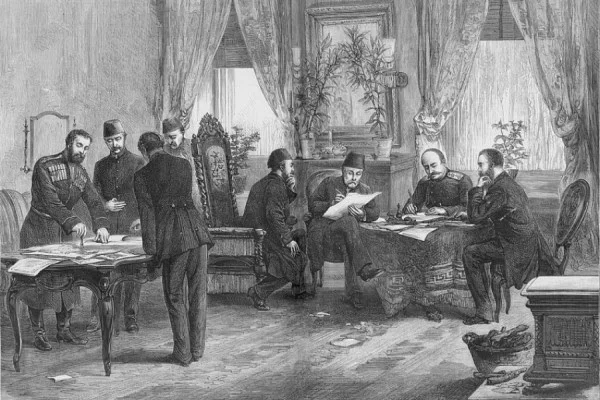
A month after Errena's ceasefire, the Peace Treaty between the Russian and Ottoman Empire was signed on March 3rd, March 1878.
The Treaty of St. Stafian exhumed the Ottoman Empire about 80% of its belongings in the Balkan Peninsula. In hopes of avoiding opposition to other great powers, Russia received nothing from these territories.
It was limited by removing Romania, which it had allied in the war it won, the province of Bessarabia in the north of the Pruth River, and by annexing several provinces owned by the Ottoman Empire south of the Caucasus (Cars, Ardahan, Bayazid and Batum). Its hegemonistic goals in Southeast Europe, the Carist Russia would provide mainly through the large autonomous Bulgaria that was created with the Treaty of St. Stefan.
Bulgaria would be an autonomous principal with its government, tributaries to the sultan. Its formation was in itself a positive step, as it freed the Bulgarian people from the centuries-old Ottoman yoke. But Russia created a large Bulgaria, which it would have as its satellite in order to establish through it its ownership in the Balkan Peninsula. Its borders would include the destructive majority of lands that broke up the Ottoman Empire. This would extend east to the Black Sea, south to the Aegean Sea, north to the Danube and west to the mountains of Voskopoja. Although large Bulgaria would remain under the sovereignty of the Turkish sultan, the High Gate would have no right to impose within its borders any Ottoman military garrison.
The rest of imperial territories would be given to Romania, Serbia and Montenegro, which returned from autonomous principles to independent states. Greece did not benefit anything. It would remain as it was, an independent state within its pre-war limits.
The Treaty of St. Stefan did not mention Albania, which for Russia did not exist as a subject of political rights. According to the St. Stefan Treaty, nearly half of the Albanian lands were given to Balkan Slavic states. Bulgaria would take, in addition to others, the Albanian provinces of Korca, Bilci, of Struga, of Kricova's Debar, of Tetovo, Skopje, of Kacanik, etc.
Serbia, which would mainly extend to the southwest, would also annex northern and northeastern parts of Kosovo to the vicinity of Mitrovica.
Montenegro, whose area would grow more than three times, would also include within its borders a series of Albanian provinces, such as Ulcinj, Kraja, Anamal, Hoti, Gruda, Tuzi, Kelmendi, Plava, Guita and Rugova. The rest of Albania would remain under the rule of the Ottoman Empire. As a result, with the Treaty of St-Stefan Albanian soils to be torn apart among four foreign states. The Russian Empire thus severely crippled Albania's earthly whole and exacerbated the Albanian people's struggle for the creation of national state.
The deep anger caused by the Treaty of St. Stefan in Albania further increased the terror of the Serbian-Montenegrin armies over the Albanians of their occupied areas and the violent evacuation of tens of thousands of Albanian families, which flocked as immigrants to the uninvaded provinces by Balkan armies. Only in the Kosovo villa did some 100,000 men, women and children roam, displaced by the Serbian occupation area. Nearly 38 thousand people expelled from the Russian and Bulgarian armies were scattered, according to the English consul Blunt, in parts of the monastery's villa. According to reports by the Austro-Hungarian Consul Lipic (Lipich), over 26 thousand Albanians expelled from the Montenegrin occupation area, were located at the Shkodra villa. But the number of displaced Albanians was greater, given that not a few of them were sent to the villas of Thessaloniki, Istanbul, Izmir, Adana and Syria.
Anger against the Treaty of St. Stefan encompassed all layers of Albanian population, from peasants and craftsmen to Chicago and trade districts. This anger of Albanians was directed not only against the Russian Empire and its Balkan allies, but also against the Ottoman Empire, which had signed such an act, which sentenced their homeland to death. The fact that none of the other major powers raised voices for Albania's national rights eventually convinced Albanians that they were already completely alone.
The new situation that was created by the decisions of St. Stafan and the subsequent events in March 1878, when it became clear that the Western Great Powers were determined at all costs to protect the rule of the Ottoman Empire in the Balkans and therefore were not allowed to take into account the national rights of Albanians, the Istanbul Central Committee concluded that both the armed anti-human establishment and the demand for Albania's independence could no longer stand as key points of its political programme.
Now that the fragmentation of the Albanian lands began to come to life and the task of protecting Albania's entire land came to light, the armed uprising against the Ottoman Empire not only did it not solve the Albanian issue, but it further complicated it and the fate of the homeland.
Under such international circumstances, the Istanbul Albanian Committee adopted, as long as this complex situation would take place, a new political platform, which called for the mobilization of the whole country to fulfill two key tasks: to fight armed warfare, on behalf of Albanian nationality, any decision that would take the Great Powers, even with the consent of the Ottoman Empire, at the expense of Albania's territorial wholeness, and at the same time, to achieve the union of all the country's lands in a single, self-equivocal villas, with some rights that could be carried out without the Supreme Conflict.
Fulfilling these goals required the formation of a single Albanian political front and the acceptance of this front of the political platform processed by the Istanbul National Committee.
For the creation of the united political front, which would form the form of an Albanian national link, there was already in Albania a land to some extent prepared from a organizational point of view. As early as December 1877, in the peripheral provinces of Albania, when they began to be threatened by the Serbian and Montenegrin conquest, the Albanian district covenant had been organized, or local self - defense commissions, as they were called in some areas, that tried to mobilise Albanians into action as soon as they were released. The St. Stefan Treaty gave a powerful incentive to create new covenants. But with the economic, social, political and cultural evolution that Albania has suffered over the past decades, unlike previous periods, the consciences of the district community were already exceeded among Albanians. Each province had begun to feel like members of a single body as part of a common homeland. This evolution in the national conscience of Albanians was a favourable factor for the activities of the Istanbul National Committee, which now belonged to the task of uniting the district covenants into a single organisational body and with a single political platform.
Until they were merged into a national organisation, in front of the district covenants there were three fundamental tasks: mobilizing the broad levels in the large protest movement against the unjust decisions of the Treaty of St-Sefan; preparing militarily to oppose with arms the fragmenting of Albanian lands, in case the Treaty's decisions remained in force; to help and arrange about 150 thousand Albanian migrants gathered in the villas of Kosovo, the Shkodra of the Monastery, who had remained without bread and shelter.
Meanwhile, in April 1878, Albanian public opinion was informed by the international press of the opposition the Treaty of St. Stafan had found in other major powers. Indeed, the most severe opposition he had was from England and Austria-Hungary, which was greatly disturbed by Russia's rapid growth of influence in the Balkans through Great Bulgaria. For this reason, with their insistence, it was decided that the conditions set out in the Treaty of St. State would be revised by a special congress of the Great Powers, which, according to the decision later made, would be gathered in Berlin on June 13, 1878.
Albanians were convinced that the Great Powers, though they rejected the Treaty of Saint-Steftan, were still not priorities to take into account Albania's national interests. However, his suspension until the Berlin Congress call gave Albanian patriots a valuable time to better organise political and military resistance. But, on the other hand, the permission the Istanbul Committee had sought to form an Albanian connection finally met in opposition to the High Gate. In principle, the Ottoman Empire did not view the movement of the protest of its populations against the Treaty of St-Seftan, but it did not accept in any way that this movement would develop and organise as the Istanbul Committee understood it to be a national Albanian movement. The High Gate required that Albanians protest against the Treaty of St-Stefian as Muslim citizens, who did not want to break away from the Ottoman Empire and its Sultan.
Albanian Patriots, who could not reconcile those conditions, decided to form the Albanian connection by relying on the popular movement and local covenants.