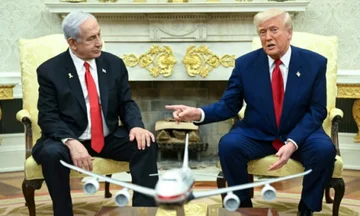
CNN: Netanyahu seeks emergency meeting with Trump amid mounting tensions over negotiations with Iran
 7 minutes ago
 (4 years ago)
Relief in imports and exports proceedings, free movement of citizens with ID, common market for the 12 million residents of Albania, Northern Macedonia and Serbia, removal of controls at border points or co-operation in preventing and eliminating the consequences of natural disasters are some of the agreements signed under “Balkan [...]
Relief in imports and exports proceedings, free movement of citizens with IDs, the common market for the 12 million residents of Albania, Northern Macedonia and Serbia, removal of controls at border points or co-operation in preventing and eliminating the consequences of natural disasters are some of the agreements signed under the “Balkan Open Together. Among other things, after meetings, agreements were signed among the three countries on the conditions for free access to the labour market in the Western Balkans, the agreement on the interconnection of electronic identification schemes of Western Balkan citizens, and the agreement on co-operation in the field of veterinary, food and phytosanitary security in the Western Balkans.
On the other hand, in trade exchanges among the three countries Serbia is dominated as the largest economy, with more residents but also a solid industrial structure inherited from the former Yugoslav state and with more advanced factories in the processing of trees or food production, with advantages in IT technology, and so on. Northern Macedonia has an export of 223m euros to Serbia and imports of Serbia's 558m euros in 2020, meaning that Serbia sells three times more goods and products in Macedonia than vice versa, the Ent for Statistics data shows.
Macedonia in Serbia iron and steel, iron products, pharmaceutical products, mineral garbage, plastics, trees and vegetables, etc. In Serbia, machinery and electric equipment, iron and steel, machinery, and numerous food industry products include wheat and flour. Trade exchange between Northern Macedonia and Albania remains modest, while unlike Kosovo, which is among Macedonia's main trade partners, Albania is not ranked among the ten states with which we have greater trade exchange. This is due to delays in building the modern corridor as highway to Corridor eight, and Albania's orientation to have trade with older traditional partners like Italy and Greece, as well as new ones like Kosovo, Turkey, Germany, France, China, Spain, and not creating infrastructure conditions for both countries to advance bilateral trade.
In 2017, North Macedonia's export to Albania was worth close to $74m to increase in 2020 to over $100m. Last year, North Macedonia and Albania have scored exports of 11.655m dollars, and imports of 12.063m dollars. So trade exchanges between the two states are rough in export and import. From 2017 to 2020, North Macedonia's export has increased to Albania from $8,431m (70.258,333 euros) to 11.655m euros (97,125,000 euros).
In northern Macedonia's export to Albania, food, plastics and plastics, plant and animal oils, different shades, etc. Even one of the prominent exporters from northern Macedonia to Albania is the company KONTIHIDROPLAST, or the pipeline factory from Gevgelija. From Albania we import even more products from the construction sector as cement, nickel and iron, iron bars, aluminum, etc. Analyzing shows that trade exchange between Serbia and Albania has increased by 70 percent from 2016 to 2020, while more than 1,000 firms from Serbia are working with partners from Albania in Albania. The value of Serbian export to Albania was 156.2m euros, while Albania has exported nearly four times less goods to Serbia or exported a value of 45.3m euros last year. During 2020, the most important products sold by Serbia in Albania have been the remains of iron and steel, corn, non-alcoholic beverages, electricity and wheat. In Albanian exports to Serbia, the most important products are tomatoes, cucumbers and fresh peppers, cement and concrete steel.
On the other hand, the idea of free circulation of people, goods and capital so far has had praise from the international community, as well as criticism from the opposition in northern Macedonia, Albania and Serbia, as well as from the countries of the region.
“Mini-Shengen” initiatives have sometimes stressed that the initiative is open to other Balkan six states, Kosovo Montenegro and Bosnia and Herzegovina, but these states currently do not share Skopje, Tirana and Belgrade enthusiasm. Not all business associations in northern Macedonia have received this initiative with great affection. Long ago, the Economic Oda of northwest Macedonia has stressed that “Zenen” should include all states of the Western Balkans, but being careful not to harm the economies of states. Several months ago, former Oday League Chairman and current Skopje Mayor Danella Arsovska has reacted to the social networks for “Missen Schengen”. “q from Europe. Macedonia was stuck in Geton and Micro-Balkan Schengen and won the date for entry into Vranje”, Arsovska stressed. Meanwhile, Macedonia's economic Oda has welcomed such an initiative.
Otherwise, Northern Macedonia, Albania, Serbia aims to remove controls at their borders for goods and circulation of people from the three countries, starting on January 1st, 2023, an initiative that this summer officially changed the name to “Balkani opened” from the renowned “Mini-Balkan Schengeny”. mk
35 minutes ago