CNN: Netanyahu seeks emergency meeting with Trump amid mounting tensions over negotiations with Iran
 3 minutes ago
 (5 years ago)
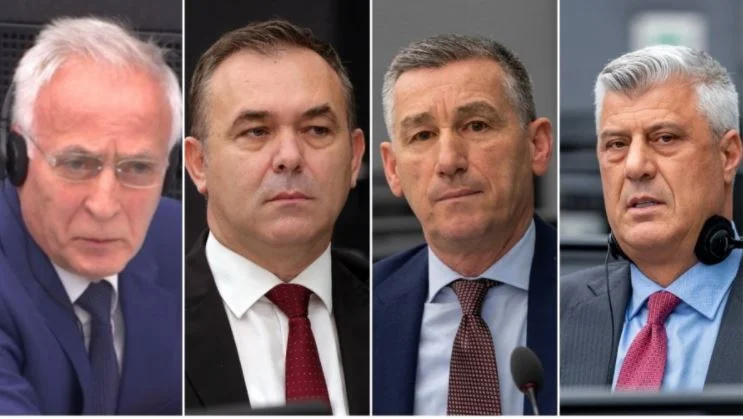
A year has passed since former Kosovo Liberation Army superiors Hashim Thaci, Kadri Veselini, Jakup Krasniqi and Rexhep Selimi are being held at the detention centre of Specialised Chambers in The Hague, and there is still no date when the trial process will start against them, on war crimes charges and [...]
Despite the fact that all these months have passed since their arrest, the Specialised Prosecutor's Office, so far, has failed to hand over to court the preliminary file for this case, containing summarys of evidence, which the Specialised Prosecutor intends to present in connection with the conduct of the alleged criminal work.
One such thing, the Specialised Prosecutor's Office has been ordered to do by December 17th of this year, this one, decided by Prosecution Judge Nicolas Guillou.
Concerned with slow prosecution of material by the Specialised Prosecutor's Office is expressed in a conversation with Hashim Thaci's leading lawyer with Radio Europe, Gregory Kehoe.
Kehoe says the prosecution has repeatedly requested postponement of material delivery deadlines, providing various reasonings about delays, including reasoning about the large volume of documents, evidence, evidence and other materials, as well as lack of staff to proceed with them.
It's hard to say how many materials we've accepted, when we don't know how many more will come to us”, says Kehoe.
In November 2020, at the first appearance of Thaci, Veselin, Selimi's Krasniqi before The Hague tribunal, the Specialised Prosecutor's Office has said it aims for the trial to begin at its latest in the summer of 2021.
During the Prosecutor's word, there are over 1,500 different evidence that must be administered, as well as over 150 witnesses.
Former Kosovo President Hashim Thaci's defence lawyer, Gregory Kehoe, says that delays in handing over material on the prosecution have to do with the fact that, according to him, the Specialised Prosecutor's Office has filed charges without being ready for this process.
“Arsyet are different, but number one is that they [the Specialised Prosecutor's Office] have filed charges before they are ready. Our clients have been in custody since last November, more than a year, and when the prosecution has filed the indictment, they have said they will be ready to try this case in the spring of 2021”, says Kehoe.
According to him, the Specialised Prosecutor's Office would have to share documents according to procedure long ago.
They're not ready to do that yet. They have not yet handed over all the documents and repeatedly requested additional time to hand over what should have been handed over long ago, in view of the fact that last year, the court said they would be ready to proceed in spring”, says Kehoe.
He adds that many prosecution documents are highly edited and that it is difficult to understand what witnesses are talking about.
Very often when we have statements of witnesses who are strictly edited, it's very difficult for me and my staff, as well as for people who review this information, to fully understand what witness is saying. Very, very difficult”, Kehoe says.
Ellis: Prosecutorship Can Be held responsible for delay
The executive director of the International Court of Lawyers, headquartered in London, Mark Ellis, says he does not believe the start of the trial process for Thaci, Veselin, Krasniqi and Selimin is being postponed for some purpose.
He says that based on what has been seen so far, a big job has been done in the Special Chambers, including the development of eight status conferences.
The status conference, or conference on the performance of the issue, calls the judge of the preliminary procedure, and it is aimed at organising exchanges between the sides. At such conferences, the prosecution shows what kind of evidence is available.
If the Court finds that the prosecutor is deliberately neglecting his obligations and obligations, it would go in favour of Mr. Thaci for bail. And also, the Court would hold the prosecutor responsible for any further delay of”, Ellis tells Free Europe Radio.
Ellis says that, under international laws, everyone enjoys the right to be tried within a reasonable deadline and that any delay by the prosecution in the case is also concern for the Court.
The trial will be much more concerned if the case drags on, drags on and drags on and, at the same time, Mr Hashim Thaci is held in The Hague detention centre”, Ellis says.
At the latest status conference, which was held on 29 October, the Specialised Prosecutor's Office has confirmed that it has carefully revised human resources and that 17 December it will hand over the preliminary file.
The Specialised Prosecutor's Office tells Radio Free Europe they are making efforts to pass as soon as possible in the judicial process, but does not give any timeline.
“The SP [the Specialised Prosecutor's Office] seeks to pass into judgment as soon as possible. The next status conference is scheduled for the 15 December, 2021 afternoon, and the Specialised Prosecutor's Office is preparing its preliminary document on December 17th, 2021”, the SPS response reported.
The upcoming conference on the performance of Thaci's case, Veselin, Selimi's Krasniqi, has been confirmed for December 15th.
Court Against Release, Fear of the Influence of Indictees
Kosovo's Specialised Chambers fear the impact those charged with war crimes and crimes against humanity have and, for this reason, does not approve their parole demands, says Mark Ellis.
In addition to the complexity of the case, the functioning of Kosovo's Specialised Chambers is complex, he says.
For now, the Court is pointing to reforming its concern that Mr. Thaci's best place for Mr. Thaci is the centre of preventing Specialised Chambers so that he can be monitored; his communications [so] can be limited, if necessary. So, the Court, apparently, thinks this is the best place for Mr. Thaci to be, says Ellis.
Ellis says that since the establishment of Specialised Chambers in 2015, the question of witness influence and safety has been challenging.
I think the Court has consistently taken care that Mr. Thaci and others cannot prevent procedures through any intimidation of witnesses. And that requires that they be monitored at the detention center [of Specialised Chambers]. This is the difference between this case and the other cases you may have seen in the international tribunal”, Ellis says.
Ellis says it is not determined until specialised rooms can keep former President Thaci and other war crimes indictees in custody.
Hashim Thaci, Kadri Veselini, Jakup Kranqi and Rexhep Selimi remain in custody in The Hague since their arrest in November 2020. They have been denied parole requests.
On November 30th, Specialised Chambers have rejected Kosovo Police guarantees of the former president's parole condition, Hashim Thaci.
In the Court's reasoning it has been said, among other things, that Thaci has influence and that his release poses a danger to witness intimidation.
After the decision of the Specialised Rooms, The REL has asked the Kosovo Police for the assurances provided, as well as for the court's findings that this institution has limited capacity to ensure Thaci's parole, but in the police have not wanted to comment on these issues.
The Kosovo Ministry of Internal Affairs has done the same.
The Court's decision and the possibility of granting new guarantees has not answered even the Kosovo Ministry of Justice.
What are Thaci, Veselin, Krasniqi and Selimi accused of?
Former Kosovo President Hashim Thaci, former head of the Democratic Party of Kosovo Kadri Veselin, former KLA member of General Staff Rexhep Selimi, and former spokeswoman The KLA, Jakup Krasniqi, is accused by the Special Chambers of grave criminal acts, such as war crimes and crimes against humanity.
The Prosecution Act holds Thaci, Veselin, Krasniqi and Selimi accountable for war crimes-related criminal acts, such as illegal or arbitrary ban, cruel treatment, torture and unlawful crimes against humanity - imprisonment, other inhumane acts, forced extinction of persons and persecution.
According to Specialised Chambers, these crimes were committed between March 1998 and September, 1999.
The prosecution claims that these crimes introduced in the indictment have been committed at various locations in Kosovo, as well as in several others in northern Albania, in Kukes and Cahan respectively.
All accused have been acquitted for every point of the indictment.
The Specialised Chambers and the Specialised Prosecutor's Office are established through a decision by the Kosovo Assembly in August 2015, and the mission has investigated alleged crimes of former KLA members committed against ethnic minorities and political rivals from January 1998 to December 2000.
The claims on these alleged crimes were mentioned for the first time in a Council of Europe report in 2011, whose author is Swiss Senator Dick Marty.
31 minutes ago