6 minutes ago
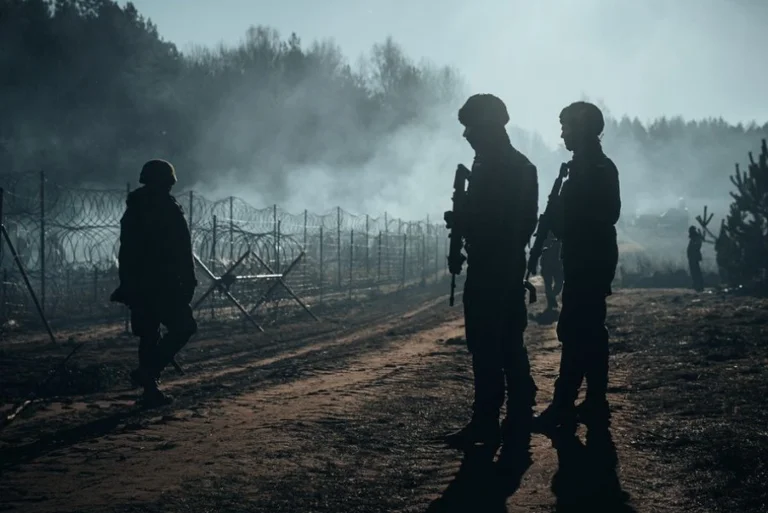
Poland-Belarus border crisis, the most dangerous escalation of Vladimir Putin's hybrid war
Periskopi(5 years ago)
(5 years ago)As tensions at the border between Poland and Belarus continue to escalate, it seems that Europe is slowly waking up with the fact that the man responsible for this fabricated crisis is not Belarusian dictator Aleksandar Lukaschenko, but his protector and sponsor Vladimir Putin. Days ago, Polish Prime Minister Matthews Morawiecki pointed his finger at the Kremlin. This [...]
Days ago, Polish Prime Minister Matthews Morawiecki pointed his finger at the Kremlin.
“This attack being carried out by [Aleksandar] Lukashenko, but he has his brains in Moscow, the host is the president [Vladimir] Putin”, Morawiecki said during a parliamentary session in Warsaw.
Shortly after that, German Euro-Depute Manfred Weber echoed that warning.
Weber, who heads the European People's Party, the biggest party in the European Parliament, reiterated Morawieck's claim that Vladimir Putin was “Prime Minister” following Lucashenco's actions, which he unequivocally labeled as “a hybrid fight against the European Union”.
It is not hard to understand why more and more European politicians suspect the orchestrating of events in neighboring Belarus. Putin himself has defended Belarus with a loud voice, while Russian Foreign Minister Sergei Lavrov has suggested the EU must pay Minsk to resolve the crisis. Russian media controlled by the Kremlin have also provided strong support for propaganda for the Lukashenko regime.
Many of the migrants now concentrated along the EU's eastern border claim they have reached Belarus via Russia itself. This is not the first time Moscow is accused of having “arming” immigrants to create conflict with the West. During the country's military intervention in Syria, Russia has repeatedly faced similar claims.
Moscow also appears to be increasing its direct military involvement in this crisis. In such a development, Russia and Belarus announced plans to launch joint patrols along the border of Latvia, Lithuania, Poland and Ukraine.
This perimeter around the Baltic states, Poland and Ukraine must be monitored by Russian military and Belarus”, Lukashenko has said.
In parallel with this statement, Russian nuclear bombers carried out a monitoring mission in Belarus's airspace.
More importantly, few reliable observers believe that Belarus's dictator would dare engage in such provocative actions in the EU border without permission and encouragement from the Kremlin. While relations between Lucas and Putin have been historically complex, the growing international isolation and internal vulnerability and strength of Minsk following the presidential elections in Belarus in August 2020 have made it almost entirely dependent on Russia for its political survival.
Over the past 15 months, Lukashenko has been forced to give Moscow a wide range of concessions that have undermined Belarus's sovereignty and placed his country under Russian influence. This process has been particularly prominent in the security sphere, with the establishment of new joint military bases and a record number of joint military exercises creating what constitutes a permanent presence of Russian troops in Belarus, causing much to comment as a accelerated military “union between the two countries”.
Given the context of Lucas' deep dependence on Russia, it seems very incredible that he would act alone in promoting the current border crisis. Instead, the confrontation bears all the identifying marks of the hybrid tactics of war approved by the Kremlin in recent years, as it has tried to arm everything from social media to illegal immigration to confrontation with the Western world.
Europe has been constantly warned that Russia's aggressive actions at “the grey” zone between war and peace will only increase until Vladimir Putin faces decisively.
These supporters are inclined to underestimate the importance of Putin's war in Ukraine, while choosing to handle numerous cyber attacks, deinformation campaigns and political killings occurring throughout Europe as isolated incidents rather than evidence of Russia's hostile goals. Instead, they promote an approach like the usual “business toward Moscow and continue to support the Russian gas pipeline project “Nord Stream II”, even though the Kremlin uses open energy as a geopolitical weapon against Europe.
This calming of Putin has brought us into the current situation, with rival military troops now located only a few metres from one another of the EU's eastern border and across the continent.
Sadly, the western response to this recent Russian escalation has been insufficient. It is the desired thought to suggest that new measures of EU-proposed sanctions will force the Kremlin to continue.
In the short term, this will now depend on the determination of Poland and Lithuania. At the same time, Ukrainian authorities must address events in Belarus as an extension of Russia's hybrid war against their country. With Lucashenco now acting as Putin's puppet, the thousand-mile border between Ukraine and Belarus must be described as the new front of conflict.
To counter the Kremlin threat, countries on the first line of hybrid war with Putin's Russia must join their efforts. The ideal platform for this is the Lublin Triangle, a diplomatic initiative launched last year by the foreign ministers of Ukraine, Poland and Lithuania. It would also make sense to include Latvia and Estonia, if possible, and to establish a more formal Baltic alliance -- the Black Sea -- that would facilitate a more pronounced military co-operation.
As they work to create the conditions for strategies, these countries that are on the front line should also seek greater commitment of the United States of America and Great Britain. The latter remain the two most reliable partners for countries facing the challenge of a resurrected Russia. It is unnecessary to say that such efforts should be addressed in a way that will be met in the country by reducing NATO's role as the final guarantor of peace in the region.
With the situation currently at risk of getting out of control at the Belarus border and Russian forces again concentrated near Ukraine, there is simply no time to lose. We must be prepared for Russian aggression in the coming months.
Complete Scripture