a few seconds ago
Emmerson: Special Court discriminates against Veselin, has returned to extraordinary court
Periskopi(5 years ago)
(5 years ago)Judging on the basis of international law and bypassing local law, the defence finds that the Special Court is discriminated against Kadri Veselin in relation to the other indictees under similar circumstances, and is therefore behaving like an extraordinary court in opposition to Kosovo's Article 103507. The defense of the former Mayor [...]
Judging on the basis of international law and bypassing local law, the defence finds that the Special Court is discriminated against Kadri Veselin in relation to the other indictees under similar circumstances, and is therefore behaving like an extraordinary court in opposition to Kosovo's Article 103507.
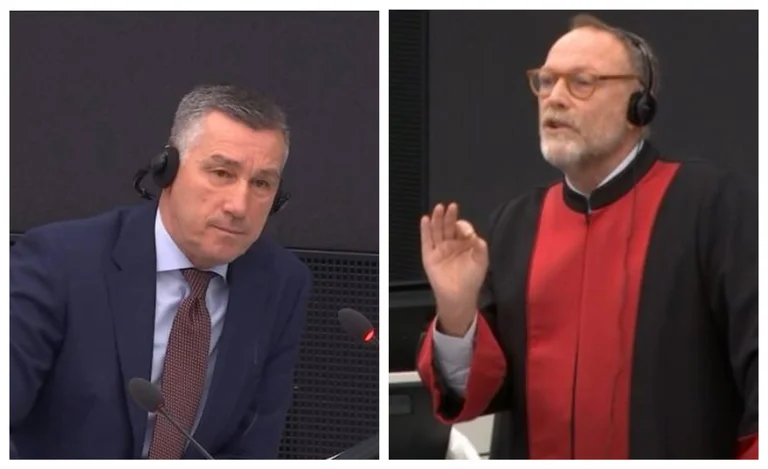
The defence of former Speaker of the Parliament, Kadri Veselin, has complained in the Special Court Appeals Chamber to a decision by the judge of the preliminary procedure related to constitutional violations, namely the right to justice before the law and guarantees against extraordinary courts.
Judging on the basis of international law and bypassing local law, the defence finds that the Special Court is discriminated against Kadri Veselin in proportion to other indictees under similar circumstances, and is therefore behaving as an extraordinary court in opposition to Article 103507 of the Kosovo Constitution.
The team of lawyers, led by Ben Emmerson, has concluded that specialised rooms are implementing a material law different from other Kosovo courts, in violation of the principle of equality before law and protection against discrimination, turning the special court into extraordinary courts.
The defence stresses that war crimes judgments in Kosovo, by local courts, are made based on laws of the time when crime occurred and that the former South Yorks Code has been applied in this case.
“On one hand Specialised Chambers enforce international law, while other local courts continue to implement the local timely law (The Criminal Code of the former Yugoslavia). Currently there are twelve cases being tried in other Kosovo courts under the Criminal Code of the former Yugoslavia”, has written the defence in its motion, which is already public on the page of Specialised Chambers.
The defence adds that “does not exist any mechanism to assess the decision of the Specialised Prosecutor to try a person in front of the Special Chambers. So there is no control as to how the prosecution applies this extraordinary power”.
Furthermore, Wessel's lawyers claim that although formally the Law for Specialised Chambers emphasizes that it is aimed at judging suspected persons related to the KiE report ( Dick Marty's report), according to the decision of the Procedure Court the category of potential indictees before the Specialised Chambers is quite broad, including almost every war crime committed during the conflict with Serbian forces, including cases currently being tried before other Kosovo courts.
“in any case, there is no excuse why the suspected persons in the Council of Europe report should be judged according to a different material law, contrary to the principle of equality before the law”.
Under the protection that Wessel, the Pre-Procedure Judge, erred by exclusively relying on the Constitutional Court's ruling on the case of the Specialised Chamber.
The Constitutional Court decided, not on the constitutionality of the Specialised Chambers Law, but on the Constitutional Amendment that could allow in the future, a specialised court. The Constitutional Court was unaware of the fact that the Specialised Chambers would enforce a material law different from the local one. It is incorrect that the Constitutional Court was aware of the specialised chambers based on the Paper Exchange, as the latter did not provide for the implementation of a different material law. On the contrary, the Constitutional Court was convinced that the Specialised Chambers would operate within the legal framework of criminal justice” and in a manner similar to the Supreme Court's Special Chamber on the Kosovo Privatisation Agency, which operates on the basis of separate rules of the procedure, but implements Kosovo internal law”.
In this motion, the defence has cited the Venice Commission when a court can be named extraordinary.
“According to the Venice Commission, one of the basic criteria for determining whether a court is extraordinary relates to whether the court has special power and whether it applies different procedures from those applied to existing courts. This principle also finds confirmation in the GEDNJ practice, which in the case of Bahaettin Uzan v. Turkey found that the court in question was not extraordinary because “did not implement a different legal framework” by other local courts”.
<x0... ironically, to justify the constitutionality of the Specialised Chambers, the prosecution was based on the practice of extraordinary African rooms in Senegal; Lebanon's Special Tribunal, or the extraordinary Chambers in Cambodia Courts. In fact, these courts are international and i) extraordinary. Although these courts are legal under international law, they are prohibited by Article 103 (7) of the Constitution”. Article 103, point 7 in the Kosovo Constitution, specifically does not foresee extraordinary courts. The specialised “Courts can be established by law when necessary, but in no way can extraordinary courts be established”, it says at this point. The defence in the end points out that the “Country character of the Specialised Chambers was never questioned even by international partners who demanded the foundation of the Chambers. For example, statements by US ambassadors, the United Kingdom, or of the Low Countries specifically confirmed that the new court would act according to the laws of Kosovo, and in no way would it be an international court”.