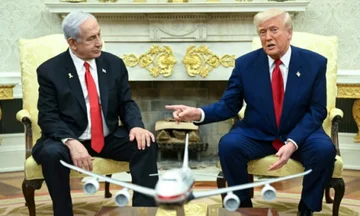
CNN: Netanyahu seeks emergency meeting with Trump amid mounting tensions over negotiations with Iran
 a minute ago
 (5 years ago)
Parliamentary political parties unanimously express principles of dialogue. The two opposition parties, the Democratic Party of Kosovo (PDK) and the Democratic League of Kosovo(LDK) agree with the ruling party, Vetevendosje (LVV) that the final agreement with Serbia should be for mutual recognition at the current borders and maintaining the country's constitutionality. However, it is stressed that the status quo of [...]
Parliamentary political parties unanimously express principles of dialogue. The two opposition parties, the Democratic Party of Kosovo (PDK) and the Democratic League of Kosovo(LDK) agree with the ruling party, Vetevendosje (LVV) that the final agreement with Serbia should be for mutual recognition at the current borders and maintaining the country's constitutionality. However, it is stressed that the status quo of dialogue is damaging Kosovo, and the lack of a final agreement is hampering Kosovo's international subjectivity.
At today's conference of the Kosovo Democratic Institute (KDI) for the impact of dialogue on foreign policy, Kosovo's largest diplomatic presence in the international arena was requested.
Although it was said that the status-cuo harms Kosovo, LVV deputy Victory Pacolli-Dalip said Kosovo's main approach is mutual recognition with Serbia preserving territorial integrity, but success is not only up to Kosovo, but also the other side.
The “Dialolog does not depend solely on Kosovo, the success of dialogue does not depend on the Government of Kosovo, much depends on who they are that we are discussing. ... Besides dialogue on what has affected our foreign policy, it should be cited that we have not had embassies prepared to push away from the agenda of Kosovo, our embassies are led by people who have been the political faces of the ruling parties that most of the time have served political parties and their private interests”, Pacoli-Dalip said.
Pointing to the LDK's position for dialogue, Deputy Speaker Shqip Blackki said the absence of a final agreement is hampering Kosovo's membership in international organisations.
A comprehensive final agreement should bring mutual recognition of the two countries, also respecting the current borders and constitutionality of Kosovo... ] Staus quo is not good for both sides, but the more for Kosovo, because we are in a different situation, because we do not have visa liberalisation, then you have mentioned in the report also that the lack of a final agreement hinders Kosovo's membership in international organisations, we are only talking about the time that there was mortorium, but consistently”, she added.
While PDK chairmanship member Bernard Nikaj said that within foreign policy the objectives of travelling with the EU and membership in other international organisations should be identified.
He also urged the Kosovo government to define Kosovo's goals and roads in dialogue.
Our foreign policy in relation to the EU has been and continues to be closely related to what has been achieved, what is being done and what can be achieved in the dialogue between Kosovo and Serbia. On the other hand, we have consistently tried and must continue to prove to be the target of EU membership and membership in international organisations and empowering our third-party international subjectivity...]we are now at a point where the faster we need to define and build a political and social consensus on what our objective is in dialogue and what are the means and roads that must be pursued”, he added.
Part of this conference was Switzerland's ambassador to Kosovo, Thomas Kolly, who urged institutions in Kosovo to focus on membership in international organisations. Until he said Kosovo-Serbia dialogue is important for Kosovo.
The foreign policy “is always the particular issue of the system of governance, and especially in Kosovo where foreign policies are completely essential, especially when it comes to dialogue. I think foreign policy has had an impact on each citizen, and the same is more important for Kosovo than for other states”, he said.
While KDI researcher Eugen Cakoli said the time period when a final agreement between Kosovo and Serbia can be reached is unclear.
The time period when a final agreement can eventually be reached between the parties is unclear. The current situation is not to be hopeful at all, especially for Kosovo. On the one hand, we have always added voices in Serbia and the position that there will never be recognition of Kosovo, while on the other side of Kosovo we have the bypass at least declaration of this topic and extreme polarisation that has put the process of dialogue on status-quo. Such a status quo will lose both sides, though it is clearer that the biggest loser would be Kosovo”, he said.
29 minutes ago