4 minutes ago
Abandoned school at age 16: Confession of the woman who discovered the first coronavirus
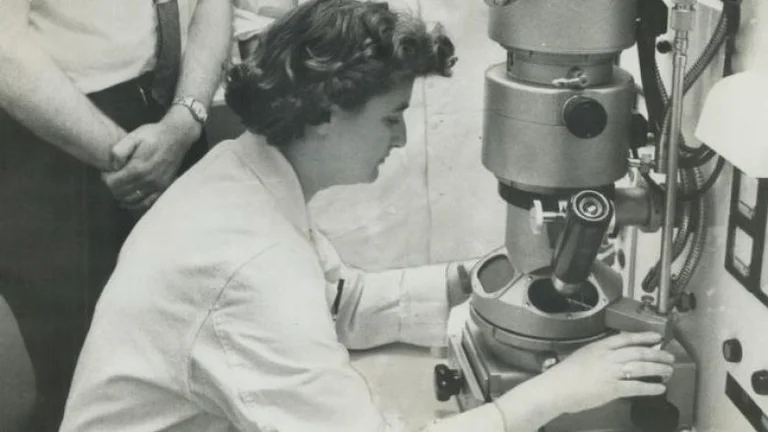
Periskopi(6 years ago)
(6 years ago)The woman who discovered the first human coronavirus was the daughter of a Scottish bus driver who left school at the age of 16. June Almeida continued to become a pioneer of images of viruses, whose work has become a focus again during this current pandemic. David-19 is a new disease but it's caused [...]
The woman who discovered the first human coronavirus was the daughter of a Scottish bus driver who left school at the age of 16.
June Almeida continued to become a pioneer of images of viruses, whose work has become a focus again during this current pandemic.
David-19 is a new disease but it's caused by a type coronavirus first identified by Dr. Almeida in 1964 at her laboratory at St. Thomas in London.
By BBCFollow Telegrafie, The virologist was born in June Hart in 1930 and grew up in an apartment near the Alexandra Park in the north east east of Glasgow.
She left school with little official education, but took a job as a laboratory technician in histopatology in Glasgow Royal Infirmary.
Later she moved to London to continue her career, and in 1954 she married Enriques Almeida, a Venezuelan artist.
Common cold research
The couple and their young daughter moved to Toronto to Canada and, according to medical writer George Winter, was the Cancer Institute in Ontario that Dr. Almeida developed her excellent skills with an electronic microscope.
It initiated a method which best painted viruses using antibodies to collect them.
Mr. Winter told the BBC Radio Scotland that her talents were recognized in the United Kingdom, and she was lured back in 1964 to work at St. Thomas, in London, the same hospital that he treated Prime Minister Boris Johnson when he suffered from Coved-19.
After her return, she began to cooperate with Dr. David Tyrrell, who was leading research into the common cooling unit at Salisbury in Wiltshire.
Mr. Winter says Dr. Tyrell had studied “nosewashing” by volunteers, and his team had discovered that they were able to grow some common viruses accompanied by cold, but not all.
A sample in particular, which came to be known as B814, was from a student's <x0...
They found that they were able to transmit common symptoms of cooling to volunteers, but they were unable to increase it in the routine culture of cells.
However, voluntary studies demonstrated its growth in organ cultures and Dr. Tyrrell wondered if he could be seen by an electronic microscope.
They sent samples to June Almeida who saw the particles of the virus in the specimens, which she described as flu viruses, but not exactly the same, writes the BBC, records Telegrafi.
She identified what became known as the first human coronavirus.
Coronavirus is a group of viruses that have a crownlike appearance (corons) when viewed under a microscope.
Mr. Winter says that Dr. Almeida had actually seen particles like this before while he was investigating mouse hepatitis and infectious poultry tank.
However, he says her letter to a magazine revised by other scientists was rejected “because the judges said the images she produced were merely bad pictures of flu virus particles”.
The new discovery by B814 was written in the British Medical Journal in 1965, and the first photos of what she had seen were published in the Journal of General Virology two years later.
According to Mr. Winter, it was Dr. Tyrell and Dr. Almeida, along with Professor Tony Waterson, the man in charge of St. Thomas, who called it coronavirus because of the crown surrounding him in the viral image.
Dr. Almeida later worked at the Postdiplomical Medical School in London, where she was given a doctorate.
She finished her career at the Wellcome Institute, where she was appointed to several patents in the area of virus images.
After leaving Wellcome, Dr. Almeida became a teacher of yoga, but returned to virology in an advisory role in the late 1980s, when she helped get new photos of the HIV virus.
June Almeida died in 2007, at age 77
Now 13 years after her death, she is finally getting the “recognition she deserves” as a pioneer whose work accelerated understanding of the virus that is currently spreading worldwide.