9 minutes ago
Chief UNMIK calls on Kosovo, Serbia for constructive dialogue
Periskopi(6 years ago)
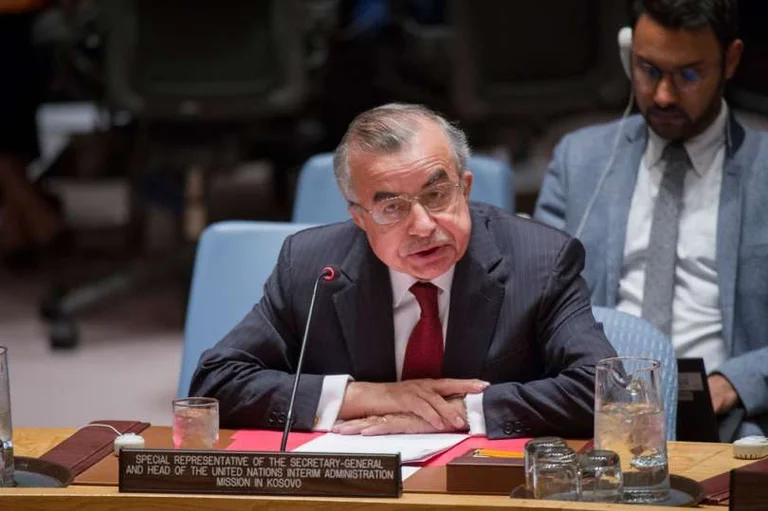
(6 years ago)The chief of the UN mission in Kosovo (UNMIK), Zahir Tan, has welcomed the continuation of dialogue between Kosovo and Serbia in Brussels and has called on both sides to resolve all open issues with constructive talks. At a video session of the Security Council of the Nations [...]
The chief of the UN mission in Kosovo (UNMIK), Zahir Tan, has welcomed the continuation of dialogue between Kosovo and Serbia in Brussels and has called on both sides to resolve all open issues with constructive talks.
In a video session of the United Nations Organisation Security Council (OKB), in which the new six-month report on UNMIK's work has been discussed, Tanin has stressed that meetings of representatives of Kosovo and Serbia in Washington have shown the potential for progress “in further resolving serious issues”.
The most important conditions that need to be met, so that the talks can succeed, are political unity, strong commitment and goodwill, in Pristina and Belgrade, as well as the existence of international support for achieving the comprehensive agreement on normalising relations”, Tanin has said.
He has stressed that publishing the proposal of the indictment of Chambers Specialised to Kosovo President Hashim Thaci and the leader of the Democratic Party of Kosovo, Kadri Veselini, has been forwarded to Kosovo on charges that the work of this Court is “politically motivated”.
The specific reactions in Kosovo's opinion have been worrying, including efforts to question the legitimacy of the Specialised Chambers, as well as claims that their work is politically motivated. Unfortunately, certain political leaders have not always helped correct these false statements”, the chief of staff said. UNMIK.
Tan has stressed that specialised rooms are integral parts of the judiciary in Kosovo and an important factor for Kosovo's future.
Chief UNMIK has stressed that Kosovo, in the past seven or eight months, has faced a number of challenges, starting since the crisis sparked by the coronary pandemic. He added that Kosovo “has not been left only” in the fight against pandemic.
Daciq: Pristina breaking agreements
Serbia's Foreign Affairs Minister in Serbia's Technical Governance, Ivica Dacic, has stated at the UN Security Council meeting that Pristina, after signing the Brussels agreement, has refused to implement the agreement and form the Association of Serb majority municipalities.
Daciq has accused Kosovo of breaking the agreement from Washington, in the part dealing with the year-long recipients of accession-related activities”, stressing that “Pristina has continued to lobbi for new recognition and in that way makes deals” meaningless.
“A we can call at all dialogue and agreement something we're talking about, we're dealing with, we sign, and then one party says we're not going to implement the deal”, Dachic stressed.
He said that despite the appeal to local authorities to react quickly and find perpetrators of the attack on Serbs in Kosovo, justice for them “is slow and unattainable” and that the number of incidents “is not dropping”.
Dacic has stressed that UNMIK's presence in Kosovo is necessary and that it is as important as the presence of the European Union mission.
Haradinaj-Stubla: Belgrade doing constructions to Kosovo
Responding to Daciqi's accusations, Kosovo Foreign Affairs Minister Melza Haradinaj-Stubla has declared that neither Serbia is implementing agreements and that “is continuing to propagand for the destabilisation of Kosovo”.
She has stressed that Belgrade continues to undermine Kosovo's membership in international organisations, including admission to INTERPOL.
Serbia continues to have influence over criminal groups operating in northern Kosovo, is refusing co-operation in fighting organised crime and other forms of crime”, Haradinaj stressed.
She added that Serbia also does not accept guilt for past conflicts.
Serbia's “Serbia denies the past, as was the case with the Recak massacre, which Aleksandar Vuciq (President of Serbia) said a few months ago that it didn't happen and it is about factory”, she stressed and demanded that missing troops return to Kosovo.
“Active shopping is the best way to move forward”, Haradinaj-Stubla stressed and added that Kosovo “besson in the rule of law, but also in the fair fight, which members of the Kosovo Liberation Army have made”.
Russia's Warning
On the eve of Kosovo Foreign Minister Melza Haradinaj-Stubla's speech, Russia's ambassador to the United Nations, Vasily Nebezya, has said that she will be removed from the next meeting because, after that, during the key to the video, were Kosovo state symbols.
The “conditions under which Kosovo representatives can participate in the Security Council meetings are clearly set”, said the Russian ambassador, who heads the Security Council.
USA: We'll follow Washington's implementation of agreement
Deputy Ambassador to the United Nations Cherith Norman Chalet has declared that the United States of America will carefully convey the implementation of the September 4th White House agreement, signed by Serbia's President Aleksandar Vuciq and Kosovo Prime Minister Avdullah Hoti.
Stressing that it is “historical event”, she has said that Vuciqi and Hoti have had determination and made “one step has the bright future”.
The Agreement presents the basis for progress in the coming time. Full normalisation is the common goal of the European Union and the US. We will continue to strongly support the dialogue under the umbrella of the European Union”, Cherith Norman Chalet noted.
She added that the US remains committed to the rule of law and justice for all victims of the conflict.
She also said it is time to reduce the role of the UN in Kosovo and that the US supports drafting the UNMIK transition plan and in responsible reduction of the role of the UN mission.
Germany and Great Britain Hail Continues Dialogue
Germany's Ambassador to the United Nations, Christophe Heusgen, has welcomed the continuation of the dialogue in Brussels, stressing that unresolved relations between Kosovo and Serbia pose obstacles to the entire region.
“The aim of dialogue must be strong and a binding agreement”, Heusgen said.
He stressed the importance of the Special Court, saying it is an important part of building rule of law and halting impunity.
Heusgen has added that he regrets the fact that representatives of Serbia never speak of Albanian victims during the 1998 and 1999.
Welcoming the continuation of the dialogue between Kosovo and Serbia, Great Britain has again demanded that the role of the UN mission in Kosovo be considered, saying the situation is dramatically better compared to 1999, when the UN mission had come to Kosovo/Rel.