4 minutes ago
Why Balkan governments damage environment for HECs

Periskopi(7 years ago)
(7 years ago)In the European Parliament, they gathered to seek support for the protection of river activists from around the Balkans. Supporting the European Left and Nordic Green Group in the European Parliament on Thursday (07.03) in Brussels gathered to seek support for their activists' agenda for river protection from [...]
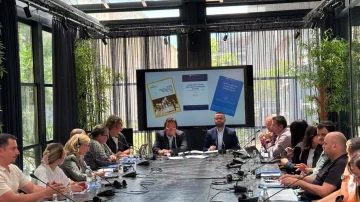
In support of the European Left and Nordic Greens group in the European Parliament on Thursday (07.03) gathered in Brussels to seek support for their urban river protection agenda from across the Balkans.
Movie characters and TV reports that have covered popular resistance against HECs from all over the Balkans joined a European Parliament hall. Here representatives of communities and journalists took pictures together and exchanged their experiences in stopping the HECs in their own countries.
Maida Bilali stood by the Albanian flag with her banner from Bosnia, where he saw the inscription of his native Krusica, the village where residents stopped building the hydropower plant with their troops. Bilal and his allies blocked the road to the building site 505 days in a 24 - hour day. That way they had stopped building the HECs in their home. But shows Maida “bet has not ended, as the concession contract<x1 has not yet been withdrawn.
We've had an important meeting here with the European Commission, where we've conveyed the importance of saving natural resources, since my vision is to save this fortune for future generations”, she says of the DW.
In Brussels there is also tourist guide and ecological activist from Albania Alben Kola, who has with him the iconic post of the recent protest in Kosovo against building the HECs on the bed of the Peja River. The poster with its fist closed, the red and black flag and Bosnian symbols had covered the European Parliament corridor. Elton Bayzak's documentary film “Free Flow” was shown in the hall, where many problems caused by the HECs and their construction process were explained in detail.
Why Balkan Governments Give Their Resources to Others
After the film, Eurodeputt Thomas Waitz, from Austria's Turkey, said HECs benefit some but destroy tourism development potential for the entire area. “Why should an Austrian energy company's income destroy a country?”, the Austrian asked. “How is it possible that the governments of countries like Bosnia and Herzegovina, Serbia, Albania, Montenegro, Kosovo are willing to destroy their country on behalf of others? It's corruption”, Waitz said.
This is Austria's Economic Chamber, which is lobling for these hydropower plants. I have talked to some Austria ambassadors and they are quite critical of these practices. But there is also the government that lobbies for these companies, as companies are close to the ruling parties”, he said.
In the question of whether the hydropower plants can be stopped and whether there is hope, Waitz said that some of them have been halted”.
Who funds HECs
Igor Weinovic of Bankwatch, an international NGO, has investigated who finances these plants and who benefits from them in the Balkans. For a change from Western Europe where state or local companies have built the plants, in the Balkans all projects are made by foreign companies.
He further indicated that EU institutions should be made responsible for financing hydropower plants in Balkan. He singled out the European Bank for Development and Reconstruction, the European Investment Bank as public banks, which often finance these projects through local banks such as the Unidacs from Italy and Erste from Austria.
For his part, Besar Likmeta related his experiences as a journalist covering issues related to the HEC. He showed that in Albania public opinion is totally opposed The HECs, but they continue to invest, and the main reason is money. To stamp out that the hydropower plants have nothing to do with green and environmental protection, WF representative Adria Irma Popovic-Dujmovic said: “These are not green projects and should not be financed”.
The rapporteur for Albania from the European Parliament, Ivan Jakovcic and Edward Kukan from the EPP, also locked up in the debate.