6 minutes ago
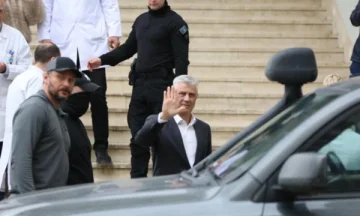
Payan, who was arrested in Albania in84, was accused of assassination with Enver Hoxha (Photo)

Periskopi(7 years ago)
(7 years ago)Dasnor Calucci Memorial.al publishes the unknown story of Namik Luci, the invisible engineer from Peja who is forced by the oppression and depression of Kosovo's titanist regime in 1961, discontinued university studies for industrial Kim in Tuzla, Bosnia, and returns to his native Peja, to then flee to the mother country, [...]
Remember. al It publishes the unknown history of Namik Luci, an engineer of origin from Peja, who is forced by the oppression and despair of Kosovo's titan regime in 1961, discontinued university studies for industrial Kim in Tuzla, Bosnia, and returns to his hometown, Peja, to flee later towards the Mother State, Albania. Graduate at the University of Tirana and the excellent career as a chemist in all five-year-olds' work, and then in Laci's Superfosphate plant where he was arrested in 1984 and sentenced to 18 years in political prison, charging that, along with several of his Kosovo-born countrymen, he would make Enver Hoja assassinations during his visit to Kruja to the inauguration of the Skenderbeau Museum
The events of the spring of 1981 when the student youth, intelligence, and all of Kosovo's people rose to protests, revolts and mass demonstrations against violence and fierce oppression that were practicing Belgrade's titanist regime against them had a big echo throughout the world's opinion, as well as in Chancellors of the West, which not only raised their voices in defense of that martyr population but forced Belgrade to withdraw its war machine from Kosovo, which was engaged there with all its arsenal. But while almost all international diplomacy was listed against the vulnerable Kosovo population, the mother state, communist Albania of the time, paradoxically, did not do what was needed, had the opportunity and was entitled to do. Even though the communist regime of Tirana, apparently, was established in defense of the rights of the Kosovo population, Enver Hoxha and its narrow circle of communist leadership at the time, in principle opposed the status of the republic that Kosovo sought. This, in view of the fact that they were afraid and feared the formation of another Albanian state in the Balkans, as by gaining the status of the Republic, Albania's image and benefits would drop significantly, as the West and all other developed states would turn their eyes to Kosovo. And so, the isolation where they put Albania would increase even more. In view of this, just a few months after the student demonstrations of the spring of 1981, the communist regime of Tirana launched a rampant campaign of arrests, imprisonments and exiles, of “enbores -- Kosovars (as he described him as the Kosovo regime coming to Albania), in order to lower in the eyes of Albanians, the image of Kosovars, labeling them as UDB spies, Western agents, and all kinds of other slanders. Under this campaign, which extended to all those cities where Kosovo's “migrants, in 1984, even talented chemical industry engineer Naik Luci was arrested. With Nami (who for years worked and lived in the city of Lachi), the cold safety cells also ended up: Selim Kelmendi, Estref Kelmendi, Shefqet Kelmendi, etc., against whom State Security had mounted one of the most absurd and terrible accusations: “The amendments to the main leaders of the Party and People”. According to Kruja's Internal Affairs Branch investigator, Nexhat Selimi, who was also the mastermind and former of the act-acza against him “the extremely hostile group”, “the Kosovars' group”, would carry out the assassination at the Kruja Museum, where the main leader (Ever Hoxha) would go to make his inauguration. And as a result, “the hostile group” of Kosovars were initially sentenced to death, and then the party's generous “ ”, their sentences dropped: from 25 years to “the heads of the group” to 18 years, to Namik Lucian. All these events have been placed in a book by friends and close friends of Namik Luci, who has been prepared by his wife, Lenno Luci, and Esat Myftari, (one of the closest friends and people of the Nami since the University School of Pec's banks, mostly talking about the famous technologist of the chemical industry, who was separated from life on March 7, 1998, the day that peace gathering was held in support of Kosovo. From that book we have selected for publication, some memories of friends and friends of the Nami who lived and worked with him in the city of Lachi.


Esat Myftari: A Rare Man
You wrote about Namik Lucian, the political immigrant in its soil, it's like writing about a generation of our Kosovars, who had a paradoxic and painful fate. In fact, they were the product not only of an unfair historical decision, such as the fragmentation of Albanian lands, but also of the Cold War, during which Kosovo and Albania shared with “-perde iron” ideological and police. The latter should be pointed out because lack of information and inspiration of the evolution of national awareness and personal cooking were due to many personal and family disasters. Kosovar immigrants in Albania (is using this term because it was the official individual of the communist regime), face a category of Albanians whose backs have been dropped the burden of Albanian-Yugoslav relations. I stress that fact because he referred to them as crimes but also undeserved cloves. So when I took to paper some memories of my friend Namik Luci's life, I felt as if I were putting one generation of our Kosovars, a, narrower, whose ideal for Albanian was Platonic. They certainly bear the mark of time and few today can perceive even the fact that, as I said, they have within themselves a mystery of paradox and apology. I was a joint student in high school with the Nami. My approach to him was perfectly natural, as it is at that golden age, when everything is right. It came from an average citizen family. His father, Mustafa, had backed the city's communist movement, without being an activist at large. However, after the war, thanks to even the scratches (Namí's cousin's cousin's wife, Mehmet Shoshi, the figure of this famous district nomenclature), the family's positions were solid. And on my uncle's side, he enjoyed the assurance that, under those terms of police depression, you could have a very negative side: the temptation to take advantage of such a status. In the meantime, fate wanted these two hypothetical temptations of the throne to end dramatically: Her father committed suicide, and her uncle died in an accident (an accident that was never explained). His self - sacrifice also remained a mystery. So he was left with a very young father at eight years of age, although with great care from loved ones. The enemy had stayed somewhere in the literature room. His true disposition was mathematics and Kimia. He went to school with Kimi Industrual in Tuzla, Bosnia.
Ahmet Ulaj: Nami, the Great Spirit of Homelandly
If someone asked me what I had with Namik Lucie, I'd find it hard to answer, I'd tell you, I had a friend, that's very small, to say that I had a friend, that I'm not allowed to, because I was more... It's years of recognition that makes me say that. But more than years later, we were connected by Kosovo. We were both born on the other side of the Albanian lands, the Nami in Pec and I in Vuthaji. But more was added to the love Nami nurtured for all the people in general and for the boys and girls of Albanian soils outside the border of the Albanian state that had come to Albania. He found something comforting in him that began his first encounter with him and went on for the rest of his life. We were also subjected to great concern for our countries, and great concern for the fate of the people there. We were also connected with the Nami by sharing with our people there, but not least worry about our brothers who had come as well as us to Albania, and they were called “migrants” in their country. It was the end of 1984. One day before my arrest, I went to the house of Nami as usual. He didn't feel well. He was tired, upset, with the flu, he told me. I never found out, didn't ask him later, knew he'd be arrested. A day later I walked into his backyard shouting: “O Namic”. Since he lived on the last floor, he often did not listen, and most of the time his neighbors warned him, which I was expecting. Some light curtain moves I saw in different apartments, not ordinary, but nobody warned me. Somehow I was surprised. These movements and the looks of some random citizens gave me some sort of doubt that something could have happened. Nurse Marte, she was calling me, several times: Dr. Ahmet, with half a voice. I quickly approached and read something bad in her eyes. Don't call me. He's not home. Go to the hospital. The enemy was arrested last night”. I was so shocked, but holding back. I had anxiety, why not and fear, feeling that I had experienced many other times alone and that I and Nami were arrested by Idriz, Jatttullah, Esatin, Cola, Shefqeti, Prof. Kelmendi, Issa and others. But of course I was very upset about the Nami, who was next. We had often talked about this kind of treatment of Kosovars. Discreet and arguments praised many of them as patriots isolated in prisons, because they knew a lot, didn't agree with everything, and eventually there were changes in the country. The enemy had a unique position in Lach because of the personality of his outstanding traits. He was working at Europe's largest pollution plant, but he was dressed every day in a suit, tie, white pardesy, ironed, with the mild smell of some donated perfume. Were not these traits enough to isolate him as a bearer of capitalist-revisionist ideas?
Avni Martinaj: For what you deserve most
It was 1979 when I first took up work at the Bucky Plant in Lac, which just produced the first production. And that's exactly where I got to know Namik Luci, and I've heard his name before. Exertious energy, it was appreciated by all experts for its professional skills and innovation, but for this area it is others who have to do precise assessments, as they have professional knowledge and dozens of years of work links with Nami. My age made a big difference, and I cannot say that he was my friend, but by the way he was communicating, he seemed too close to me, so age was of no value. That was not just me. The entrance of that man into the office, home, cafeteria, or other environments brought satisfaction to everyone. Kindly, with a good mood and rare simplicity, he appealed to them. Human prepared as no one else to help those in need. If you look into the company of the Nami in detail, you will find its most precious quality, there you will find the rare soul, the love of the common people, the risk of helping, etc. He never became a servile or a career contender, he was found with his employees, and he was much more satisfied there. Wherever the rulers of the day needed it, they took it to one plant as much as they could to exploit its abilities. The longer the years went by, the more knowledge and fame of Nami spread, that there was no joy, engagement, wedding, and so on, where the Nami became not the main place. All humor, let him wish with tears of joy that flowed out of his angelic eyes. But these high virtues paid dearly. However, after his release from prison, he showed no evidence of revenge for those who pained him personally and his family.
Chacori lamp: The Enemy - A Modest, Generous Patriot
Remembering Namik Lucian, you can't remember an elegant man for the time of his greatest maturity and who broke up with this world when you didn't wait, and it wasn't even thought of. That's what made the biggest and most insurmountable pain of those who loved him, of his family, of friends, but of us friends we spent many years together. I had it in my hands before we met each other. He had seen him walk with two Peyan girls and those students in Tirana and the famous Kosovo poet Agim Gjakova. The case brought us to work in a city even in various professions. The city of Lach, where we lived and worked for a long time, had great intelligence and created a suitable ground for academic conversation, an admirable intellectual vitality, but sometimes these created a jealousy in a mediocre machine that was not small, which in some cases also creates obstacles or difficulties, which were overcome by the personality he had created and the sound social opinion that he had created about himself. As one from whom only goodness stemmed, the circle of his commitments was Kosovo with its problems, work at the plant, and family, so no one, and nothing could penetrate his life and problems. The patriotic and supreme feelings of the Nami were present at any moment. This gave rise to our conversations on every occasion and without reservation. The most critical case was the explosion of Kosovo youth and intelligence demonstrations in the early '80s. At this time, there were two moments at Nami's experience, which were quite expressive and defined: first excitement, boasting and even pride over what was happening there in Kosovo, but also the sadness and regret that was here, and not with friends who were fighting these events, because in my opinion, he imagined himself there in the war, where the danger was greater. All of this, because before all, he was a patriot of his homeland. I remember one occasion at Superphosphate Uzina. The enemy was sitting in a large group where mainly students from the branch of Industrial Chemistry were sitting in Lach. When I entered, a teacher of theirs recognized me and called me. Meanwhile, the Nami stands up, gets a chair, and introduces me more than she met me. As in these cases, the subject of conversation was varied, but from time to time the conversation went to Kosovo and its events. The fact that 7-8 newspapers were on the table also proved true. After a few minutes of free conversation, I whisper to the Nami two verses from the “Songs of Milosaos” of De Rada, which I have always had in my heart. “Doemos going to die on the bed / If we don't pounce on our houses” Namik Luci was an exemplary parent. This was not only in dealing with the woman whom he considered to be the best part of but also in contact with his four sons, who were more friends than children. His social relationships were on a broader plan. Entering Namik Lucy's family was a pleasure because you felt a warm, sincere environment and no fear you usually feel when you enter a foreign family. Generosity and generosity were the main traits of this family.
White Rica: He's in everybody's memory.
Namik Luci, in my memory will remain the portrait of a noble, courageous intellectual, true patriot, the correct family, who, above all, characterized the unmatched sincerity in all his activity. Then when Albania was torn apart in the most macabre manner, physically, spiritually and mentally, by heartless atheists, this fashion student from Kosovo, would be forced to leave to Tirana, where, thanks to his passion and will for knowledge, he would continue his studies at the University of Tirana, where he would graduate for Kim. After the university ended, he would be devoted to his mind and intellect in Lach, Kurbin, and he was one of the designers and pliators of the Kimiko-Meterurgy Nation in Lach, Russian, Chinese, French, Polish, and so on. Thanks to his innovation, he was able to adapt and apply highly functional models adapted to the surrounding conditions, he for the rest of his life did not know the time at work, worked with and without shifts, as in that man was engraved with desire and passion for work, strategy and new contemporary technologies. This passion also enabled him to create professional Kimia branch school, contributing to the professional formation of specialists. Despite the work and sacrifice, the Nami would be pursued and persecuted by the infamous State Security. Meanwhile, he burned with homesickness for Kosovo's martyrs, whose son he was, for his childhood peers. I will never forget a trembling moment at the bar “Drini” in 1978. A group of young people from Kosovo would give life that night. These young people were from the birthplace of the Nami, and I was with them at the bar. Nami knowing he was under State Security's watch, couldn't meet, embraced, and messed with his Kosovar brothers. By experiencing this inability within himself, he could not stop the tears that flowed through the pages. It was tears of sorrow, but tears of curse for those without religion and homelands who separated Albanian lands because of the bad policy they followed for 50 years. It would not be long before Nami would end up in the infamous prison dungeons of the dictatorship and be sentenced to 18 years in prison. By the confessions of his fellow slaves, he would stand out among them as a man of determination and honour, standing and surviving without losing great spiritual, intellectual, and social values. If, for someone, the most expensive thing is a good name, Nami left it behind in all directions.
Mal Berisha: The Nami instilled in me a love for Kosovo
On a summer evening in 2002, I'm sitting in a beautiful coffee near the White River that runs between Pec. The city has not yet recovered from the untold ruins it has suffered from Serb hordes. River freshness, side-on-side coffees, loud music played on magnetphones, all make this evening a really nice pet, in the town where she was born and grew up, one of the best friends of my life, Namik Luci. I have a nice, nice young guy, less than half my age, but I'm really into talking to him. It's Avni (Anni), the son of my dear friend, the late engineer Namik Luci. For Annie, he's the late beloved, suffering and prideful father, for me, for my friend, friend, and loved one. On this night I told Annie a lot of things he knows and I don't know, but I want to remember. It must have been the end of the '60s, when a village known in Albania by the Church of St. In support of hundreds of thousands of workers who flocked across Albania, there was also a handsome boy, blonde, alive, many expressive, with an easy walk by the athlete, known by all as the engineer Nami. The tendency to have association with Kosovars soon made me get in touch with him, although I was just a high school student in that city. At that time high school “Ismail Kemali” Laci sent his students to the Sulfuk acid factory for learning practices. One of my pleasures of the time was the fact that there I could meet engineer Nami, his Kosovo State issued a shadow of goodwill to the people, not only within the plant's own departments but also in the city. Friendly, funny, sometimes very medical, dear to the workers, pleasant to drink, this was his portrait in those days we spent at the plant. But that left behind a long line of association and communication with the Naqira and then his family. Although for some reason she was cut off physically later, her spirits never ceased. That night in Pec, I felt that the story I had told Annie had to be told in the book on the Enemy. And I was very honored to have the opportunity to put this book on this book for my honored friend, Nami.
Hik Kaman: He was cruelly condemned for being a native
Namik Luci was one of the Kosovo boys who had come to Albania as <x0migrant” in 1961, with a pure domestic desire and dream, with full confidence that here, in Albania, the national issue and resolving the Kosovo problem were the main problems of the Albanian politics and the communist state. But he and all who came like him were soon disappointed. He learned this truth very quickly in the Cherma and Seman concentration camps, when he saw his friends branded and massacred, imprisoned and exiled only because they wanted Kosovo united with Albania. Despite the overarching conditions of the communist regime, where, for a word of mouth, Namik Luci never fought to defend the Kosovo issue for its union with Albania. He had special skills and flexibility in this field. He knew Kosovo's political and social situation at the time, perhaps better than any Kosovo <x2migrant”, and this thanks to his dedication to this issue and the ties he had made with Kosovo's leading people: writers, politicians, scientists, professors, singers, educators, artists, etc. I many times in Lach in conversations with the Nami, learned about developments in Kosovo; the events, activities and attitudes of Albanians, which at times made me happy and at times depressed. He has spent much of his time, energy and financial means to meet and talk about people coming from Kosovo to Albania from 1967 to 1981. Nami introduced me to prof. Zakaria Cana, prof. Hajrula Goranin, Luljeta Pula, Ramiz Kelmendi, etc. Two pictures he always carried with him - Adem Demach and the Paganist Nexmije. For the first time, I heard Nami's name in 1961, when I was in my third year at the Normal Elbasan School, and I remember that I was told about it by Qazim Radoniqi, my child's companion, and also Peja. Thanks to his properties, he soon became one of the most popular in the circles of Kosovo's “migrants” and wider. In addition, at the Nazi funeral ceremony, I was commissioned to keep my word of farewell. After writing down my word, we saw it with Ahmet Ula, Peter Zeff, and Avni Martin. They appreciated it. On that day in the comfort of the former, for Namik Lucian, friends from all over Kruja, from Lezha, Shkodra, Tirana, Durres, Kavaja, Elbasan, etc. I had not seen for 30 years in Lac so many people a day mortore, that day mortar to Namik Luci. There even came a former security officer, operative, who in 1984 had boasted he was the one who discovered our “enemy” Namik Lucy. The enemy was buried in Lachi's cemetery, where all the people had flocked to follow him. Namik Luci went to that great life, left a good name, a good deed, and good sons and wives.
Nami's letter from Qafe Bar Prison:
Look for my corespondence with Enver Haver's Chicken”
Dear Annie, in the environment where I live, I think, I fight working on my political, literary, and professional establishment, when I receive letters from you or Ilir, Petlit, Visar, I am very happy. And that joy has its reasons. Especially sensitive is joy, when the distributor, through the crowd, washes you for paper or telegram. And this well confirms what is called beautiful and true: That someone thinks, remembers, fights, plans, and perhaps in silence thinks both of me and of himself, with the only intention of defeating, sorrows, troubles, and so on. I got my letter late, dated 27,06,1990. I was so happy to meet Jethu, who was very happy, because he did not have anyone, and he wants to know everything that is related to you, whether your learning or your work or your health. Many were glad you were healthy. From the letter, I learned about the effort you make in bringing light of what was made up in the name of the goddess Justice in April 1984. I explained to Ilir and Petrit all of them, and I even told them about the many letters I sent including the Supreme Court. And for me, it's very important how much effort I've made to clarify the problems I've handled, because in all the letters sent have been shown many people, and above all, I've agreed to trade in my very clean biographies of the family and the social circle, whether here or here, whether in Kosovo, when today, the press, television, especially those of Pristina Pec, my family and social circle are freezing into the pedestal, but at the same time being enlightened the truths about all the young Kosovars who chose my way of exile. So I'll mention two great truths: In the memory of the Albanian people, there will never be forgotten the stance and war, Luljeta Pula's undaunted effort (which you too had the opportunity to get to know in 1978 in Lach), at the American Congress, to expose the notorious Brecanin elabors plans, Chubrillovic, Andrij, and the last to life, Milosevic. It will always be remembered with respect to the war and effort he made in Western countries for 23 years, the late Enver Hader. I wrote these two truths in order that Luljeta correspondent and Enver's photos ask those who took them during their search for my arrest. When you come, don't forget me and the books: “what Kosovars ask for”, second volume, “Literacy” of Sabri Hamit and “With love doth Nami embrace you. /Remember. al