3 hours ago
In Serbia, association is viewed as “Republika Srpska minus”

Periskopi(8 years ago)
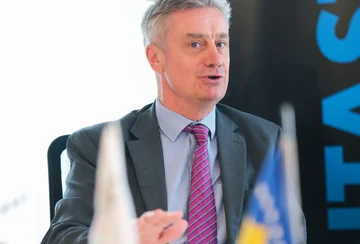
(8 years ago)The agreement between Belgrade and Pristina could bring about resolving a number of open issues, said Goran Svilanovic, secretary general of the Council for Regional Co-operation. In an interview with B92, he said that since 2000, when it comes to the Balkans, there have been three open questions and one is on the way for [...]
In an interview with B92, he said that since 2000, when it comes to the Balkans, there have been three open questions and one is on the way to be resolved.
“One is the unresolved name problem (of Macedonia v.j.), the other, of course, is the relationship between Belgrade and Pristina, third being the functioning of Bosnia and Herzegovina. As we saw in the past year, intensively over the last few weeks, one of these three problems is on the way to be solved. We all have great expectations that the procedure in the Skopje Assembly will be finalised positively and then parliament will react the same way in Athens, so one of these three major problems may be behind us”, he said.
According to him, the decisions of the EU summit in Sofia, the agreement of Greece and Macedonia, serve neither Belgrade nor Pristina as much encouragement.
Svilanovic says the conditions under which Serbia will become an EU member are not directly linked to the Belgrade and Pristina agreement, but there are a number of reasons.
The agreement between Belgrade and Pristina, from Belgrade's perspective, should move things better for what we have today. This is an attempt to achieve something better than it is today, to correct things, and as much as possible, so I understand the discussion about possible correction of borders. Of course, reactions are very different, and some of these reactions are quite discouraging, for the public in Kosovo and Serbia, especially in the part of the European public. I think you need encouragement to reach a deal. Unfortunately, our European partners at the moment cannot offer us this encouragement because they are largely occupied with the EU's own issue, in the context of the financial crisis, given Braxin, the immigrant problem”, Svilanovic said, broadcast Kosovas Prees.
He added that the agreement with Kosovo should also determine Serbia's EU membership date, but according to him, the agreement between Belgrade and Pristina implies some things.
“First, to go beyond what Ahtisaari predicted, when it comes to the status of Serbs in Kosovo. I talk about something that will be Ahtisaari Plus. Second, to go into something that is certainly not the new Serbian republic, but would be the Serb Republic minus, when we talk about association. In this area, a solution should be sought, and this solution cannot be if there is no clear guarantees for Serbia's EU membership, and if there is no clear indication of resolving relations between Belgrade and Zagreb, and if there is no full guarantee from Serbia for the integrity of Bosnia and Herzegovina, which of course does not mean the disappearance of the Serbian Republic, but means only a full synchronization of all political actors in Bosnia. All this contributes to the full stability of the Balkans and opens up opportunities for membership of all of us”, Svilanovic said.