3 hours ago
This is how they vote to elect the new German government (Photo)

Periskopi(9 years ago)
(9 years ago)On 24 September, Germans go to the polls to elect a new Chancellor, or German Chancellor Merkel will be re-elected again. Germany has a complicated voting system for selecting its own Bundestag or lower room, said “Deutsche Welle”, Periscopi broadcast. This system aims to combine the benefits of direct representation [...]
Germany has a complicated voting system for selecting its own Bundestag or lower room, said “Deutsche Welle”, Periscopi broadcast.
This system aims to combine the benefits of direct and proportional representation, thus preserving election mistakes made in the past, which have had a political fragmentation during the Republic of Weiari between World War I and World War II.
Who can vote?
The 2009 and 2013 parliamentary elections had a significant decline in German voter turnout to about 70 percent, but as the populist movement grew, the number of voters is expected to increase this year.
61.5 million people aged 18 and more have the right to vote in national elections, according to figures by the German Federal Statistics Office.
Of them, 31.7 million are women and 29.8 million are men, and with about 3 million voters eligible for the first time.
More than a third of German voters -- 22 million -- are over 60 years old, which means the old generation often has a special impact on the outcome of the elections.
The largest number of voters rightly live in the western state of Nordrhein-Westphalia (13.2 million), followed by southern Batvaria (9.5 million) and Baden-Wurttemberg (7.8 million).
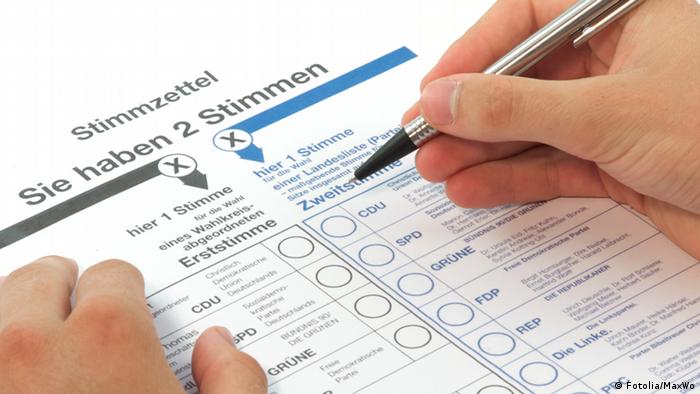
When the Germans go to the polls on September 24th, they will receive a simple two-term ballot of one for a district representative and one for a party.
The first vote, or “Ersttimme” for the district representative, follows a system like elections in the United States.
The voter chooses his favourite candidate, who represents their district in parliament. Any candidate who wins one of the 299 German areas, which are divided for 250,000 people, is guaranteed a country.
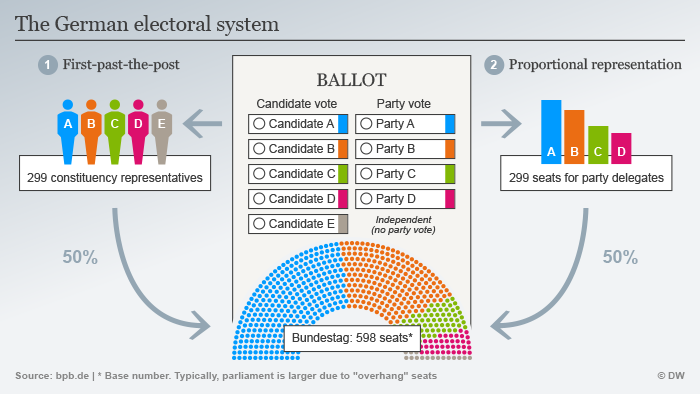
To fill the other half of the 598 countries in Germany's Bundestag, voters cast their vote in the second vote, or “Zweittimme”.
This vote amounts to a political party instead of a single candidate. It also determines the percentage each political party receives in Bundestag.
The larger German countries can send more representatives to Bundestag than smaller ones.
What makes the elections especially interesting is that the vote allows voters to split the vote among the parties, perhaps voting for their CDU candidate in the first vote, but casting their vote on the free market Liberal Democrats (FDP) in the second vote to help the traditional partner of the small CDU coalition enter parliament.
Currently, there are 630 seats in Bundestag.
In order for a party to enter Bundestag, it must win at least 5 per cent of the second vote.
This system was put in place to prevent smaller separate parties, such as those who hit the Republic of Weimari in the 1920s, from entering parliament.
At the moment, there are five parties represented in Bundestag: Chancellor Angela Merkel's centre-right CDU and the Socialist Christian Community (CSU), the centre-left Social Democrats (SPD), the Left and Green Party.
Who chooses the Chancellor?
Unlike the presidential system in the United States, voters in Germany do not directly elect the Chancellor, who is the head of the government. The new parliament must meet for the first time no later than a month after the vote.
It could be earlier if coalition talks go quickly.
The main candidate from the party that wins the most votes usually manages to establish a coalition. The president, who is head of state and plays a largely ceremonial role, then presents this person as a candidate for Chancellor, who then approves the newly elected members of parliament in a secret vote.
If, as in the previous three elections, the CDU wins the majority of votes, their candidate for Chancellor Angela Merkel will hold the post for the next four years.
There is no limit to the number of mandates a Chancellor may be in office in Germany. But so far no Chancellor has served more than 16 years in total since Chancellor Helmut Kohl./Periscopi/