7 hours ago
The offensive dictionary and physical violence, the lack of intellectualism of politicians

Periskopi(9 years ago)
(9 years ago)The rude and offensive discussion, with which individuals of the political scene and representatives of political parties publicly communicate with, as well as the verbal and physical violence it produces, breaks all public presentation rules as well as laws in power, recognises the connoisseurs of political and social developments in Kosovo. Politologist Ramush Tahiri, [...]
The rude and offensive discussion, with which individuals of the political scene and representatives of political parties publicly communicate with, as well as the verbal and physical violence it produces, breaks all public presentation rules as well as laws in power, recognises the connoisseurs of political and social developments in Kosovo.
Politologist Ramush Tahiri, speaking of Radio Free Europe, estimates that discours and behaviors, with which certain representatives of political parties are served in public presentations, reflect the lack of intellectualism in politics.
This is because, according to him, street or personal vocabulary is being carried into public vocabulary, under the argument that it is original, but that, as he says, is not in the level of public communication, which has rules of courtesy.
Unfortunately, Kosovo is going into a kind of militant and provincialism, as well as an animation of a kind where arguments are not important and where language is being valued, in terms of said, of the strong. It means the argument of force, not the argument of speech. The man who speaks intellectually is not being appreciated; he gives the arguments slowly and giving the program. But it is remembered that the one who has spoken a great word, a bad word, or made a gesture that, in my opinion, would be primitive and would not have the place in public presentations”, Tahiri says.
Similar thoughts are expressed by sociologist Shemsy Recica. He tells Radio Free Europe that the inflammatory discurs, with which a number of politicians in public are presented, are heading to a dead end. According to him, instead of offering arguments and facts in various public debates, they offer a dictionary, as he calls it, dirty, hard, insulting, and offensive to fellow speakers. This, according to him, reflects badly on onlookers, listen, or read them.
So I see this as a lack of work, job results, lack of arguments to deal with problems. This, then, is compensated for with empty words but with grave words, swear words, not to say a truth but to degrade and possibly disarm the conversationor, in front of those who see or hear or in other cases even read it”, estimates Recica.
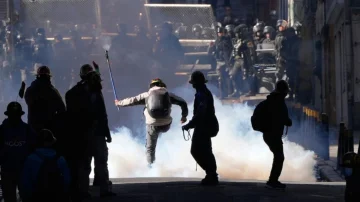
Public vocabulary degradation, in the face of representatives of political parties, has also brought physical clashes among them. This has taken place on Friday in a live show on one of the local televisions, among Kosovo Parliament MP from the Vetevendosje Movement ranks, Fraser Krasniqi and Kosovo Assembly deputy from the Kosovo Initiative's ranks, Milaim Zeka.
Kosovo police have reported that “that two males have been attacked among themselves. One of them has accepted medical treatment. The same have been interviewed and, at the prosecutor's decision, one of them has been arrested and sent to maintenance, while the other suspect has been released”.
This clash has prompted widespread reactions to citizens on social networks who sided with one or the other MP.
Politologist Tahiri says such situations can produce extremely negative consequences by carrying on such confrontations in society.
“Yes, because Kosovo, unfortunately, is heading towards this edge of policy and the lack of dialogue. It seems that power is being valued at all costs. Not solved are the means to come to power, but they are also to retain power. To us, unfortunately, a person is being appreciated who succeeds, no matter what means, not the man who respects procedures, not the party, who respects procedures and is called into procedures. Therefore, we have promotional political statements, which are above law”, Tahiri points out.
Sociologist Recica expresses fears that at a later stage, verbal clashes, but not excluding even violent ones, are at risk of being carried into opinion, unless measures are taken by political parties themselves but also by law institutions.
If allowed in the Kosovo Assembly or visual media, speak at such size as an insulting language, which our people do not accept, then we can say that in some way, the way is directly opening the way for the use of violence”.
This violence appears first, in the studio, as we saw last night. However, this is also expected to appear in the Assembly, and then, from the Assembly, it can be taken out of the Assembly to the followers of persons or political groups”, says Recica.
Politologist Tahiri points out that situations that have quarries of conflict between political parties, in the face of opinion, are also helping some media, portals and intellectuals, who have created customer reports, benefits and expression of influence. According to him, in this way it gives society a bad mirror, all the time that no one is called into legitimacy and constitutionality, and it does not respect procedures.