23 minutes ago
These would be options if the United States and North Korea fought militarily (Photo)

Periskopi(9 years ago)
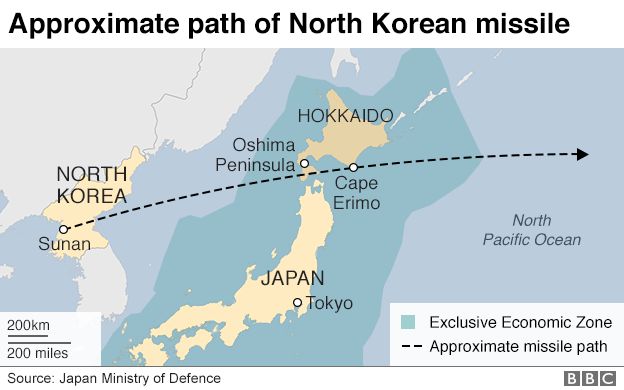
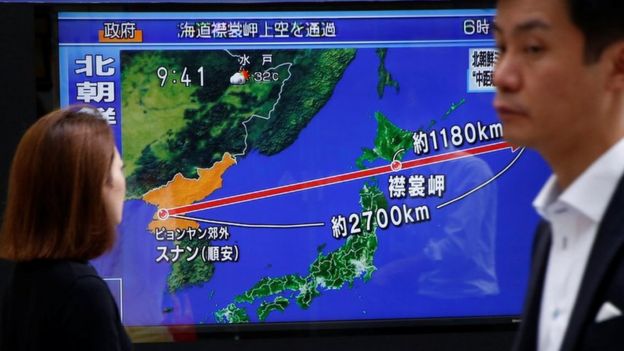
(9 years ago)President Trump has said that “all options are on the table” after North Korea launched a rocket over Japan. How could military attacks against Kim Jong's regime appear? When a ballistic missile crossed the Japanese island of Hokkaido, residents were warned of the danger they faced. Starting was a provocative act, [...]
When a ballistic missile crossed the Japanese island of Hokkaido, residents were warned of the danger they faced.
The launch was a provocative act, which was followed by warnings from the North Korean regime that it was just a “first step”.
The UN has imposed sanctions on North Korea, while President Trump said he would review the next steps, “reported. BBC”, report Periscope.
While the U.S. has enormous military forces, options for an attack on North Korea are limited.
Option 1: Expanded Control
This is the least dangerous option, but perhaps with a limited effectiveness, as some terrain that has succeeded in the past in preventing ballistic missiles and North Korea's nuclear programme will be built.
The US Army may have unlimited movement in South Korea, including missile protection as Thaad's controversial system, heavy artillery and armoured vehicles to show its readiness to use force.
However, South Korea has decided to halt the current Thaad missile system and oppose any growth of US Land Forces due to concerns about North Korea's provocation.
In fact, North Korea would almost certainly interpret such movements as a beginning for an invasion across the ground, taking into account its reactions to the joint annual exercises between the armies of the United States and South Korea.
China and Russia will undoubtedly strongly oppose and both have the power to make this situation more difficult for the US in other areas, such as Eastern Europe and the South and East China Sea.
In addition to marine options, the U.S. Air Force can strengthen its air force, with more combat squads, support tanks, surveillance planes, and heavy bombers at the bases of Guam, South Korea, and Japan.
However, the US Navy and the US Air Force are heavily charged worldwide and are feeling the tension of more than a decade of intense distribution in support of military operations, including those in Iraq and Afghanistan.
Such a policy would represent a very expensive and perhaps unstable challenge to North Korea, as well as a dangerous escalation toward direct military conflict.
Option 2: High precision
US Air Force and “US Navy” possess the most advanced capabilities of high-profile attacks on Earth.
The use of cruise missiles from Tomahawk missiles that were dismissed by submarines off the North Korean coastline and B-2 countering North Korean nuclear missiles may look like an attractive proposal at first glance.
The immediate danger of U.S. aircraft will depend on many factors, including the amount of warning from North Korea, the number of flight attacks, and the contribution of aircraft that are not displayed within the range of its defense.
However, the state of North Korea's air defence network is very difficult to determine, as it is a mixture of missile systems and air surface radar systems and the Chinese Soviet/Russian radar system that have been built within 50 years.
Option 3: Full - scale relief
In view of the apparent size of the People's Army, the power of its artillery, the protection of its dense air, and the reluctance of South Korea to support any American military action, this option is heavily charged with the US.
Any attempt to truly conquer North Korea would take months for the apparent military formation of the United States, full participation in South Korea, and a means of guaranteeing the mysterious nuclear capabilities of North Korea.
It would also cost hundreds of thousands of lives on both sides.
In addition to heavy artillery bombings, the People's Army has long been trained to infiltrate large - scale commandos in South Korea, using slow aircraft that landed where they are hard to detect on radar, via small ships and cruel submarines.
The last time the United States and its allies advanced to North Korea during the 1950 Korean War, China went to war helping North Korea prevent the creation of a united Western Korea on its land border.
Such a development is still something that China is willing to help North Korea for reasons that have supported Kim Jong's regime for so long./Periscopi/