8 hours ago
Ten days of men campaign for national elections in Kosovo

Periskopi(9 years ago)
(9 years ago)Research by Leonidas Molyqaj if we briefly recall the recent campaign for the national elections in Kosovo would remind us of ten days of campaign men. Candidates for prime minister were all men, 70% of the electoral lists with candidates were men, cities filled with advertising men's posts, shows where men and men discussed, gatherings [...]
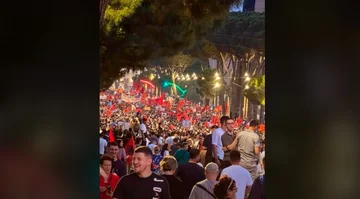
If we briefly recall the recent campaign for national elections in Kosovo, we would be reminded of ten days of campaign men. Candidates for prime minister were all men, 70% of the election lists with candidates were men, cities filled with promotional men's posts, shows where men and men discussed, gatherings where speakers and participants were mostly men
Men and women formally have equal rights to engage politically and participate in all political processes. In practice, however, it is often difficult for women to exercise that right. Politics, traditionally like a man's battlefield, is often inappropriate even hostile to women.
Worldwide, women and men do not have the same opportunity to participate in the political sphere. This becomes even more vulnerable when it comes to participating in the elections.
In societies where patriarchal values are strong, women face practical barriers to enter the electoral race, thus including prejudice over their public activity, lack of financial resources, poor education, lack of room in decision-making within political subjects, discrimination in the media, and greater family responsibility, which often limits their participation in public activities.
If we briefly recall the recent campaign for national elections in Kosovo, we would be reminded of ten days of campaign men. The candidates for prime minister were all men, 70% of the election lists with candidates were men, towns filled with promotional posts of men, shows where men and men discussed, gatherings where speakers and participants were mostly men, etc.
As a result of all this atmosphere for someone who is favorable and not for someone, most women, especially those who first ran for deputies, could find no space equal to male candidates.
There is rarely a time to discuss the impact money can have on the election race. With the cost of the election campaign increasing, competition has also increased among the candidates for MPs. Those with higher financial incomes are reaching “buy more space for themselves and, as a result, win more votes.

That means some candidates enter the playing field with more advantages than others. Money is making the race uneven between male and female candidates. Women in general have less material resources than men, and especially in Kosovo, where the number of unemployed women is highest in the region. According to Kosovo Statistics Agency data on 80% of women are unemployed and have no access to the country's economy.
Albanian Jocaj, an activist for gender equality, says the economic situation of women in the country is linked to financial opportunities for a full cost campaign.
“The development of a campaign offering probability requires money, and the economic situation of women is certainly among the key restrictions for those running. Women in Kosovo lack economic empowerment, many are unemployed, but even many of those working do not own their wallet and do not control their own revenues”, she has said.
The organisation Arise and Democracy Plus have monitored political parties' spending in this election campaign. Television, portals, newspapers, and billboards have been analyzed by Preportr in gender. This research has found that in all forms of advertising, candidate men have invested much more money than women.
The streets of the cities were packed with billboards and posters, but rarely saw any women. In a monitoring of 269 billboards in several Pristina neighbourhoods for the last three days of the campaign, Preportr has found that only 8 of them promoted women candidates, or expressed 97.03% of the billboards were male candidates, while only 2.97% of women.

With the rapid development of online media, even the possibility of using their advertising space for campaigning has increased. This is especially noted in the recent campaign, where there were an extremely large number of candidates for MPs who have invested money in this form of advertising. Preportr has found that out of 746 ads in information portals (Koha Net, Express, Voice, Indexline, Inseder, Telegrafi, Blic newspaper, Lajm) 82.31% promoted male candidates and only 17.69% of women.
Similar results have emerged from monitoring commercials in daily newspapers (Bota Today, New Age, Koha Ditore, Voice, Kosova Sot). Of the 218 ads monitored for nine days of campaigning (June 4th) there were no newspapers, only 19.27% promoted women candidates, while 80.73% men.
The biggest investment in this campaign has been made in spots and television advertising. In addition to the cost of producing an advertising spot, candidates have paid heavily for television space. Since such advertising has been very costly, candidate women have managed to be very few on television. Out of 40559 seconds of monitored advertising, Preportr has found that 88.36% of them promoted men and 11.64% women. It is important to note that part of the analysis is just ads that have promoted candidates for MPs, not advertising political subjects or candidates for prime minister. If those ads were considered, women's space would only be limited. That is because in most political party spots there were male characters (party leaders or prime minister candidates).

Preportr has contacted political party officials to get answers about whether candidate campaigns were financed by the party or by the candidates themselves. However, the response has been received only by VV and AAK spokespersons, who have said that candidate campaigns have been paid by those themselves except candidates for prime minister.
Women's Small Number in Television Debate
Because the elections were extraordinary and political parties compiled lists with candidates for MPs in almost the last few minutes, the women candidates' campaign was even more difficult. Apart from former MPs or women who had previously had any prominent positions, other candidates did not have any public profiles created. Media and especially television debates in this direction play a major role during the campaign, where candidates present their programmes and their respective parties.
Since it was only ten days of campaigning, political parties made sure that they would present themselves in political debates with candidates who were already known for citizens, who were unfortunately mostly men.
Analyst Besa Sahini has told Preportr that since women have certain guaranteed seats, parties see that they do not need to be exposed during the campaign and therefore send men into debates and gatherings.
<x) So the parties when deciding who to send on emissions and gatherings decide for men who are on “competent” on various topics because they were part of the decision-making processes”, she said.

Preportr has analysed television debates to see women's candidates participating and has found that they have been given apparent space smaller than men.
Despite the leaders of the “Debat Pernime” show called on political parties to send at least one female candidate to three representatives, not all subjects respected the rule.
In data that Preportr has collected on monitoring this show during the election campaign, it turns out that out of 81 participating candidates, 62 were men and 19 were women.
Also in daily election debates in “TV Dukaagjini”, of the 25 candidates that were submitted, 20 men and only 5 women attended.
With this small area of presenting women candidates, the latter have failed to exploit election debates to present their political plan and have subsequently remained in the shadow of party men.

In a report by the National Democratic Institute (NDI) on obstacles to women's participation in politics published in 2015, 62% of women surveyed reportedly believe their party does not have a media strategy to promote women's image in politics.
Linda Gusia, professor of philosophy at the UP Faculty, thinks the dominance of election debates by men points to a lack of basic equality in the rejection of candidates. “Even in terms of representation, which is almost formal, we don't have the slightest attempt by political parties to change in good. We should insist on greater representation of women in public spaces”, Gusias said.
According to women's rights activist, Shqipe Gjocaj, the lack of women in television debates is a typical indicator of the thinking of political leaders. “They are only preoccupied with meeting the gender quota that can run as required, and beyond that they don't want to. So political parties do not view women as equal candidates and resources potential, but only as a means to not conflict with the law. The gender democracy they claim they enjoy in their parties is completely superficial”, she has said.

Parties have not made minimum for gender issues
Many candidates' lists for MPs have been talked about, as ever in the campaign. In this midst, women's profiles under a certain doubt that they really deserved the seat in parliament, despite their participation in the elections, should be viewed as equal to men.
It is clear that the discussion about women's politicians only as numbers or just at the level of representation is not sound and entwines them within existing frames. However, there are often double standards when it comes to women candidates for deputies. It requires perfection in relation to male candidates.
The gender equality law envisions at least 30 per cent of female candidates on political party lists. Under the Law for General Elections, the CEC must ensure that party lists apply gender quotas so that they can be certified. The CEC must also implement the gender quota in the distribution of countries in the Assembly among political parties.
No political party or coalition in this election has exceeded the number of 33 women candidates on election lists. Generally, political parties in each party's election have argued that they have failed to find more women who are willing to be included in the lists. But this argument this time has almost been exposed to the case of party coalitions which in other elections have arrived separately to find 33 women candidates, while in these elections have included the same number of women even though they were coalitions.
While some dispute the value of gender quota, most see positive in the struggle for gender equality. Given the many obstacles women involved in politics face, implementation of gender quota legislation has paved the way for many politicians.
Preportr has analysed the data on women's involvement in the Kosovo Parliament and has found that the number of women elected by vote (no need for quota) has increased over the years.
Since there were only 16 women chosen indefinitely in the 2007 elections, their numbers increased to 21.
Linda Gusia believes that the quota system has influenced us to have more women involved politically. According to her, had it not been for the quotas, even 33 women would not have been included in the political parties' lists. The case of MP Vjosa Osmani, which at the moment it was not obedient to party leaders, was ignored by number. For all women the judgment is much tougher than for men”, Gusia said.
However, she thinks that “is no longer important just to have women biologically in parliament, but it also matters what political agendas will transmit. We had the case of Margaret Thattcher, who was a woman herself, but the policies she practiced in England have directly damaged women”.

It is the first election campaign in Kosovo that gender issues are involved in public discourse. And that's great. However, it is very important to assess the political parties' positions in this regard.
Generally, political party election programmes have treated the subject as peripheral. Women and gender equality are mentioned as part of some area dealing with budget, law, employment, human rights, etc. But in most cases there was no detailed plan of how the future government would increase the number of employment or education of women.
The point, which has mostly raised public discussion about gender equality in this campaign, has been parental holiday, which, even though important with or unwittingly, diverts attention from the existing problems of women in Kosovo. So it was that women were spoken of only as mothers, not as active citizens, within the role of the amie.
In contrast to the Vetevendosje Movement, which in its ruling plan has seen parental rest split between husband and wife, the Democratic League of Kosovo has offered 12 months of free birth for women, a stance that was criticised by activists for gender equality.
“Political parties have tried to address the woman by promising solutions to issues related to reproduction, that is, by offering her permission and child feeding. This is where I'd single out the LVV for offering parental rest. I doubt the men would take the parent rest in a large way, but the very fact that there would be a chance for such a thing would be a good step towards freeing the woman from the burden of primary child care warrant”, said Besa Sahini.
It says that it is not enough to address only reproductive issues, and only to benefit the economy - to enable women to return to the job market as soon as they are born. “Patricalism in Kosovo is deep and the woman has been and remains oppressed. So solutions should be radical and affect all social spheres, such as education, property, culture, etc.”, Sahin said.
Even when the gender issue was addressed during the campaign, women were taken to guarantee equality. In a preliminary report on the election campaign published by Democracy in Action, in the activities of political subjects, where very precisely gender equality, there were 810 men and only 217 women.
Of course, increasing the number of women in politics will not automatically change the status of women in Kosovo. It is extremely important that they be involved in progressive policies that would lead to gender equality. However, the data presented in this research should not be viewed only as statistics. The goal is that through monitoring the scope of women candidates in the campaign, there is an urgent need for women's involvement and engagement in the public sphere, as well as political disinformation in relation to gender issues.