17 minutes ago
“Tren has fled”, is there still a way for Kosovo towards the EU?
Periskopi(2 hours ago)
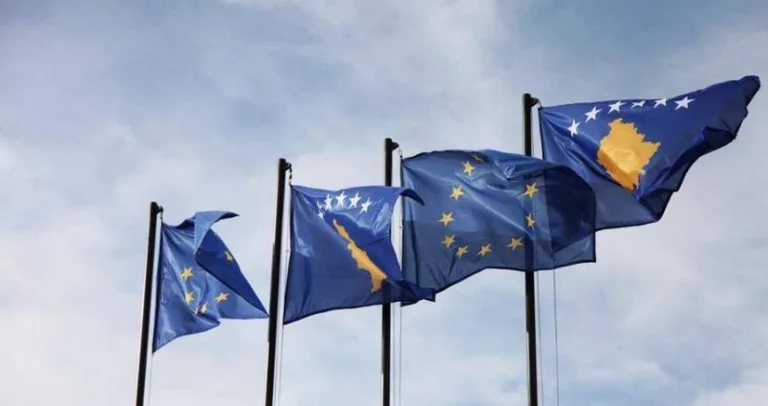
(2 hours ago)When Ireland assumed the presidency of the European Union Council on July 1st, it placed it among the top priorities for the next six months.
However, in its programme, there is no particular reference for Kosovo.
Is it just a symbolic lack or an indicator of “the” country that Kosovo currently covers in the EU enlargement agenda?
In response to Radio Free Europe, the Irish Presidency explained that it supports the progress of all candidate countries and potential candidates, including Kosovo, towards EU membership.
But he accompanied this support with a often-certified formula in Brussels: progress will depend on the conditions that must be met and on the implementation of necessary reforms.
A far more complex reality for Kosovo is behind this diplomatic stance.
A Stalled Process at First Step
Radio Editor Free Europe for European Affairs Richard Jozwiak says Kosovo, currently, is not among the European Union's enlargement priorities.
When Ireland talks about enlargement, according to him, the focus is on countries that have already advanced more in the membership process -- both Montenegro and Albania -- but also Ukraine and Moldova, which, after Russian aggression in Ukraine, have gained new strategic importance for the EU.
Kosovo has stalled since submitting its membership bid at the end of 2022, and I do not expect any movement even in the next six months”, Jozwiak says.
According to EU procedures, it is the presidency of the EU Council that decides whether an application is put into consideration.
Kosovo submitted its application on 15 December 2022, in the final days of the Czech Presidency.
But none of the upcoming presidencys pushed forward.
As a result, the application continues not to pass even the first formal phase: review by the Council and sending to the European Commission for assessment.
Jozwiak says the obstacles do not relate to the next presidency, but to the lack of political consensus within the European Union itself.
The last presidence that tried to test the Council's readiness to submit Kosovo's application to the European Commission was Sweden in 1923. Since then, no one has taken such a step”, Jozwiak says.
He adds that there is no indication that the five member states that do not recognise Kosovo - Spain, Greece, Romania, Slovakia and Cyprus - have changed their attitude.
For this reason, according to him, Ireland could quickly conclude that there is no political support needed to advance Kosovo's application and, therefore, not open the issue at all in the EU Council.
Free Europe Radio also called for the Kosovo Government's position regarding expectations by the Irish Presidency and steps meant to take to advance the European integration process, but until the publication of this material received no response.
This week, the meeting of the Stabilisation and Association Committee between Kosovo and the European Union was held in Pristina, where the EU urged acceleration of reforms, particularly in public administration, rule of law, freedom of expression and protection of fundamental rights, including those of non-US communities.
The Kosovo government, in turn, reaffirmed the commitment to implementing obligations stemming from the Stabilisation and Association Agreement (MSA).
Beyond Kosovo Reforms
Kosovo's growth on the road to the European Union, according to European Stability Initiative Enlargement Policy connoisseur (ESI), Adnan Qerigiq, cannot be attributed only to lack of reforms or political developments in the country.
According to him, the responsibility also rests with the European Union itself, which has not yet taken the first procedure step for reviewing Kosovo's application for membership.
Qarimagic argues that the EU has testified even earlier that it can find judicial solutions to advance its relationship with Kosovo, despite the fact that five member states do not recognise its independence.
As an example, he cites the Stabilisation and Association Agreement, which found a legal formula that enabled its entry into force.
A similar approach can also be applied to advance Kosovo's application for membership”, says Qerimagic for Radio Free Europe.
The obstacle is not only procedural, according to Professor at the University of Graz, Florian Bieber.
He says the European Union has linked Kosovo's progress in the integration process with dialogue on normalising relations with Serbia - a process that, according to him, has long lost its momentum.
At this point, dialogue has only to do with the management of stability, not any solution. As a result, there can hardly be any progress in Kosovo's European perspective until the European Union has either given up its condition with dialogue, or until dialogue itself takes a more serious course”, Bieber says of Radio Free Europe.
According to him, this means that even an EU Council presidency that has enlargement among the priorities has little space to change the dynamics in relation to Kosovo.
In the best case, he says, the Irish presidency could promote a discussion on how the enlargement process for Kosovo is built and whether its European perspective should continue to be conditioned by dialogue with Serbia.
Even so, he sees little prospect.
Bieber estimates that the lack of consolidated institutions in Kosovo, but also the tense reports that Albin Kurti's incumbent Government has created with several key European Union states, have dimmed the political readiness in Brussels to change its approach to Kosovo.
So I don't see much readiness on the part of the EU to change dynamics, and I don't think Ireland is able to do much in this direction”, Bieber says.
Such a political climate coincides with an extended period of institutional instability in Kosovo.
For more than a year and a half, the country has faced political deadlock, as three election processes, held within 16 months, have not produced a stable parliamentary majority.
Currently, Kosovo expects the formation of new institutions after the June 7th elections, in which the Vetevendosje Movement, led by Albin Kurti, again emerged the first political force.
What can Kosovo do?
Jozwiak says that space to draw Kosovo closer to the European Union, in the current phase of enlargement, is limited.
“I think the train for this has left”, he says.
But it sets off an issue that, according to him, continues to have great weight in European institutions: progress towards establishing the Association of Serb-run municipalities.
This has always been a key condition of the EU and remains so now, although the moment, of course, is no longer there when it comes to dialogue”, Jozwiak says.
The association of Serb majority municipalities stems from the 2013 Brussels Agreement reached in the Kosovo-Serbia dialogue, mediated by the European Union.
It is envisioned as a co-operation mechanism among Serb majority municipalities in Kosovo.
Over the years, the EU has insisted that its establishment is one of Kosovo's main obligations in the context of dialogue, but the process has remained blocked, due to disagreements about the competencies of association and concerns that it could violate the functioning of the state.
Moreover, the very dialogue between Kosovo and Serbia is in a period of stagnation.
The last high-level meeting was held in September 2023, just before the armed attack on Banjska.
Since then, European Union efforts to restore the process on track have not produced significant progress.
Where does Kosovo stand in relation to the region?
While Kosovo's integration process has remained virtually frozen, most other Western Balkan countries have scored, on different levels, progress on the road to the EU.
Montenegro remains the most advanced candidate, with all open negotiation chapters and their majority currently provisionally closed.
Montenegro's “country in the European Union is now taking shape”, EU Enlargement Commissioner Marta Kos has said during a visit to Podgorica in May.
If its membership materialised in 2028, as targeted, it would mark the European Union's first expansion in 15 years since Croatia's accession in 2013.
Albania is holding membership negotiations, while Northern Macedonia, although formally starting them, faces political blockades, especially from Bulgaria, for opening the first chapters.
Bosnia and Herzegovina received the green light for opening membership negotiations in 2024, while Serbia, although negotiating with the EU since 2014, has been without opening new chapters for years due to lack of reforms and non-compliance with EU foreign policy, particularly Russia.
In contrast, Kosovo remains the only Western Balkan country that does not even have EU membership candidate status./ REL/