9 minutes ago
Unauthorized BMW: How luxury cars are being built from parts of Russia
Periskopi(an hour ago)
(an hour ago)The German automaker BMW withdrew from Russia just a few days after Moscow began its invasion of Ukraine in 2022. Today, however, the Russian market is being sold in luxury SUVs mounted without BMW's authorisation, destined for very wealthy clients and not caring for major risks.
The BMW-shaped car, mounted in Russia, first emerged in March 2025. They were built from parts remaining in warehouses after the German company suddenly discontinued its long-term partnership with the Avtotor factory, located in the Russian enclave of Kaliningrad.
Russian media have reported that 145 sold in Russia during last year BMW “pirate”, mounted on Avtotor. These vehicles are known for bearing a 2025 production date, but they preserve the design of 2022 models.
The BMW introduced aesthetic changes (“phacelif”) for its X series during 2022 24.
Caroline Bachmann, spokeswoman for the BMW Group, told Radio Free Europe (REL) that Avtotor “started producing limited auto series BMW in 2025, mounting vehicles from old, partially outdated complexes that had remained available since the break in co-operation in 2022”.
According to Bachmann, the unauthorized assembly has continued “irregularly until today”.
She added to an e-mail that “to address and ease the risks related to the purchase and use of these unauthorized vehicles, we have informed all parties involved, including public authorities, vendors and potential customers, clarifying the” circumstances.

A picture from a website advertising three models of the BMW mounted in Russia.
The three models of the BMW SW mounted without authorization at Kaliningrad cost about $1153,0006,000 for basic versions.
This price is several thousand dollars lower than that of the BMW equivalents imported to Russia through subx0-market gray” schemes, where cars are bought by a concessionor in another country, sent to Russia and sold as new.
Christopher Ludwig, British automotive expert, told REL through email that, even though Kaliningrad's factory had available original BMW parts, it would face great challenges to produce these unauthorized vehicles.
The lack of engineering surveillance and processes from the BMW means that vehicles are assembled without direct technical assistance from the company, which, at least, raises serious concerns about quality”, said Ludwig, who runs Automotive Logistics and other automobile industry magazines.
“One of the main complexities of modern vehicles is managing different electronic control and software units that connect all of the” systems, he added. “This software is probably disconnected from BMW and, therefore, can't be updated, or reprogramped or replaced”.
Russian vendors who promote cars mounted in Kaliningrad present this fraction of software as priority rather than as a problem. They stress that vehicles cannot be blocked by BMW programmers, who could theoretically disarm vehicles associated with the company's official systems.
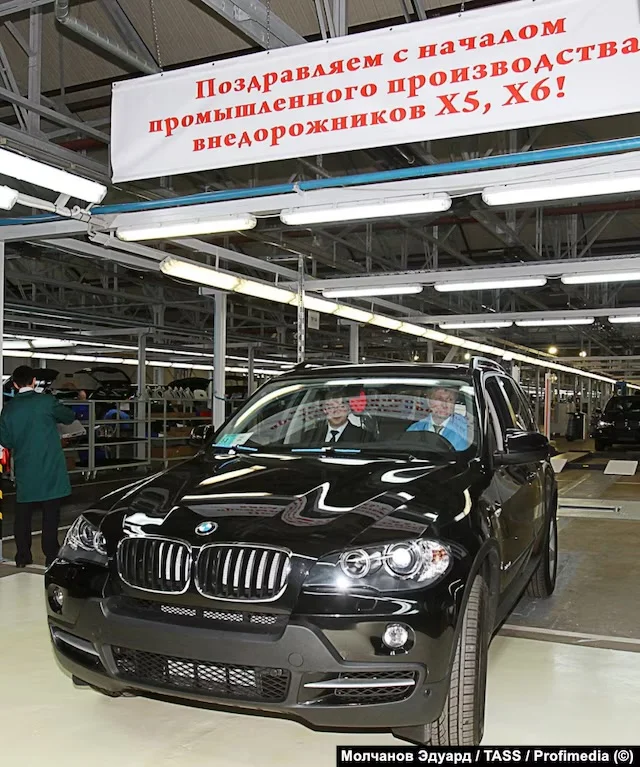
A BMW leaves the production line at the Avtotor plant in July 2009, when the company launched production of multifunctional sports vehicles (SUV) for the German brand of BMW automobiles.
Russian media have also reported that some simple parts, such as rubber intestines and electrical installations, are already being produced in Russia for these BMW without license. Meanwhile, mechanical parts of unidentified suppliers have also been provided in recent months to supplement the remaining reserves by 2022.
Ludwig said that BMW cannot indefinitely track every component of its vehicles, so sections can be provided “through different foreign subjects and countries like Central Asia, China, the Middle East or other countries that continue to have trade connections”.
According to him, such a supply chain and the highly mediated assembly process “would be more likely and less efficient”, but “not impossible”.
Even Tbilisi-based economist Vakhtang Partswaniya, who has written extensively on ways in which Russia avoids sanctions, agrees with that assessment.
“Tectically it is possible that some parts of the BMW or compatible components continue to enter Russia through the grey market, intermediaries or parallel imports”, he told the REL by e-mail, adding that “Russia has developed many such routes since 2022”.
However, a new claim that the Avtotor had begun to assemble the motor design BMW X6 40d, a model allegedly never produced before at the Kaliningrad plant, has surprised industry experts.
Due to limited superlocation among models, providing all components for a vehicle that had never been produced in Kaliningrad would be a giant achievement. Modern supply chains in the automotive industry include hundreds of suppliers offering tens of thousands of parts for each individual vehicle.
So how is it possible for the Russian factory to produce a model that has never been assembled there before?
The answer is: It is not possible.
The BMW has not publicly commented on this specific claim, but available data on the Internet shows that he is a liar.
A video published in May 2026 claimed that the X6 40d model was being assembled for the first time in Avtotor. However, several comments below the video contradicted this claim, and one of them presented concrete evidence.
This video says X6 40d was never mounted on Kaliningrad. Then how come I bought a new one in August 2016?”, a commentator wrote.
He also published the full number of car identification (VIN). Verification of this number through online vehicles showed that the diesel vehicle was actually mounted in Kaliningrad in June 2016.
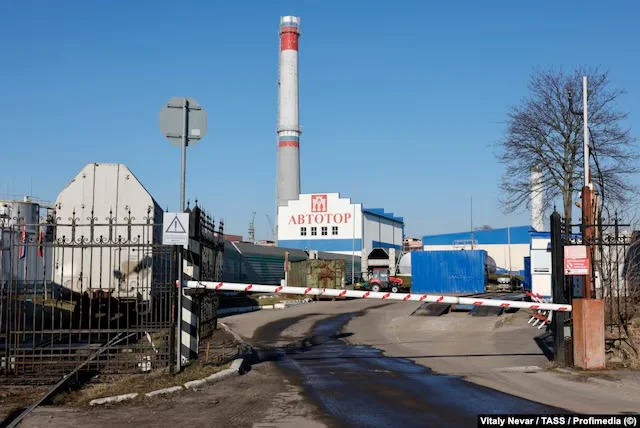
The Avtotor automobile factory in Kaliningrad, photographed in March 2022.
New BMW censuses in Russia have increased significantly in recent months, but the latest statistics of the Russian automotive industry do not specify where these German design vehicles were made.
If Russian reports of high demand for BMW mounted in Kaliningrad are accurate, the production of these vehicles without licenses can continue for a long time.
logistics expert Christopher Ludwig said that Avtotor, where more than 261,000 were assembled BMW between October 1999 and the beginning of 2022 probably had <x0) a full supply chain of at least three months, and maybe six months or more”.
Stressing that these are just estimates, he added: “If the factory produced 1,000 vehicles a month before 2022, but now produces only 50, then even a three-month reserve for three months from the period prior to 2022 could suffice for five-year”.
A source from the Russian automotive industry, which talked about REL in condition of anonymity, said the current pace of BMW production without license is “a point in the ocean” compared to factory production before 2022.
However, he added: “would be interesting if new wheelchairs began to appear (after )facelift) and things really take off”. /Radio Free Europe