6 minutes ago
Havenier: Kosovo risks losing Washington's confidence if it fails to act
Periskopi(2 hours ago)
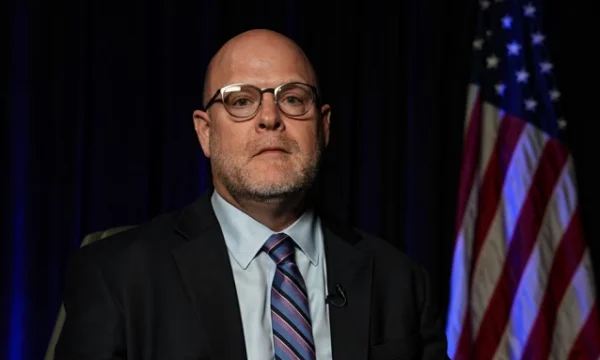
(2 hours ago)Kosovo cannot move ahead with its top priorities without stable institutions, says former American Ambassador to Pristina Jeffrey Havenier.
In an interview for Radio Free Europe, he warns that the political stalemate is damaging Kosovo's position in relation to the United States, the European Union and other partners.
Houvenier says suspending the Strategic Dialogue with Washington is already a concrete consequence for Kosovo.
According to him, Pristina must act more quickly on the Serbian community and energy issues if it aims to restore its relationship with President Donald Trump's administration.
He stresses that Washington's attention “is not endless”.
Therefore, I think it is important to use the opportunities offered and not spend too much time thinking or reflecting, but instead, to try to find common areas of co-operation and progress”, says Havener.
Radio Free EuropeAmbassador Havenier, Kosovo is again struggling to create functional institutions. Who holds the greatest responsibility for the current drive?
Jeffrey HavenierIt's hard for me to say who bears the greatest responsibility for the current cramp. What I would stress is how harmful this strain is for the citizens of Kosovo.
Kosovo cannot move ahead with its most important strategic priorities as long as it is governed by a government in office or faces the threat of new elections.
So, I think there's a lot of responsibility for the current situation.
If I were still US ambassador to Kosovo, I would do anything to encourage all political leaders either from Vetevendosje, P DK, LDK, AAK or other parties to find a way out, for the good of the country and citizens.
They must create a new government, elect the president and offer the United States, the European Union and other partners a reliable and legitimate co-ordinator.
Radio Free Europe: Are you saying international intervention is necessary?
Jeffrey HavenierI hope not. Kosovo is a consolidated democracy. Many years have passed since the declaration of independence, but this is a test for the political class: could it put aside narrow party interests and act in the best interests of Kosovo citizens? I believe so.
I still know Kosovo politicians very well and believe they are capable of doing so. Now it's important they do.
“responsibility must be split”
Radio Free Europe: How do you assess the refusal or reluctance of some opposition parties to become part of the next government? Do they also bear responsibility for the crisis, or does the main responsibility remain over the election winner?
Jeffrey Havenier: I don't know if I want to get into who, I think, bears the greatest responsibility, because I think the responsibility should be shared. But what I want to stress again is that Kosovo, at this moment, is paying a price that it does not necessarily have to pay.
All citizens of the country would be in a better position if politicians put aside some of their internal differences and found a common way forward, in the best interests of the country.
Radio Free Europe: We know that Kosovo has held three sets of elections in a year and a half. Do you think the problem has now become structural, or will anything solve new elections if they are held?
Jeffrey Havenier: It's always hard to predict elections in advance, but, as you said, three sets of choices have been held, and this process of inability to form a stable government or elect a president continues.
This negatively affects Kosovo's ability to advance its strategic goals, such as re-enacting and improving relations with the United States, advancing aspirations to advance the European Union membership process, membership in the Council of Europe, representation of its interests in Kosovo-Serbia dialogue and other important issues, such as developing the economy.
Therefore, the only thing I can say is that Kosovo's most important partners want to see a reliable and stable co-operationor.
Three elections within 18 months, the threat of other elections and the inability to form a government do not help Kosovo achieve what, I think, should be its highest priorities for the benefit of Kosovo citizens.
“Connection to Trump administration is not at the desired level”
Radio Free Europe: What do you think should be Kosovo's priorities?
Jeffrey HavenierLet's talk about some of them. It is no secret that the relationship with [US President Donald's] administration is not a secret. Trump is not at the desired level.
The clearest index of this is the fact that Strategic Dialogue with Serbia will begin 17 July in Washington and [Serbia's Foreign Minister Marko] Djuric will be there to meet with Deputy Secretary of State [Christopher] Landau.
Meanwhile, there has been no movement for Strategic Dialogue between the United States and Kosovo since its suspension in September last year, due to differences over some political elections made by then incumbent Prime Minister Albin Kurti. This is something that, I think, Kosovo should address.
I think Kosovo wants to position itself as a strong partner of the United States. I've heard that from all political leaders and everyone has publicly declared it since I left Kosovo.
But to do that, you have to have a government. You must have government policy. You must have communication and commitment. And I believe that all those who are currently in government would say that they are doing these things.
However, the situation is different when the threat of other elections exists, when the president has not yet been elected, or when the government continues to be in office. Government policies are needed to move forward.
Another element is that the U.S. Government, this American administration, the Trump administration, has been quite clear to its desire for Kosovo to be involved in American energy initiatives in the Western Balkans, and especially in some of the frames created for liquid natural gas (LNG).
This has now become a political issue in Kosovo. I understand that. But I'm talking like an outside observer. I no longer represent the United States government. If the Kosovo government wants to build a closer relationship with the current American administration, then it is probably in its interest to find a way to respond to some of the requirements and discussions coming from Washington.
Strategic dialogue is one way to do this, but it is not the only one. However, even for him you have to have a functional government so that there can be energy policies and final decisions. This is a priority group.
Now let's talk about European priority. I believe we all agree that Kosovo's future is in Europe. We all expect that one day Kosovo will become a member of the European Union, and now the time has come for this process to move forward.
But how can you do that with the European Union when you do not have a consolidated government and continue to function with institutions in office? It's very difficult. How can you draw up government policies to respond to EU requirements if you do not have a full government? How can you address areas that the European Union identifies as priority in its annual progress reports?
These are the priorities I'm talking about. And, in the end, is the Kosovo-Serbia dialogue. For better or worse, he will not disappear. The European Union facilitates dialogue, but remains the mechanism to achieve a kind of mutual accession.
The United States, under the Benden administration and all previous administrations, have believed that this process should end with mutual recognition. But how can it move forward in this process and how can a better situation be achieved in relations between Kosovo and Serbia, if not through this dialogue?
My impression is that the dialogue facilitated by the European Union has remained largely frozen. Not because of the EU's unwillingness, but because of Serbia's actions, government changes and elections in Kosovo. There has been very little progress, and this, again, affects Kosovo citizens negatively.
These are priorities, but there is another: growth and economic development. Whether we talk about energy, jobs or investments, it's all easier when you have a consolidated government that people know will stay for a while. A government with clear policies that attract investments, make the country attractive to investors and reassure those who want to invest or create jobs in Kosovo.
Because they must feel secure about the stability of the country. After all, Kosovo is a consolidated democracy.
Now, we're not talking about a situation like that of the 1990s. Nothing like that. Business people, however, do not like uncertainty.
As long as you see the American Economic Ode statements in Kosovo and what it requires: predictability, transparency and ways to help attract investments and advance economic growth.
So, I think these are real priorities for any government that will be out of this process and I hope that she will be able to address them as soon as possible.
Radio Free Europe: In a recent interview, you have said that Kosovo's reputation in Washington has suffered a “serious hit”. What concrete consequences can Kosovo face if this reputation does not return soon?
Jeffrey Havenier: As I said, this week the Strategic Dialogue starts with Serbia, while currently, there is no such dialogue with Kosovo.
This is for me to regret, even an incorrect presentation of the region's reality.
Kosovo should be on the table with the United States, as much as Serbia, and we would have a different agenda with Kosovo than we would have with Serbia.
With Serbia we will talk about Russian investments and Russian energy. I hope we'll also talk about elements of democracy and human rights. I hope we will talk a little bit about Kosovo and the threats made, including those from a recent minister, which are completely contrary to the way the democratic and modern XXI governments should talk about their neighbours.
With Kosovo, our conversation would have to focus on the very priorities. How can we consolidate democratic achievements? How do we advance growth and economic development so that Kosovo continues to be a source of stability in the region? How do we work together?
But, of course, with the Trump administration there would also be a conversation with transactional character, which would include LNG and other energy issues.
Therefore, the fact that this conversation is not taking place in this structured way through Strategic Dialogue is already a consequence for Kosovo.
I would also say that, actually, you have good people serving as ministers on duty, but it's different when you have a full government.
For example, it is easier for the economy minister to be in touch with his American counterparts when they know that the person will continue to be minister for several years. The same is true of the foreign minister and others.
These are the consequences I'm talking about.
I think it's no secret that some people within the Trump administration have felt challenged by some of the elections the prime minister has made over and over again, Kurti. That's why the Strategic Dialogue was suspended.
But it has a great opportunity to restore this relationship and move forward in co-operation with the United States.
Two things for Kosovo
Radio Free EuropeSo, based on your experience, what concrete steps must Kosovo take to begin Strategic Dialogue? What standards should Washington see?
Jeffrey Havenier: I can't speak for the Trump administration, nor would I want to. I'm not part of their discussions, so I can only speculate.
I guess they'd like to see, maybe, two things.
The first one, they would like to see an answer to their desire for Kosovo to be included in the wider regional energy infrastructure, and in particular in projects related to the LNG.
I believe the Trump administration has made it clear that this is a priority of it, so I think if you're trying to build a close relationship with the United States, it would be wise to respond positively.
The other thing I would say is that this is not just a matter of the Trump administration. It's an issue that existed in other American administrations where I worked.
I think that, from time to time, we have had different views with some representatives of Kosovo's current government, as well as with Kurti Government in the past, regarding the best way to address the very sensitive issues of non-communal communities, especially the Serb community in Kosovo, as well as the very difficult issue of ensuring that Serbia does not exercise sovereignty outside its borders.
Kosovo is a sovereign state and should be responsible for managing its sovereign state within its borders. But, at the same time, it should be sensitive to the concerns of the Serb community in Kosovo and find ways for Serbia to exercise the right to the Ahtisaari Plan to support that community, without violating Kosovo's sovereignty.
These are very, very difficult issues. They're very, very sensitive issues. But I think that's where the Strategic Dialogue was interrupted, or more precisely, that's where the decision was based that the American Government took last fall. It was specifically related to actions taken by Kosovo authorities on these sensitive issues, without having, from the American perspective, sufficient consultations or efforts to find ways to move forward, which would be less disturbing for the ethnic Serb community.
Therefore, I think Kosovo will also have to find ways to show Washington that the Government of Kosovo understands this is an important and sensitive issue; that Kosovo will not give up its sovereignty, nor should it do so, but that it will work with the United States and the European Union to find a common way forward in handling these issues.
I think these are the two main issues.
“Kosovo risks losing trust”
Radio Free Europe: Will Kosovo lose confidence if it fails to act?
Jeffrey HavenierI think so. Again, I can't speak on behalf of this administration, but from all I see, it's quite transactional and its space of attention isn't too big.
So I think it's important to use the opportunities offered and not spend much time thinking or reflecting, but instead to try to find common areas of cooperation and progress.
Radio Free EuropeWe talked about the LNG projects. Do you think Kosovo is in danger of losing this strategic energy potential with the United States?
Jeffrey Havenier: This is hard to say, and I'm not an expert on these issues. Experts dealing with them see the Trump administration is bringing about changes in the energy infrastructure of the Western Balkans.
I will only point out that, as I understand, all of Kosovo's neighbours are already part of a consensus with the United States that includes US LNG as an element of the region's energy infrastructure.
Therefore, it is difficult to understand why Kosovo would be such a different case that it did not make sense to it if it makes sense for Greece, Northern Macedonia, Albania, Bosnia and Herzegovina, Croatia and other countries in the region.
Again, I have no expertise in this area, but I am also seeing political signals, and they are also very clear from Washington.
Radio Free Europe: It may be hard to say, but why does Kurt hesitate in your opinion?
Jeffrey Havenier: I have a lot of respect for Prime Minister Kurti. During the years I have worked with him, however, I have learned never to explain the decisions he makes because he thinks in his own way, very unique and very deep. So I think that would be better asked.
My advice to him, if I were still there, would be: finish your thinking process and come back with ideas, because Washington's attention is not endless and they're expecting a positive answer.
I think it would be in your interest to find a way to cooperate with the United States on this matter, at least with Trump administration.