a few seconds ago
The longest solar eclipse of this century is coming and will last more than six minutes
Periskopi(12 days ago)
(12 days ago)The total solar eclipse that will take place on August 2, 2027, will be one of the most important astronomical events of this century.
Fenomen will be visible from parts of Europe, Africa and the Middle East, and in the most favourable location, the total phase of the eclipse will last up to six minutes and 23 seconds.
This is the longest total solar eclipse that will easily be accessible to land observation during the 21st century.
The longest phase of total darkness is expected near the city of Luxor in Egypt, so this country is now noted as one of the most desirable destinations for observing this rare heavenly event.
The length of the eclipse is the result of the extremely favourable position of the earth, the moon, and the sun. The moon will then be close to the curtain, the point at which it is closer to the earth, so it will appear a little larger in the sky than usual.
At the same time, the earth will be near the afel, its most distant spot from the sun, so the sun will appear smaller. This arrangement will allow the moon to block the sun's disk for a longer period of time.
Where will it be visible?
The total road will be about 258 miles [258 km] wide and extend from the Atlantic Ocean, through the Strait of Gibraltar and as far as the Indian Ocean.
The total eclipse will be visible from southern Spain, northern Morocco, Algeria, Tunisia, Libya, Egypt, Saudi Arabia, Yemen and Somalia.
Partial eclipse will be visible in a much wider area, including almost all of Europe, Africa and the Middle East.
For many observers, this will be an opportunity to see at least part of the phenomenon, while the most impressive images are expected within the narrow area of totality.
During totality, daylight will give way to short twilight, air temperatures will drop, shadows will become more pronounced, and the stars and planets will be visible in the sky.
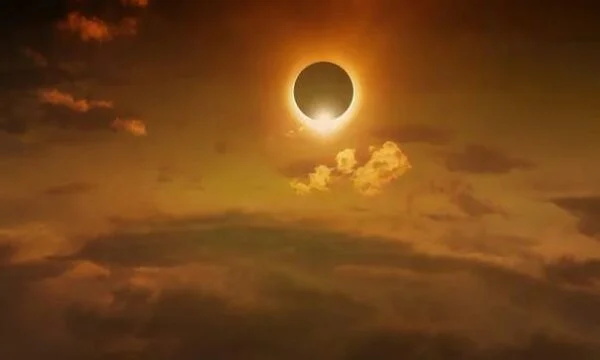
When the moon covers the sun completely, the Sun Corona becomes visible, the outer layer of the sun's atmosphere that looks like a bright ring around the moon's dark disk.
Precautions
Experts warn that you should not see the sun directly without special solar filters or glasses designed to observe the eclipse.
Common sun glasses do not provide sufficient protection for the eyes. Free - eye observation is only safe during a brief phase of total darkness when the sun's disk is completely darkened by the moon. / Periscope/