10 minutes ago
Irish chairmanship with EU) turns enlargement into focus, Montenegro can wrap up talks, Kosovo outside the agenda
Periskopi(2 hours ago)
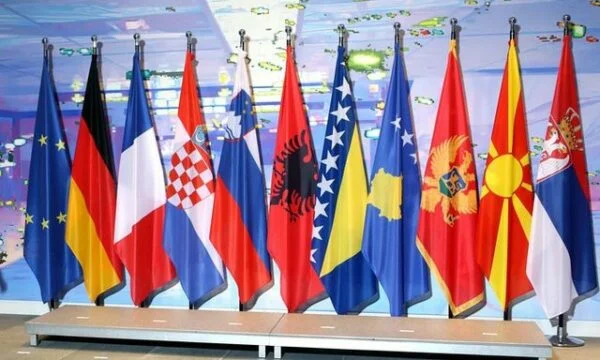
(2 hours ago)Ireland will take over the rotating six-month presidency of the European Union Council (BE) on 1 July, and this half-year period will be important for the bloc's expansion for several reasons.
Until Montenegro can wrap up talks under Irish direction, setting it in track to become the 28th member The EU by 2028, Kosovo is not expected to be part of the agenda at all.
Meanwhile, Ukraine, Moldova and Albania are also expected to continue their progress towards membership, while there could be movement in the same direction for Iceland and Serbia.
There is also great interest in the fact that Ireland is taking the staff. Dublin headed the presidency when the EU carried out its major expansion of 2004, welcoming eight Central and East European countries to the club, as well as Cyprus and Malta.
Irish diplomats stress to Radio Free Europe (REL) that this period is still remembered in homesickness on the island, and that numerous polls show that Irish are largely supportive of the bloc's enlargement.
In Brussels, Ireland is also seen as a fair “intermediation on the issue ʹone of the few member states whose government has never blocked any enlargement steps and has no bilateral disputes with any of the candidate countries.
The issue is one of Dublin's top priorities for the coming months, and significant progress is expected for that reason.
Before we see the chances of countries expected to enjoy progress, an assessment of Kosovo and other countries not expected to be in focus.
Kosovo, other countries in the stalemate
While there is much movement in the enlargement process, four countries are expected to remain at a deadlock: Kosovo, Bosnia and Herzegovina, Georgia and Northern Macedonia.
Kosovo faces old trouble.
Although she submitted her application for EU membership at the end of 2022, Kosovo's bid has not yet been forwarded to the European Commission for assessment. The reason is that the five EU member states that do not recognise Kosovo's independence -- Cyprus, Greece, Romania, Slovakia and Spain -- have not agreed to move the process forward.
Ireland is likely to test the positions of these five countries during its presidency. The last member state to experience this was Sweden early in 2023, but Stockholm was ignored, especially in Madrid.
Few people in Brussels believe there will be a change in this direction in the coming months.
Meanwhile, due to internal complications, Sarajevo has still failed to appoint a chief negotiator for talks with the EU. Furthermore, the two laws Brussels required the country to approve, one related to the functioning of the judiciary and another aimed at limiting political interference in the judicial system, have yet to be adopted.
In Northern Macedonia, the constitutional changes needed to reflect the status of Bulgarians in the country have yet to be adopted and there are no indications that this will happen soon.
According to the European Commission, Georgia is a candidate country only by name. After numerous clashes with Brussels, the government in Tbilisi has suspended virtually every effort to launch membership talks by 2028. Removing candidate status is considered impossible, and EU officials stress that the next step should come from Georgia itself.
Montenegro 28th member in 2028?
Montenegro is certainly the country to be closely followed at this time.
The small Western Balkan country has so far closed 16 out of 33 membership chapters, with each chapter representing a political field in which the candidate country must adopt EU rules and legislation.
Podgorica wants to close the remaining 17 chapters during the Irish presidency. Irish Prime Minister Michel Martin was in Montenegro at the beginning of June under the Western Balkans summit and stressed that it would be “sfidant” to finish everything within the next six months, but that this was Dublin's goal.
Cyprus, currently holding the rotating presidency, could be able to close to three more chapters at the end of June, before the power to hand over Ireland's staff. Afterwards, Irish hope to hold regular intergovernmental conferences (known in Brussels as “IGC” during the autumn, where more chapters will be closed.
An EU diplomat stressed that Montenegro must complete all negotiations during 2026 or early next year to achieve goal of becoming its 28th member The EU in 2028. This deadline reflects the need for the membership treaty to be ratified by all 27 EU member states -- a process that could last a year if not longer.
It is also noteworthy that more frequent meetings of the special working group in Brussels dealing with drafting Montenegro's EU membership treaty are planned during the Irish presidency. Established in April, the group started drafting in May and, according to European officials with whom it spoke REL, the process has gone smoothly so far.
Albania, ever closer
Cyprus could also manage to close the first chapters with Albania in late June, but if it does, Ireland is expected to do so in July.
After opening at the rapid pace of all chapters during the 1920s, Tirana has so far stalled in fulfilling the so-called intermediate criteria in chapters 23 and 24, which relate to rule of law. She finally managed to meet these criteria in late May.
Since the EU is concerned about the state of the judiciary and fundamental rights in many candidate countries, it is not enough to open and close negotiations in these two chapters. The intermediate criteria must be met. These criteria are determined by all 27 EU member states, which then must unanimously decide that they have been met before being appointed final closure criteria for the candidate country.
Having met the intermediate criteria for rule of law, Albania could soon close three membership chapters -- science and research, education and culture, as well as foreign relations.
Serbia and Iceland increasing pace?
Two other countries that can begin to move over the next six months are worth attending.
One of them is Serbia.
Seeing that Montenegro and Albania moving at a fast pace, Belgrade is eager to resume progress, as it has stalled on its path to the EU since late 2021.
Rumours circulate in the EU corridors that the country could open an entire set of chapters, mainly related to the economy and competitiveness, since July, especially because France is pushing this to happen.
Still, others continue to hesitate.
Baltic states are concerned why Serbia ignores EU sanctions policy against Russia, even though their tough stand on the issue is no longer as principled as it once was.
Then there are countries, especially the Netherlands, which do not want to see Belgrade progress in the EU membership process soon due to serious problems with rule of law in the country.
However, this is something worth following in the coming months.
Then there's Iceland.
The island state applied for EU membership in 2009, after being shaken by a financial crisis.
Starting membership negotiations shortly afterwards, he managed to close 11 of the 33 negotiating chapters, until a new government announced Brussels in 2013 that dealt with the EU in the midst of the eurozone crisis dealt with talks.
That was also during the chairmanship of the EU presidency from Ireland at the time.
In an interesting historical turn, Iceland will hold a referendum in late August to decide whether to resume membership negotiations. And Ireland is back in the lead if the Irish vote for, which polls show can happen, although the difference is narrow.
This opportunity has not gone unnoticed in Ireland. Irish Minister for Europe Thomas Byrne has declared that the Irish “suspended their negotiations during the last Irish presidency. So, if it were to start again from there, I think it would be a big moment for us”. Periscope.