22 minutes ago
DnV for five days of campaigning, 56 hate language cases identified
Periskopi(24 days ago)
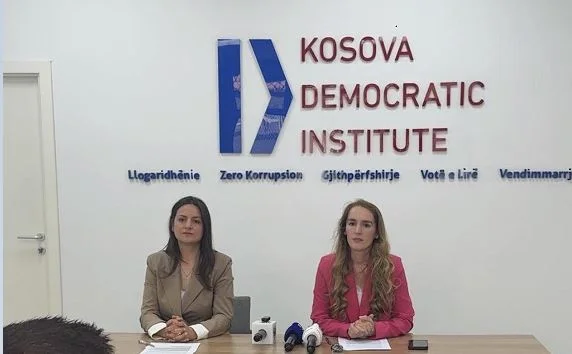
(24 days ago)Democracy in Action ( DnV has presented its analytical assessment over the first five days of the campaign for the June 7th parliamentary elections, which says the process is taking place in a generally calm and competitive environment, but continues to face challenges related to the equality of the race, the quality of public debate and the spread of hate speech in digital space.
Violet Hajoli from DNV said that in these elections, a total of 21 political subjects are competing with 902 candidates, of whom only 34% are women. She stressed that unlike the December 2025 elections, political subjects have updated their candidate lists, in some cases even up to 50%, but women's participation in the list has remained relatively the same.
Democracy's Action report notes that the largest number of candidates come from municipalities with greater electoral weight. Thus, Prizren leads with the largest number of country-level candidates with a total of 157 candidates, followed by Pristina with 153, Ferizaj with 77, Peja 68 and Fushe Kosova with 55 candidates.
The program reference of political subjects in this election could be assessed as recycling the previous bid, but ambalized in the form of commitments, mainly oriented in the field of energy, wages, social schemes, infrastructure development and technology. Most Albanian political subjects have already published these programmes on their official websites.
A continuing concern remains uneven competition in the election race. The use of public resources before the official start of the election campaign, including government decisions in office to distribute financial benefits for citizens, have created unfair electoral advantage for the ruling party”, DnV says.
Meanwhile, in the course of the campaign, in the first five days, the highest intensity of election activities on the ground has been observed, where political subjects have concentrated on opening campaign gatherings at Kosovo's main centres, even cases of child use in several gatherings of political subjects, for which two complaints have already been filed in the Electoral Panel for Ances and Paraseta (PZAP).
Contrary to the calm flow of election activities on the ground, the campaign in online space, respectively, on social networks is noticeably tougher, due to the hate speech being spread by party supporters. On the other hand, the use of insulting and discriminating language by political subjects, though at a lower level compared to previous election processes, shows that online space continues to present serious challenges to the quality of public debate.
“During the 5-day period, 56 cases involving hate languages, slander or derogatory languages, dezinformation and content outside the context have been identified. In such cases, 35 are classified as hate languages, 19 as defamatory or derogatory, and 2 as dezinformation. Almost half of the recorded cases point to women participating in the election contest. Monitoring 152 information portals in Albanian and Serbian has recorded over 70,000 comments containing hate languages, representing about 6% of the total of comments analyzed during the monitoring period.
The data of the Democracy report in action shows a disturbing level of verbal attacks on online space, especially on women participating in the election process, negatively affecting the quality of public debate and their participation in political discourse.
The campaign is being characterised by an outstanding degree of personalisation and centralisation, where political leaders and candidates for key positions dominate public activities and political communication, while MPs have a more limited role in public and media presentations. As a result, candidates are using more social networks for their promotion, through publishing attitudes, photographs and videos from meetings with citizens. Also, increased use of creative videos with visual effects has been recorded, reflecting the commitment of specialized design and content production companies, which points to increased spending on digital campaigns. The number of posts made by party candidates totals up to 300 a day.
In terms of Facebook content sponsorship, values spent over five days range from 10,000 to 12,000 euros to total, showing an apparent intensification of investments in online communication.
Hajoll stressed that these trends show social networks are turning into one of the main platforms of political communication, both for the delivery of messages and for the construction of public image of candidates.
As far as the media space dominates emissions or debates with just one subject or candidate in front of journalists, while debates with analysts number 17. The shows with the participation of more subjects are 9, while direct confrontations between the two candidates remain very rare, with only 2 cases.
A widespread gender inequality is noted in television debates, where men make up about 80% of participants, while women only 20%. However, in the election chronicles, media spaces appear more balanced at first glance, with 60% of the time devoted to men and 40% for women.
In the context of election management, the Central Election Commission is continuing with activities to organise the June 7th elections, mainly with a consensus decision-making. However, disturbingly, the CEC's recent decision to leave the issue of appointing commissioners in discretion to political parties, although there may be commissioners on these lists being investigated for misappropriations in the December 2025 elections. This conflicts with electoral integrity standards.
While, in terms of complaints mechanisms, the Electoral Panel for Ances and Parashtesa has accepted 3 complaints by political subjects, of which two are related to the use of children in the campaign and one with stimulating and hateful language. It has only been decided on one occasion, where complaints have been rejected as unfounded, is further emphasized.
In general, the findings of the first five days of campaigning show that the election process is under way in a generally calm and competitive environment, but that it continues to face challenges related to the equality of the race, the quality of public debate, and the spread of hate speech in digital space.