a few seconds ago
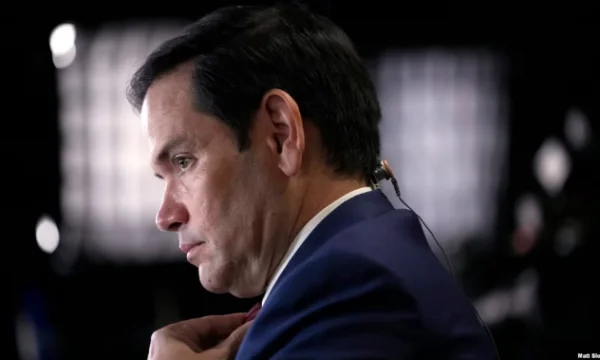
Amid tensions to withdraw US troops, Marco Rubio meets with NATO
Periskopi(a month ago)
(a month ago)US Secretary of State Marco Rubio leaves for Sweden on 21 May for the NATO foreign ministers' meeting, as European allies seek security in terms of reducing American troop presence and changing Washington's rhetoric in terms of the alliance.
Rubio will attend the meeting in Helsingborg on 22 May, which is one of the last ministerial meetings on high level before coalition leaders gather for the summit in Ankara in July.
According to the US State Department, the US top diplomat is expected to appeal to allies for increased defence spending and for <x0 most weight division”, while the focus will also be on Arctic security.
But the meeting takes place at a time when there is great concern. European officials are seeking clarity regarding the scale of the American military presence on the continent, following a series of Pentagon movements that have shaken the alliance.
“Information”
Uncertainty stems from recent reports that have raised fears across Europe that Washington may be weakening its security guarantees at a dangerous moment.
Earlier this month, US President Donald Trump announced plans to withdraw 5,000 troops from Germany. The Pentagon later confirmed that it was canceling a planned delocation of some 4,000 troops in Poland and was suspending plans for the delocation in Germany of a Tomahawk floating battalion that is launched.
A senior European diplomat, speaking of Radio Free Europe under anonymity, warned that the alliance's key prevention capacity is being undermined by lack of communication.
The worst thing is the fact that the continent seems to be being kept in informative darkness about the size of this withdrawal”, the diplomat said, stressing that the states that are in the front line, like the Baltic countries, are having difficulty making the right plans.
This diplomat added that the reported US plans for reducing contributions to the NATO-led model of forces, under which the members pre-initiated force for the major crisis ♫ would hurt Europe's initial “defence lines.
NATO's “effectability relied on the idea that it was indestructible”, the diplomat said. Now, in a divorc, you start looking at a crack show”.
US administration officials have insisted that these movements are a temporary adaptation rather than a strategic attraction. The US vice president, JD Vance, stated late that the administration's focus remains on “European independence and sovereignty”, while Pentagon spokesman Sean Parnell described the decision for Poland as a standard “voir in rotation”.
Rubio, as transmitter “stable” of messages
For many European officials, Rubio's presence offers a measure of security. The American top diplomat is widely seen in Brussels and the capitals of Eastern Europe as a more stable and traditional transatlantic figure than some other figures in the Trump administration.
Congresswoman Don Bacon, Republican from Nebraska and supporter of NATO, Free Europe told Radio that Rubio plays a key role in stabilising relations. Bacon said he hopes Rubio will reinforce Washington's commitment to collective defence, while simultaneously urging European allies to increase defence spending.
Congresswoman Bacon has repeatedly argued that the alliance remains central to US security interests and has warned against isolation at the time when there is increasing threats from Russia, China and Iran.
These concerns were reflected even 20 May during hearing sessions in the Senate to confirm Trump's candidates for ambassadors in several European countries.
Michael Kavoukjian, nominated to serve as ambassador to Norway, described Oslo as “eyes and the ears of the alliance in the Arctic” and pledged strengthening military and intelligence co-operation against the growing activity of Russia and China in the region.
Jeanne Shaheen, the leading Democrat in the Senate for Foreign Policy, warned that Norway is located on the first line of activity and the growing sabotaged efforts of Russia in Baltic, in the North Sea and in the Arctic”.
Meanwhile, Eric Wendt, Trump's candidate for ambassador to Albania, stressed the importance of burden sharing inside NATO and said it would encourage Tirana to meet the alliance's goals of increasing defence spending to 5 per cent of the Bruto Interior Production by 2035.
The hearings highlighted the difficult balance facing Washington: securing allies for America's commitment to European security while continuing to pressure NATO members to spend more on their defence.
Objections by Congress
Speaking on May 20th in Carnegie Endowment for International Peace, conventioner Michael McCaul, chairman of the Foreign Affairs Committee in the House of Representatives, defended NATO.
“NATO has kept us out of a world war for 80 years, so it is worth”, McCaul said.
Even though McCaul admitted Trump is trying to transform him NATO from what it called a <x0nd-child relationship” in a more equal partnership, he warned against rhetoric that could remove key allies.
McCaul also said Congress is opposing some unilateral military movements of the administration in Europe.
I welcomed the shift of some of these troops to Poland, where you are putting them directly close to the threat that exists”, McCaul said, referring to Russia. “But, later, the administration argued withdrawing from Poland. Congress has now intervened and said no to”.
Rubio's challenge in Sweden will be to balance competitive pressures: to protect the policies “The America of Para” in front of sceptical European allies while maintaining unity within an alliance facing an increasingly determined Russia. / REL/