12 minutes ago
Oil hits businesses in Kosovo hard
Periskopi(3 months ago)
(3 months ago)The effects of warfare in Iran have gone beyond the battlefield, quickly turning into a shocking factor for global energy markets. During more than a month of bitter hostility with attacks by the United States and Israel on one side and Iran's responses on the other ʹthe price of crude oil Brent, global standard [...]
The effects of warfare in Iran have gone beyond the battlefield, quickly turning into a shocking factor for global energy markets.
During more than a month of bitter animosity with the attacks of the US and Israel on one side and Iran's responses on the other side -- the price of crude oil Brant, a global standard of reference -- has increased to nearly 50 percent in crisis peaks.
This increase, driven by uncertainty about global supply, has been reflected rapidly on European energy markets until Kosovo.
Without the refinery of itself oil, Kosovo is completely dependent on imports and, therefore, exposed directly to price shocks in international markets.
Since the beginning of the conflict on February 28th until mid-April, oil prices in the country have risen for more than 50 cents per litre.
In an effort to control the market, the Ministry of Industry, Enterprise and Trade (MINT) has set a maximum trading margin for oil derivatives, thus limiting the profit space for sellers, and then replaced it at ceiling prices.
But the effect of this move remains controversial, especially for businesses that depend directly on import and global supply chains. Some of them report that it is not enough to compensate for the increase in production costs.
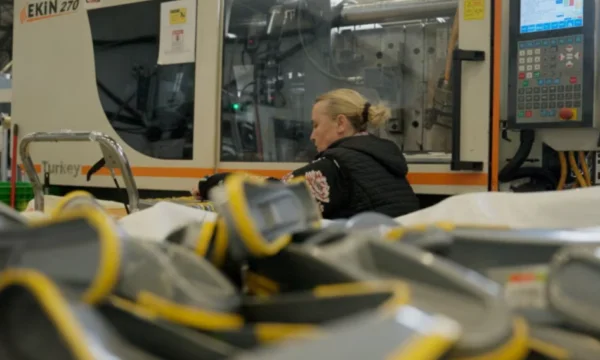
In Ferizaj the southeastern part of Kosovo ʹ the cleaning products factory “Cadi Clearing” is a direct example of this pressure. Within weeks, the cost of its raw materials, imported from abroad, has increased dramatically.
Its owner, Sadri Gashi, says that the base of their production is plastic granulat é is closely related to oil, as it flows from processing in the refinery. As a result, each move in the oil price translates almost immediately into increasing costs for its factory.
The first subject is almost oil. The grenade has oil content, it means from the refinery, so there are extremely high prices in us, about 100% the price rise of”, says Gashi for the Free Europe Radio Expo programme.
In addition to the expensive first class, transportation and supply costs have increased, further burdening the company's balance. Currently, Gashi's factory, with 75 workers and about 70 per cent of export-oriented production, is operating with stock provided earlier, while new supplies come at markedly higher prices.
We have taken on the new prices, in the hope that the market will be adjusted and stabilised, because at these prices we do not know how we will be competitors in international markets”, Gashi says.
This uncertainty does not stop only in extremes, but it gradually moves to the domestic market, where businesses face choice between lowering profits or increasing prices for consumers. In both cases, economic pressure ends up in the citizen.
Kosovo Statistics Agency data shows consumer prices have continued to rise in March, confirming the country's inflation trend. According to the harmonised Consumer Price Index, monthly inflation reached 1.5 percent compared to February, while the annual rate was 6.7 percent compared to March of last year.
This heat wave comes on a ground already tired of record inflation in early 2020, which was driven by the COVID-19 pandemic, and then by the war in Ukraine.
Lulzim Rafuna, chairman of the Kosovo Economic Ode, says oil prices are one of the main drivers of inflation in the country.
In an economy like Kosovo, dependent almost entirely on foreign markets with over 7 billion euros of imports and less than 1 billion euros of exports last year, he stresses that the derivatives represent basic costs for every business, and their expensive is reflected directly in transport, production and final prices.
In his words, Kosovo is also importing the consequences of the recent crisis in the Middle East.
The price of oil derivatives has increased not only in Kosovo, but also in Europe and around the world. In countries where the first item is produced, operational costs directly affect its price. Afterwards, our producer buys that raw material and imports it at the new price that the country's producer” puts in place, Rafuna says of the Expose.
According to him, the most expensive oil derivative sector is the production sector. He warns that increasing costs weaken the competitiveness of local businesses in the face of import, bringing down demand for domestic products and, then, risk of contractions in production, business closures and job losses.
In this context, Rafuna stresses the need for more active intervention of the Government, in defense of local production, ceiling prices for oil derivatives say it is not enough.
We've been asking since a month ago, when there was a tendency to increase prices, to take measures: either lower the excise rate, or lower the tax rate on Added Value, or even completely remove the T The VV. But no action has been taken, with the argument that the state budget” is damaged, Rafuna says.
The excise for oil derivatives in Kosovo is 36 cents per litre, while T The VV is estimated at 18 percent of the final prize.
In the region, some countries have directly intervened to ease price hikes. Northern Macedonia has temporarily lowered T The VV for derivatives, while Serbia has lowered the excise and temporarily banned their export, to ensure internal supply and to curb price hikes.
Meanwhile, even large European economies, such as Germany, have stepped in by lowering taxes on oil and gasoline in some cases up to 17 cents per litre for limited periods.
Government institutions in Kosovo say the impact of rising oil prices on inflation is being managed through targeted measures and limited interventions in the market.
In response to Radio Free Europe, the Ministry of Industry, Enterprise and Trade says the focus is on the most sensitive sectors, such as agriculture and transport.
For these categories, according to the ministry, direct support is provided, including reviewing subsidies' schemes and continuing excise coverage for agricultural fuels, as a practice that has been applied for years.
As for consumers, institutions are preparing a bill aimed at creating intervention mechanisms in the event of market destabilisation, including the possibility of setting profit margins or ceiling prices for basic products.
This bill, currently, is being treated as a priority in Kosovo's Parliament what reflects institutional commitment to create a solid legal basis for quick and effective interventions, in protecting consumer and fair market functioning”, says MINT.
In a proposal to journalists last week, Industry Minister Mimoza Kusari Lila estimated there is no need for additional measures, such as lowering the excise or lowering the VAT, stressing that price hikes have not been extreme, despite movement in international stock exchanges.
The International Monetary Fund, on the other hand, came up with a grim prediction. The financial institution, headquartered in Washington, warned that the global economy could approach recession if tensions between the US, Israel and Iran continue and energy prices remain high.
On Report “World Economic Outlook” The IMF estimated that, in a negative scenario, stable increases in oil, gas and food prices, global growth could drop below 2 percent in 2026.
The IMF did not specifically mention Kosovo, but stressed that slowing growth and increasing inflation are expected to be particularly pronounced in developing economies, which include Kosovo.
The country ranks among the poorest economies in Europe when measured by the gross domestic product per capita. Its economic structure continues to rely on imports, remittances and consumption, while the production sector is relatively weak.
Under these circumstances, Gashi remains waiting to stabilise the market on the contrary, cautions the dearness of his products by the end of April.
This situation doesn't go on, if it goes on, it gets worse. I don't know. If it continues, it will continue for everyone... but I hope it will be settled”, he says.
And, as international analyses warn, even if the conflict is quickly halted, the energy market does not immediately return to normality, as shortages in supply and uncertainty are expected to continue for months if not years.
The Free Oil End does not mean the end of its use. It means the highest cost of daily life”, media book The Conversion.