3 minutes ago
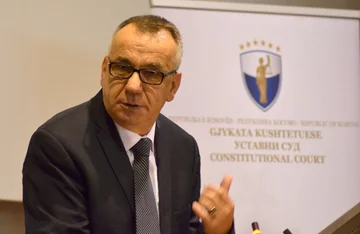
Hasani: I rule out the possibility that the Parliament will not be established and the Constitution will be put back in motion
Periskopi(10 months ago)
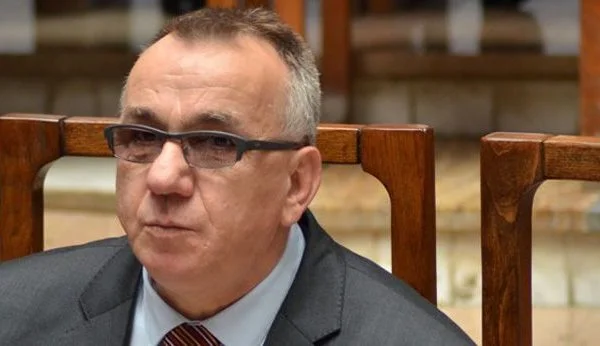
(10 months ago)The former head of the Constitutional Court of Kosovo, Enver Hasani, says it is politics that, within constitutional standards and principles, find ways out of the political stalemate. In this interview for Radio Free Europe, Hasan says he does not rule out the possibility that the Assembly will not be constitutionalised within 30 days and the Constitutional Court “is imposed [...]
The former head of the Constitutional Court of Kosovo, Enver Hasani, says it is politics that, within constitutional standards and principles, find ways out of the political stalemate.
In this interview for Radio Free Europe, Hasan says he does not rule out the possibility that the Assembly will not be constitutionalised within 30 days and the Constitutional Court “will be put back in motion under the previous constitutional and legal procedure”.
According to Hasan, who is professor of Law and International Relations at the University of Pristina, the Constitutional Act regarding the constitution is clear, but adds that given the behaviour of Vetevendosje, the 30-day deadline will not be respected.
If we judge Mr. [the head of LVV, Albin] Kurti, the situation is heading towards the Kosovo Assembly failure. It is implementing the final act of the Constitutional Court with the aim of obstructing the institution or inaugurating the Kosovo Assembly”, he says.
Hasan estimates that the only lack of constitutional bias is that constitutional sanctions are not clarified there. As a possible sanctions, he cites the decertification of the head of the constitutional session, Avni Dehari, or when the cases of violators of Constitutional decisions are identified, they, according to him, should be eliminated from the leadership positions in this case, in the process of constitution”.
The Constitutional Act on 18 August gives MPs 30 days to complete the system process. It says that the prime speaker is elected by an open vote, and the name of a candidate could be put to the polls up to three times.
Radio Free EuropeProfessor Hasani, have recent decisions of the Constitutional Court, which concern the issue of the Kosovo Assembly's constitutionalisation, caused unclear?
Enver Hasani: No, nowhere can the Constitutional Court be blamed for the uncertainty. Both this bias and that of June are clear. The problem is born and is always born on political ground. That's how it was in the past. The constitutional provisions have been and remain clear, distinguishing between the Kosovo Parliament's (inauguration) constitution and the work of the Kosovo Parliament after the constitutional constitution, such as the Constitutional organ, lawmakers, overseers, deliberatives and the representative of the people of Kosovo and its citizens.
The institution is the solemn inauguration of the Kosovo Assembly after the national election is certified, as the Constitutional Court has clarified in 2014. There can be no other parliamentary group in this solemn inauguration except those that come out of free will and ballot boxes. Only after the inauguration could the reshaping and reshaping of parliamentary groups in the Kosovo Assembly come.
Even then, however, it cannot change the structure of Kosovo's Assembly bodies, nor those related to its work. There are judgments of the Constitutional Court that do not allow the change of the leadership of the Kosovo Assembly and the structure of the Central Election Commission as a result of party flights that naturally take place in the Parliament and on political grounds. Any approach otherwise would negate the meaning of national elections.
The various interpretations that have been done and done to this dimension are thus to reassure Kosovo's Parliament and its judicial-unconstitutional nature are malicious and come from people who have no basic knowledge of constitutional right and parliamentary right as part of it. In this maliciousness, we do not rarely see confused performances by individuals who were once militants of a party, while today they oppose the same party.
The constitution, however, remains the same and has not changed anything in the concept of the Kosovo Assembly inauguration -- it needs to be done, and its non-inauguration cannot lead to extraordinary general elections. This is the responsibility of parliamentary groups, as they have emerged from the ballot boxes, and never otherwise.
The first winning party, which is always a relative winner, as well as in 2021, has only one privilege: to lead the process in the manner defined by the Constitutional Court and the judgments, as they interpret articles 66.1 and 67 of the Constitution and relevant legal and legal provisions on the inauguration of the Kosovo Assembly.
Mignony of the act, “Explaining constitutional sanctions”
Radio Free Europe: Does the Constitutional Court's recent ruling provide accuracy to unblock the constitution's constitutionalisation process?
Enver Hasani: Yes. The latest indictment, without a doubt, provides accuracy for unlocking the Kosovo Assembly inauguration process. The first party, or the winning coalition of the February 2025 elections, has the constitutional pre-emptive to propose the candidate for the Parliament's chairman. With this preliminary comes responsibility, which implies that the given constitutional right cannot be abused indefinitely, because there is already a 30-day deadline within which this right should be exercised. In addition, the final act has clearly demonstrated the manner of inauguration, limiting the right to a candidate's proposal only three times.
Radio Free Europe: What's missing the Constitutional Decision?
Enver Hasani: I think he lacks the clarification of constitutional sanctions. In its reasoning, the Court, with clear professional style and eloquence, has shown that the Constitution of Kosovo can be violated even by individuals or other subjects, which have not previously figured expressly in its text. As we know, so far such violations, with clear legal consequences, could occur only by the president of the Republic. There is a rich judicial practice, which has long been studied and taught in the cathedrals of constitutional law in Kosovo and abroad, except it has been widely dealt with in academic literature.
Since the Constitutional Court, referring to the Venice Commission's opinions, has noted that even individuals may be autonomous offenders during the exercise of their constitutional and legal obligations, then clear constitutional sanctions for such violators should have been needed and should be built. These sanctions are always different from those pronounced in the criminal, civilian, or administrative sphere.
I stress this because, unfortunately, there are constantly people who, on behalf of the profession, seek the imprisonment of MPs because of their behaviour in the Kosovo Assembly inauguration process. In that sense, the imprisonment of Kosovo deputies could never happen because of the non-compliance of the Parliament. The criminal responsibility of MPs comes only if they violate criminal law, not the Constitution of Kosovo. It's that simple.
Radio Free EuropeProfessor, what might those sanctions be?
Enver Hasani: Yes, the sanctions may be, if only naturally, that would go to Mr. (chief of the Avni Constituent session) Dehari decertification and not just the removal of the leader's post by age. Or when the cases of violators (of Constitutional decisions) can be identified, to be eliminated from the leadership positions in this case, in the constitutional process.
Radio Free Europe: Is the Constitution avoiding the consequences of violating its decisions in its recent decisions?
Enver Hasani: Of course, by far the Constitutional Court has acted with a kind of timidity and has relied heavily on MPs' confidence in the implementation of its judgments. So, the reason why the Court is not pointing to the judicial and constitutional consequences for individuals who specifically hinder and destroy the process of restoring the Kosovo Assembly is linked, on the one hand, to the fear of its irrational policies and reactions, and on the other hand, with support to MPs' confidence that they will implement their constitutional obligations defined in the Constitutional Court's judgments.
Radio Free EuropeProfessor Hasani, you mentioned that the Constitutional Court has acted with a kind of timidity. Which court is feared by?
Enver Hasani: If the ruling party is considered the archive or the record of all political parties in relation to justice institutions, including the Constitutional Court, or above all, the Constitutional Court I believe that the Vetevendosje Movement has an absolute record, and the brutality with which it has invited lynch to judges of the Constitutional Court is unprecedented in the jurisdiction, not only of Kosovo, but also of countries in the region. I would say they are rare cases in the practice of former communist countries. It can be compared to Belarus, the case of the Constitutional Court in Russia. In others, we cannot meet in these (situs) that so brutally, with such brutal blows, with an invitation for lynching so primitively, as we see in the Vetevendosje Movement. There have been such efforts in 2014 against me personally, my person, and the Constitutional Court, but their implementation has not gone so hard and with so many unprofessional comments.
Osmane “request aimed at paralysing the work of Constitutional”
Radio Free Europe: Where does this avoid consequences from the Constitutional Court lead?
Enver Hasani: This deviation leads to deepening the current political stalemate, making it even more difficult to resolve the inevitable solution, because never could the individual, however politically powerful, win the battle with constitutional and legal standards and principles and state mechanisms guaranteeing their implementation. Never.
Radio Free Europe: President Vjosa Osmani has withdrawn her request to the Constitutional Court for legal consequences for disrespecting the 30-day arrangement for the constitution. In spite of that, can the Constitutional Court be expected to give a thought, and can this happen before the current 30-day deadline expires on September 18th?
Enver Hasani: Mrs. Osmani's request has been the greatest disgrace a chief of state can make. It has had only one purpose: paralyzing the work of the Constitutional Court, rather than caring for its welfare, as is its constitutional obligation.
Even if Mrs. Osmani had accurate information about the threat of national security by a Constitutional Court judge, she has not dared or dares go public and denouncing such a thing. As chief of state, it has all constitutional and state mechanisms available to initiate necessary procedures and prevent any national security risks. The name-named call of a constitutional judge from the president of the Republic, in a case where the party itself is in procedure, constitutes nothing less than institutional hooliganism, unacceptable to any state institution and less to the president of the Republic.
This request is clearly unmanaged and unworthy. The court, however, has the right to continue the related procedure. But that requirement does not have any results in procedures related to the Kosovo Assembly's constitutionalisation, because the president of the Republic cannot be represented as a party to the procedure on this subject. The president of the Republic has only one authorization: calling the first constitutional session, and not as an obligation, but as an authority that can exercise if it wishes.
The solution to the loop “is political”
Radio Free Europe: Do you think the Constitutional Court will again face demands for interpretation of the state created concerning the constitution?
Enver Hasani: If we judge Mr. Kurti's behavior, the situation is heading towards the non-compliance of the Kosovo Assembly. It is implementing the final act of Constitutional Court with the aim of obstructing the constitution or inaugurating the Kosovo Assembly.
Radio Free EuropeProfessor, when I say that can there be any demands for interpreting the state created regarding the Constitution of the Parliament mean whether there can be new demands we're saying, after the 30-day deadline ends and what can they be?
Enver Hasani: The solution has been and remains political. It is up to politics to find solutions within constitutional standards and principles, as well as the judgments of the Constitutional Court that interpret these standards and principles.
It does not rule out the possibility that Kosovo's Assembly will not be inaugurated even within these expected 30 days, and that the Court will be put back in motion under the initial constitutional and legal procedure.
Radio Free EuropeYou mean, this is migration?
Enver HasaniYes, there is no other way. The only way is for the political process to develop according to constitutional standards and principles, as the Constitutional Court has interpreted and interpreted. No other way to go. /Periscopi/