22 minutes ago
Brussels today approves 150 billion-euro EU protection plan
Periskopi(a year ago)
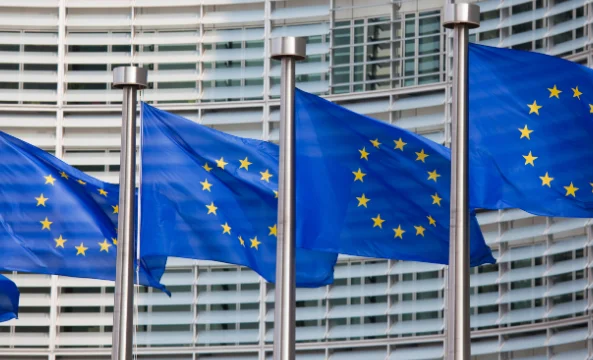
(a year ago)On May 27th, the European Union will formally approve its 150 billion-euro scheme to increase defence spending within the bloc. Adjusting the so-called SAFE (The Security Action for Europe) was proposed for the first time in March by the European Commission in response to member states' calls for financial support and [...]
The regulation of the so-called SAFE (Security Action for Europe) was proposed for the first time in March by the European Commission, in response to member states' calls for financial and political support in meeting new defence goals pushed forward by NATO and potentially substitute for Ukraine, should the United States shift their focus elsewhere.
The final regulation, seen by Radio Free Europe, clearly points out that the <x0 threats Russia and Belarus pose are of particular importance and urgency” and must receive swift responses.
Due to the time needed to develop protective products and increase the industrial capacity of production across the EU, the regulation also stresses that it will be <x0-cymetic” for the European bloc to start supporting member states “as soon as possible so that they can make a very quick order”, follows Periscope.
Brussels initially responded to member states' calls by activating the national secession clause for EU military spending, which means that expenditures for articles such as weapons and ammunition will not be included in the bloc's punitive mechanism for countries that violate EU spending limits.
This created fiscal space, but member states also need money as soon as possible.
With some capitals interested in making quick access to the proposed funds é and without the need for unanimousness or approval from the European Parliament, EU ambassadors adopted the new law on 21 May, with only Hungary voting against.
The new scheme functions in the same way as the recovery programme from the EU's COVID-19, worth 800 billion euros.
For SAFE, the bloc will use its highest-level credit rating (AAA) to collect 150 billion euros in markets and then borrow those member states. That way, it would be much cheaper than if most EU countries tried to generate funds themselves by borrowing individually.
Five EU countries -- Denmark, Germany, Luxembourg, the Netherlands and Sweden -- currently enjoy an assessment The AAA, therefore, would probably not need to participate in the scheme, leaving much of the possible loans to poorer countries.
Conditions Attachmented
The fact that loans have a maximum deadline of 45 years should not be paid for the first decade, and that countries will not have to pay T VSH for purchased equipment is other advantages Brussels hopes will spur a boom in defence spending in Europe.
But, of course, there are also certain conditions attached.
First, many southern EU member states, which are already burdened with other debts, complain that different from the recovery scheme from COVIID, which included grant components this initiative is exclusively a loan that would burden even more already tense public finances.
The SAFE also aims to promote common protection procurements among countries, with the European Commission wanting to use this instrument to create a literal European defence market instead of the currently fragmented national one that exists.
The countries can apply for loans without joining another state during the first year. After that, between 2026 and 2030 (when the scheme ends) two or more countries should apply together.
To ensure a fair distribution of funds, the share of loans granted to the three member states with the largest access should not exceed 60 percent of the total 150 billion euros earmarked for the scheme.
Who can attend?
The main issue last month has been who can participate in SAFE by balancing the member states' different wishes to increase domestic production with the reality that not every component can be produced in the EU.
For starters, countries of the European Free Trade Association (EFTA) Iceland, Liechtenstein, Norway, and Switzerland are involved in the scheme. The same applies to the EU membership candidate country, Ukraine.
The regulation argues their involvement by citing their “close partnership with the Union in the industrial production of defence” and the fact that “Ukraine is directly in the face of Russia's ongoing aggression fight. ”
Brussels Compromise
Still, there is disappointment.
The United States, in particular, has complained about exclusion from this process.
And many EU member states interested in maintaining transatlantic military ties while including other close partners in aspects of the SAFE have lobbied to open the scheme for further participation from abroad.
In the end, a 65-35x1> rule was reached. That means 65 percent of the value of purchased weapons must be generated in the EU, in the four countries ofEFTA or Ukraine. The remaining 35 percent can be produced elsewhere, for example, in the United States.
But the situation becomes a little more complex.
If a country has a Partnership for Security and Protection (SDP) with the EU, 65 percent of the value of weapons could come from that state.
The United Kingdom has recently signed such an agreement with the bloc, and Albania, Japan, Moldova, North Macedonia and South Korea also have similar agreements.
After all, as an EU official for Radio Free Europe said, the outcome is “a classic Brussels compromise” a huge deal has been reached, but the money will not start to flow until all, including many outside the family, get their fair share. /REL/