19 minutes ago
Can the agreement between Britain and Kosovo be reached on accepting migrants?
Periskopi(a year ago)
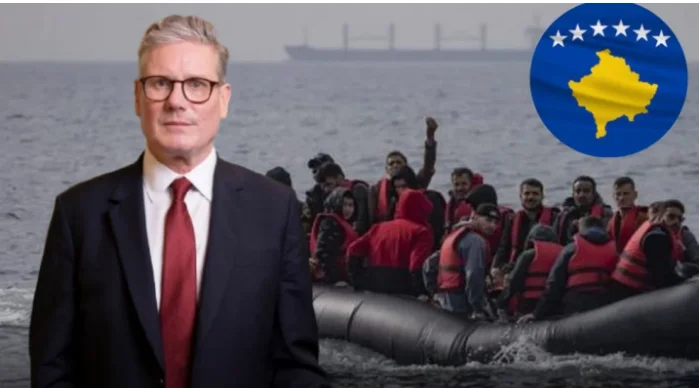
(a year ago)Great Britain is expected to officially ask the Republic of Kosovo to accept migrants who arrive illegally on British territory in small boats, as part of a plan to set up “returns” abroad. Kosovo is on a short list of nine states selected by ministers and British officials as destinations [...]
Kosovo is on a short list of nine member states selected by the ministers and British officials as potential destinations for temporary accommodation of denied asylum seekers after all legal procedures in the United Kingdom have been completed.
Kosovo President Vjosa Osmani has indicated that the country is “opened” for talks on such an agreement, signalling a willingness to consider possible London demand.
There has been no formal talks with Britain on the issue. It hasn't been raised so far. We'd be open to discuss it, but I can't say more because I don't know the details. I cannot give an answer to a request that has not been made yet. ” was the country's first expression.
Besides Kosovo, other Balkan states, such as: Serbia, Northern Macedonia and Bosnia and Herzegovina, as well as some countries outside Europe with which Britain aims to open negotiations under the management of illegal immigration.
Former Ambassador Hamiti for the possibility of accepting immigrants from Britain: Any agreement must be legal and in mutual interest
Former Kosovo Ambassador to London Muhamet Hamiti spoke after reports by international media that Great Britain is considering the possibility of placing migrants arriving in small boats in third countries as part of a plan to open “returns centres” outside British territory.
Hamiti stressed that any eventual agreement between Kosovo and Britain on such a sensitive issue should be based on common interest and on international standards of legitimacy.
Any eventual agreement on such a solution should be in the interest of both sides. Also, to be legal according to international standards,” he declared.
He stressed that at the moment there is no formal request from the British side, and only such a formal request could open concrete discussion in Kosovo institutions.
“This thing can be seen when there is official demand, if there is one that addresses the Government of Kosovo,” Hamiti told FrontOnline, broadcast Periscope.
Recalling earlier precedents, Hamiti cited the failure of Rwanda's “schemam “initiated by the conservative government in Britain, which was toppled by the country's Supreme Court because of legal violations and human rights.
There's been such an arrangement of Rwandan Creature that failed in the case of the former British government, when the conservatives were in power. The Supreme Court in Great Britain has declared it illegal because Rwanda is considered an uncertain place,” recalled the former ambassador.
Recica: Kosovo must seriously address initiatives by strategic partners, including potential request from Britain for immigrants
Former Labour and Social Management Minister Skender Recica has spoken about FrontOnline after international media reports that the United Kingdom is considering the possibility that Kosovo will accept migrants arriving illegally in Britain on small boats, as part of a plan to set up “returns centres” outside its territory.
Recica said that Kosovo, as a state of clear Euro-Atlantic aspirations and with close relations with Great Britain, should seriously address all initiatives coming from strategic partners.
Kosovo, as a state of clear aspirations for Euro-Atlantic integration and with close relations with the United Kingdom, must seriously address all initiatives coming from strategic partners --” -- Recica stressed.
He stressed that if such a requirement were formalised by British authorities, it would require a careful institutional and state assessment, taking into account the country's capacities and the need for international support.
Kosovo has several administrative and infrastructure capacities, but such an agreement would have to be based on high security standards, respect for human rights and international technical and financial assistance,”, he said.
From a strategic perspective, Recica does not rule out the possibility that such an agreement will bring specific benefits to the country, including deeper co-operation with Britain, economic development and local employment.
A possible agreement with the United Kingdom could bring Kosovo some benefits: increasing bilate co-operation, strengthening migration management capacities, investments in local infrastructure and job creation, especially in areas where these centres would be located,” said the former minister.
However, he stressed that any decision should pass through a broad institutional and democratic process, including the Kosovo Assembly, relevant institutions and civil society.
“Such a decision should be passed through a broad institutional and democratic process, including the Kosovo Parliament, relevant institutions and civil society, to ensure that any international engagement is in line with the Constitution, the country's laws and the fundamental values of our state --” concluded Recica.
Security expert: Kosovo must respond positively to Britain's demand for migrants' admission
Security Affairs expert Avni Islami has spoken after reports by international media that Great Britain is considering the possibility of opening a series of return-to-date <x0 centres for migrants outside its territory, including Kosovo as one of the options
Islam emphasised the close relations between Kosovo and Great Britain, naming it a strategic ally of our country in many areas, including security.
Kosovo and Great Britain have excellent relations. In political terms and in other spheres and in the security field. Great Britain has recently equipped the Kosovo Police with equipment fighting organised crime and smuggling,” said Islami.
He also recalled the support Kosovo has received from Britain in the international arena and the role this state has had as Kosovo's continued supporter in key political and security processes.
“given the political level as well, Britain is a strategic ally and Kosovo has had its backing,” he added.
Islam also cited Kosovo's former co-operation with the United States on the issue of temporary acceptance of Afghan citizens who fled the Taliban regime, stressing that such an approach should be followed even by British demand.
Kosovo has shown willingness and co-operation with the US when some Afghans, when the Taliban won in Afghanistan, and a part of them that were pro-Western, and with this Kosovo should respond positively to Great Britain along with that demand.
According to him, the deployment of migrants' centres does not pose financial burdens for Kosovo, as they are managed and financed by the very states that raised them.
Kosovo must accept those immigrants, because each state costs to those immigrants it takes to the state itself, and in those centres, exorcistity prevails. Kosovo would have to accept this, and the task of Great Britain eased,” completed Islam.
Sociologist Selsita for the possibility of accepting immigrants from Britain: Kosovo needs factories, not new EU prisons
Following international media reports showing that Great Britain is considering the possibility of Kosovo accepting migrants arriving illegally in Britain on small boats, as part of plans to open a series of “turning centre” abroad, sociologist Bekim Selista.
Selista stressed that Kosovo is still in the phase of economic and social construction, and therefore there is no need for investment in building new prisons, especially with support from the European Union. According to him, the country urgently needs economic development through job creation, industry growth and support of innovation.
“At the time when Kosovo tries to rise economically and secure a better future for its citizens, building new prisons with support from European Union countries is a move that runs in the face of the country's real needs,”, he said.
Sociologist underlined that while European laws and standards for rule of law are important and should be respected, it cannot be applied mechanically in Kosovo's social and economic context.
European rules, different realities. It is clear that many of these projects come as part of EU standards and practices for rule of law. But European laws cannot be transplanted mechanically in a country that has social and economic challenges. They need to adapt to reality on the ground, and reality in Kosovo today requires factories, not prisons,” stressed Selisha.
He followed by stressing that building new prisons does not bring tangible economic benefits to citizens and does not help improve living conditions or reduce unemployment.
Besides any political symbolic, there is no tangible economic or political benefit from these investments. They do not create new jobs for citizens, do not help production sectors, nor do they contribute to the country's sustainable development. Building a prison may solve any technical problem of the justice system, but does not solve deep unemployment problems and lack of economic perspective,” he said.
In this context, Selita warned that messages sent to the international community regarding Kosovo's development should be positive and reflect the real needs of society.
Instead of sending messages for progress and development, with new prisons we risk giving Europe another wrong image of Kosovo -- as a society that needs punishment more than support. This harms not only our image but also our inner collective awareness of what we should seek and what we should build,” he said.
Moreover, the sociologist called for a review of Kosovo's developmental priorities, stressing that the country urgently needs investments translated into jobs and social progress.
It is time for priorities to be revised. Kosovo needs factories that open jobs, schools that educate the future, and investments that bring life, not structures that symbolize system failure,” concluded Bekim Selista. /Periscope. /