13 minutes ago
Osmani after meeting with Sérensen: Kosovo to treat equal in dialogue, keeping measures is damaging needed balloons
Periskopi(a year ago)
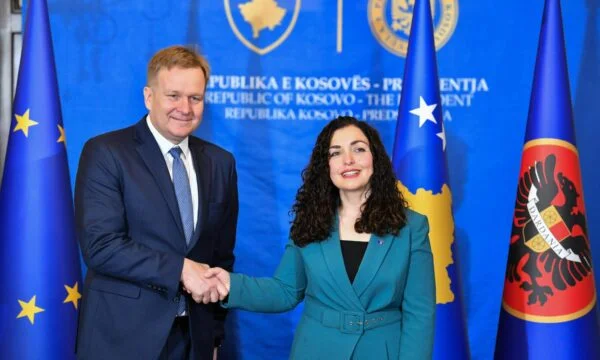
(a year ago)President Vjosa Osmani said that “Kosovo deserves equal treatment in the dialogue process and on the road to the EU”, following today's special meeting of the European Union for Kosovo-Serbia dialogue, Peter Sörensen. “At a meeting with EU Special Representative Peter Sörensen, we discussed the Kosovo-Serbia dialogue facilitated by the EU, security in [...]
President Vjosa Osmani said that “Kosovo deserves equal treatment in the dialogue process and on the road to the EU”, following today's special meeting of the European Union for Kosovo-Serbia dialogue, Peter Sörensen.
“At a meeting with EU Special Representative Peter Sörensen, we discussed the Kosovo-Serbia dialogue facilitated by the EU, security in the region and Kosovo's European integration”, Osmani announced in a Facebook post.
She said the EU's punitive measures towards Kosovo, which she called unfair, said they are damaging not only citizens, but “and Balans” in the dialogue.
Kosovo has already witnessed as a constructive side in the dialogue, committed to peace, democracy and rule of law, so keeping the EU's unfair measures against our country is hurting not only our citizens, but also the necessary balloons in dialogue”.
This is the first official visit to Kosovo by the Danish diplomat, who later met with Prime Minister Albin Kurti.
Sorensen has long diplomatic experience in EU structures.
During his diplomatic career in the EU, Sorensen has exercised several tasks in the Western Balkans. He has served as the EU's special representative for Bosnia and Herzegovina and chief of the EU office in Sarajevo. European bloc delegation to Skopje as well
Earlier, Sorensen has been working as adviser to both Kosovo and the UN mission in Kosovo (UNMIK), while also being the special representative of the EU high representative in Serbia.
In the Balkans, he has also worked on the Organisation for Security and Co-operation mission in Europe (OSBE) in Croatia.
His experience from the region is said to have also been one of the arguments why Kaya Kallas has decided to be Lajcak's successor.
Kurt and Lajcak, never with each other.
Significantly, Prime Minister Kurti has constantly had sharp criticism of former Uzar from Slovakia, Miroslav Lajcak.
Prime Minister Kurti had accused Lajcak of co-operating with the Serb side in the process of dialogue and was defending their interests.
“I would not say there has been EU co-ordination with Serbia, but the EU's special emissary has been co-ordination with Serbia's president, because it is not explained otherwise that Serbia's lack of proposals is ignored by our proposals”The Prime Minister said it.
However, these accusations of Kurt, The US State Department (DASH) had responded as “to the diligent efforts of Special Representative of the European Union Miroslav Lajcak in Kosovo-Serbia talks.
“Ne (SHBA) remains closely engaged with Kosovo, Serbia and EU partners in the facilitated dialogue by the European Union. We thank and recognise the diligent efforts of EU Special Representative Miroslav Lajcak”I've been declared by the UN.
But, despite that, two years ago an agreement was reached between Kosovo and Serbia -- the Ohrid Agreement.
In Ohrid, on March 18th, Kosovo and Serbia would agree on the Implementation Annex between Kosovo and Serbia.
Kosovo effectively gave up both recognition de jures that required it for ten years as well as resistance for Association.
In all, there are 11 articles, with the famous one also included: respect for previous agreements.
The EU, through a publication on the official site, had officially announced 11 points of respect.
The contracting parties,
Aware of their responsibility for preserving peace,
Dedicated to contribute to regional co-operation and security in Europe and to overcome the legacy of the past,
Aware that the invisibility of borders and respect of territorial integrity and sovereignty and protection of national minorities are fundamental conditions for peace,
Based on historical facts and without prejudging the different Paul views on fundamental issues, including status issues,
In a desire to create conditions for co-operation among the Pauls in behalf of the people,
They agreed the following:
Article 1
The sides will develop normal, good neighbourly relations with each other on the basis of equal rights.
The two sides will mutually recognise their respective documents and national symbols, including passports, diplomas, license plates and customs seals.
Article 2
Both sides will be guided by the goals and principles set out in the United Nations Charter, especially those of sovereign equality of all states, respect for their independence, autonomy and territorial integrity, the right to self - determination, protection of human rights. And impunity.
Article 3
In line with the United Nations Charter, the Paules will resolve any disagreement between them exclusively by peaceful means and refrain from threatening or using force.
Article 4
The sides continue with the assumption that neither can represent the other in the international sphere or act on its behalf.
Serbia will not oppose Kosovo's membership in any international organisation.
Article 5
Neither side will block nor encourage others to block, the progress of the other side on their respective EU path based on their merits. Both sides will respect the values mentioned in Article 2 and 21 of the European Union Treaty.
Article 6
While the current agreement represents an important step of normalisation, the two sides will continue with a new impetus to the EU-led dialogue process, which should lead to a legally binding agreement for the full normalisation of their relations.
The sides agree to deepen future co-operation in the fields of economy, science and technology, transport and connection, judicial and law enforcement relations, post and telecommunications, health, culture, religion, sports, environmental protection, missing persons, displaced persons and similar ones. The field through the connection of specific agreements. Details will be agreed on additional agreements brokered by EU-led Dialogue.
Article 7
Both sides commit to creating specific agreements and guarantees, in line with relevant instruments of the Council of Europe and relying on existing European experiences to ensure a proper level of self-management for the Serb community in Kosovo and the capacity to provide services in specific areas, including financial support from Serbia and a direct channel of communication for the Serb community with the Government of Kosovo.
The sides will formalise the status of the Serbian Orthodox Church in Kosovo and offer strong level of protection for Serbian religious and cultural heritage sites, in line with existing European models.
Article 8
The sides will exchange permanent missions. They will be located at the headquarters of the relevant government.
Practical issues related to the establishment of missions will be addressed separately.
Article 9
Both sides take into account the commitment of the EU and other donors to create a special investment package and financial support for common Paul projects in economic development, connection, green transition and other key areas.
Article 10
The sides will create a joint Committee, led by the EU, for monitoring the implementation of this Agreement.
Both sides confirm their obligation to implement all past dialogue agreements, which remain valid and binding.
Article 11
Both sides commit to respecting the Follower's annexed Implementation Guide in this agreement.
However, things got worse...
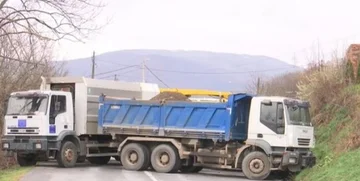
The resignation of Serbian List leaders in the four Serb majority northern municipalities, the violent protests of May 29th, where they suffered KFOR soldiers and Kosovo journalists, the kidnapping of three Kosovo police officers in June, the 24 September Serbian terrorist attack on Banjska, where the hero, Afrem Buxaku, and others remained dead...
All these are steps to violation Agreement on the Path of Normalisation of Relations between Kosovo and Serbia, which was accepted two years ago on February 27th, 2023 by Kosovo Prime Minister Albin Kurti, and Serbia's president, Aleksandar Vuciq, in Brussels.
The document, which was also recognised as “Plan Franco-German” and had US support, had to lead to a comprehensive agreement on normalising relations between Kosovo and Serbia.
It was agreed on ten years after the two sides signed the first Brussels Agreement. And to reassure “that it will be implemented, they also agreed to the Implementation Annex during a meeting in Ohrid, North Macedonia, on March 18, 2023.
So, after all these events, this agreement had a lack of implementation towards normalising relations between countries, regardless of how legally and internationally binding agreement.
The dialogue on normalisation of reports between Kosovo and Serbia, mediated by the European Union, has started in 2011. Several agreements have been reached during the process, but few have been implemented on the ground. /Periscope.