3 minutes ago
Former British officer: There can be no direct conflict until KFOR is in Kosovo
Periskopi(a year ago)
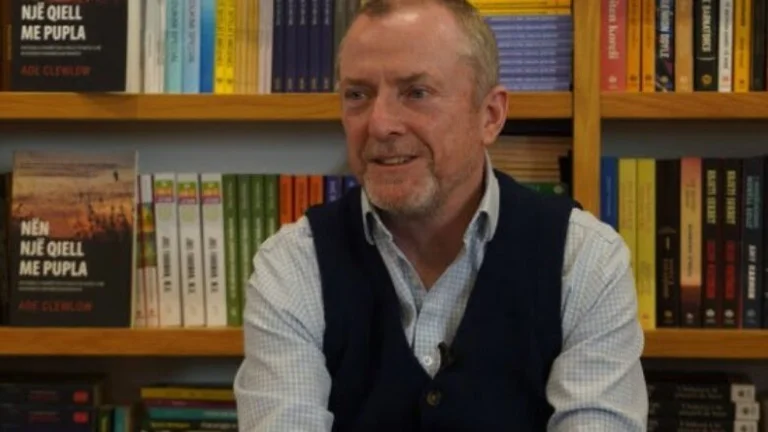
(a year ago)KFOR has the military and political power to prevent any aggression against Kosovo, says former British officer Ade Clewlow. However, it rules out the possibility of a direct conflict in the country as troops of this mission remain in Kosovo. How far away NATO membership is Kosovo and should KSF be deployed in the north, [...]
However, it rules out the possibility of a direct conflict in the country as troops of this mission remain in Kosovo.
As far away from NATO membership is Kosovo and whether the KSF should be deployed in the north speaks in an interview for KosovoPress, the former military who witnessed one of the most important processes of KPC and the creation of KSF.
Ade Clewlow, who served 25 years in the British Army, estimates that the Western Balkans is not a stable region. For this uncertainty, a major contribution, according to him is to the states of the European Union, which have not yet recognised Kosovo's independence.
Kosovo became a state on February 17th 2008 and was admitted by more than 100 countries of the world, but continues to be unknown from Spain, Greece, Slovakia, Romania and Cyprus these are part of the bloc.
The Western Balkans are not a stable region, and this is largely the result of some EU states that have not yet recognised Kosovo, contributing to uncertainty. Trump's alliance with Putin is clear, as is Putin's relationship with Belgrade. Also, we understand Serbia's goal to create instability in the Balkans whenever it can. I believe there is no possibility of a direct conflict as long as KFOR remains in Kosovo”, he says.
KFOR's role in Kosovo, Clewlow sees as very important, as he says, for preventing any aggression that the state can come from abroad.
This mission had increased its presence in Kosovo two years ago, when tensions increased in the country's north and attacks on the Kosovo Police and critical state infrastructure.
“KFOR is undoubtedly much smaller now than when I was here for the first time [in 2008], but it plays an extremely important role in preventing any outside aggressors who might have intentions to change Kosovo's political landscape. Although KFOR's mission remains the same as ensuring free movement and a safe environment his presence is essential. In reality, KFOR has the military and political power to prevent any aggression against Kosovo”, he says.
Peacekeeping Mission NATO has been located in Kosovo since 1999, when the war ended. There are 4,600 troops currently located in Kosovo under KFOR, out of 29 states.
However, Kosovo Police are the first reacter, with EULEX, the European Union's mission for rule of law. KFOR is the third reacter.
Kosovo also has the Security Force, which is in the process of transforming itself into the military. But in 2013, Kosovo institutions had pledged that the KSF would not go north without KFOR's preliminary consent.
According to the former British military man, the deployment of KSF in the north could be seen as provocation and promoting actions by Serbs who are funded by Belgrade.
From what I know about the situation on the ground, the deployment of KSF in northern Kosovo would be, as stated in English, “A read rag to a bull” [a red bull cloth]. Despite Kosovo's north is part of Kosovo's sovereignty and the theoretical KSF should be able to deploy there, the reality on the ground is that people would see this as a provocation that could lead to revenge actions by a small group of ethnic Serbs who take orders from Belgrade and aim to destabilise relations between ethnic Serbs and the rest of Kosovo”, says Clewlow.
The British say that new geopolitical developments should not be ignored until it mentions President Donald Trump, who took office in January of this year.
If Trump follows the same approach in the Western Balkans as in Ukraine, then stability in the region will be Europe's responsibility. European states will have to engage more to ensure a safe environment here”, Clewlow estimates.
In the interview for Kosovo, Clewlow also speaks of Kosovo's aspirations for NATO membership this process, according to him, which is expected to take time.
Kosovo has always wanted to be a security contributor and not a consumer. I would like to say that I see Kosovo membership in NATO soon, but NATO's future as an organisation is being questioned, especially in terms of the US role. Unfortunately, I do not believe that Kosovo will soon join NATO. However, the more Kosovo gets closer to its European allies, the greater the potential for a stable future”, the former British officer says.
Ade Clowlow, in charge of missions in many countries around the world, was found in Kosovo as a Lieutenant Colonel in 2008 shortly after the declaration of independence.
He was in charge of operational duties for six months and saw closely the process of dismantling the Kosovo Protection Corps, as well as the creation of the Kosovo Security Force that took place in January 2009.
His experience in Kosovo also preserved written, which he would later call “Under a Feathered Sky: Role in the Newly Independent Kosovo” (Under a feathered sky: The story of NATO's role in newly independent Kosovo.
When I came to Kosovo in 2008, I had no plan to write a book. But in the first few weeks here, looking at the behavior of my senior officers in KFOR, I realized that what I was seeing was worthy of writing in a book”, the former military said, among other things, during the Kosovo Press interview.
When talking about KFOR at the time, Ade Clelow says there were major differences in how it should be acted in Kosovo.
“Role was very politicised when it came to supporting the KPC and transitioning to the Kosovo Security Force”, he says.
A Brigadier General told me to sit in a corner, take notes and report what was happening to the Kosovo Protection Corps (TMK). But that would never be my approach to work. It was not as a British officer would understand that role. I was the 19th officer associated with KPC and it was clear to me that I had the duty to support and advise KPC commanders. However, after weeks in this role, I realized how political KFOR was. There were major differences in the way it should be acted in Kosovo between NATO in Brussels and KFOR in Pristina.
The role was highly politicised when it came to support the KPC and transition to the Kosovo Security Force (FSK). I found myself in this situation and was an extremely frustrating experience. Kosovo had only six months since declared independence, to national sensibilities and political positions played a major role in making important decisions, especially for closing the KPC and creating KSF”, the former British officer says.
Clewlow says it had “decided not to remain silent”, if in some cases it could cost.
I decided not to remain silent. On the contrary, I helped and guided KPC generals, trying to make sure that we shut it down. KPCs and lifts. KSF properly. There were times when I realized that I could get into trouble for my reputation. However, I always believed that the British chain of command would support me. In Kosovo, I had a two-star general with his back. He knew what I was doing and I was doing the right thing. That gave me confidence from the British perspective. But over time, it became clear that some viewed me as a stumbling block to their” plans, the former military says.
These and other pieces of experience in Kosovo, Clewlow, have been written in his book, which is also promoted in Albanian in Pristina on Thursday.
One of the most special moments for me and I've talked about it in my book "It was the holiday for the closing of the Kosovo Protection Corps." A parade was held near KPC headquarters, which is now used by another agency. The event had the atmosphere of the last day of school. KSF was close, ready to be created. We all went to celebrate the closure of this organization after nine years, at Stone Castle summer and had a lunch there... actually, that party captured everyone's feelings for the past, but also had a very strong element of hope for the future”, he says.
The book in Albanian returned the Briton once again to Kosovo, giving him the opportunity to meet with friends as well as to see countries that he once had been very familiar with.
Pristina's “timeout has changed. Every time I come back, I see new buildings everywhere. By driving from the airport today, I had difficulty getting to know places that were once close to me. Only in the city centre, where things haven't changed that much, I really felt I was back in Pristina”, says Clewlow. / KP/