22 minutes ago
What does the victory of Friedrich Merz mean for Europe?
Periskopi(a year ago)
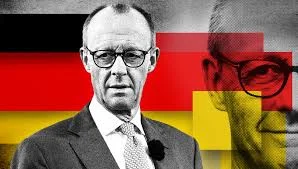
(a year ago)conservative leader Friedrich Merz won the German elections Sunday and is on track to take the reins of the EU's largest economy, Politico writes. It is not yet clear what the new German government will look like or how far Merz will be able to reform politics [...]
conservative leader Friedrich Merz won the German elections Sunday and is on track to take the reins of the EU's largest economy, Politico writes.
It is not yet clear what the new German government will look like or how far Merz will be able to reshape German politics as you see fit.
Weeks will likely pass before coalition talks between the Democratic coalition of Merz (CDU/CSU) and other parties reach an agreement and Merz become Chancellor.
However, one thing seems certain: Merz will lead Germany in another direction by current Chancellor Olaf Scholz. It may not look like Germany that Angela Merkel, also of the CDU, led for 16 years, until 2021.
Last month, Merz (without success) pushed the German Parliament for new migration measures with the support of the far-right alternative party for Germany. It marked a clear departure from Merkel's promise “Wir schaffen das” to accept refugees.
And there's more. From a possible turn in Germany's long-term nuclear energy policy and a tougher line to China, to plans to rekindle the German-French axis to strengthen trade with the EU, Merz could shake Germany's political landscape, and, with a blow, the European Union's overall one.
Here's what Merz-led Germany means for the EU.
Protection
Two days before the elections, Merz issued a harsh warning that Europe must be prepared to defend without the US.
“We need to prepare for the possibility that Donald Trump no longer unconditionally maintain NATO's mutual protection commitment”, Merz said in an interview with a German broadcaster, signaling that Germany could seek nuclear protection from European allies.
“We should have discussions with the British and the French if the two European nuclear powers -- if nuclear division, or at least nuclear security from Great Britain and France -- could also be applied to us”, he added.
Somewhere else, Merz has promised major and wide policies to boost Germany's defence industry and will be expected to soon implement an earlier promise to remove his predecessor's impasse, in sending long-range Taurus missiles to Ukraine for attacks on Russian targets.
A key theme of his first weeks in the Chancellor will be the definition of how Berlin plans to raise money to expand the 100 billion-euro fund agreed by the Scholz government to finance an improvement of Bundeswehr equipment and excavations.
That money is split and will be spent until 2027 on massive procurement programmes, raising questions about how Berlin plans to meet its obligations to NATO, which Merz has promised to do in the future from the conventional national budget.
“2 per cent target could be delayed again and then we would have to prepare for this”, Merz told the Berlin Playbook target POLITICO for plans to further increase NATO's goal, since Trump has called for a 5 per cent target.
Energy
Over the past few years, German energy policy has focused on investments in renewable energy, the closure of nuclear reactors and efforts to secure gas supplies from abroad to replace Russian imports.
Merz's CDU has likewise pledged “constantly uses renewable energy, all”. But his political family, the centre-right European People's Party, is also opposing EU goals for green energy.
Meanwhile, Merz has taken a warmer tone of nuclear energy than Scholz, who is challenging a long German taboo about atomic power.
While the country is unlikely to revive its closed reactors, a softer nuclear stance from Berlin could help pro-atomic countries convince Brussels to handle atomic energy more as renewable sources.
Merz has also said he wants to abolish Germany's Construction Energy Law, which aims to speed up a clean heating installation by offering a possible signal to green skeptics in Europe.
Climate
A government led by Merz will cost less importance to climate change than the Schelz coalition. Merz voiced concern about the campaign's track record of impact on climate policy in business, pledged to impose economic growth on all other concerns and directed a call to remove some green EU regulations.
But green lawyers express confidence that in government, Merz's rhetorical hammer will turn feathers dust. The industry, in general, requires less bureaucracy, but also requires stable policy. Industrial simulation can be used to help companies become greener and more efficient.
They won't do that on behalf of climate policy. Okay. If it's economic policy for them. Well”, said Linda Kalcher, executive director of the think group Strategic Perspectives.
Endurance
Merz, like Scholz, wants to delay the main rules of corporate sustainability reporting to promote Germany's ailing industry.
That means it is very certain that Germany under Merz would back a strong bill for simplifying green rules, a proposal the European Commission is expected to publish on February 26th.
A Merz victory also means the centre-right European People's Party, which dominates the European Parliament and is the political family of Merz, has once again a powerful ally in the EU's largest economy.
Already, The EPP has been pushing hard to ease the EU rule against deforestation with the support of the leftist groups (mostly unsuccessful so far)0.
Mobile
Merz is inheriting an economy in recession that is further stalled by a crisis that has involved its automobile sector. He knows the problems: high energy and labour costs, and fierce competition in the transition of electric vehicles. But it has been easy for details how it aims to help automotive producers.
In campaign speeches, he promised to reduce bureaucracy and reduce high costs, but did not support Germany's debt-reducing reform, which would keep Merzi's hands tied when it comes to financing such initiatives.
German car producers are highly dependent on the Chinese market, which led Scholz to reconcile with Beijing's wishes, such as lobbiing against the electrical obligations produced in China.
Merz will take a harsher stance with China and has made it clear to automotive producers that they should not come to it if their Asian investments explode.
Trade
Maintaining a stronger attitude towards Russia and China and rekindled old friendships with other EU leaders: Merz has finished work for him if he wants to link the German export economy to hot spots of global growth such as Merchur, Mexico, or Southeast Asia.
Merz acknowledges that a functional Franco-German axis can create more trade deals, more security for companies, and ultimately a stronger Europe.
“We have to overcome our Mercuarging dispute”, Merz said at the World Economic Forum in Davos last month, saying he was in regular close contact with French President Emmanuel Macron.
The Christian Democrat has also signaled a harsher approach towards China. Or, at least, he has acknowledged that the German economy is highly dependent on Beijing's problems and desires. But how Merzi's approach to trade will end, it is likely to be determined by whom he will end up as a coalition partner.
Agriculture
A victory for the Merz CDU means Berlin will join agricultural policy, as with the largest political bloc in the European Parliament, the European People's Party led by Bavaret Manfred Weber é and with EU Commissioner for Agriculture Christophe Hansen.
Ahead of negotiations on the future of the EU Common Agricultural Policy, Hansen has launched a review of the farming policy that would effectively undo the green agenda of the last term, and would instead stress making agriculture a more attractive and economically implementable profession. On its campaign platform, Merz' CDU said it wants a goat “that serves farmers”.
The government of Scholz's centre-left government promoted initiatives to support organic agriculture and reduce food waste. But she ran into farmers a year ago for her decision to lift tax cuts for agricultural oil.
The CDU said it will restore oil taxes and take broader action to strengthen the safety of planning for farmers.
“With CDU, no farmer will have to protest with his tractor in front of Brandenburg Gate”, the party said.
Central Bank
Merz's Chancellor will mark the return of the conservative opposition to the notorious failure of Germany's debt, which limits government deficit spending to 0.55 per cent per year and is seen by many as the cause of the country's poor state of infrastructure.
Scholz's attempts to confuse the brakes caused his government's collapse, and Merz's CDU faction is sharply opposed to any reform to a point.
Surprisingly, Merz himself, during a television debate earlier this month, spoke out to some arrangements, but not before further solutions are tried. Disturbed, yes, but revolutionary by a Christian Democrat.
Otherwise, financial markets are widely sceptical that Merz could do much to stem Germany's well-documented economic downturn, with gross domestic product expected to shrink 0.5 percent in 2025.
During the race, the choice between the two sides' economic policies was ultimately “representative”, not saying earlier Macro Carstenr ING Global Chief.
Plans for cutting taxes and spending reflected an almost spiritual belief in free markets the same markets that have dealt such a humiliating blow to Germany's economic prestige.
Merz will also have a critical impact on the outcome of a major transnational banking battle, which could test EU ideals.
When Milane lender UniCredit made her surprise offer to Germany's Commerzbank last year, it looked exactly like the kind of cross-border banking consolidation Mario Draghi was defending in his historic report ♫ until the Scholz government reacted with horror and dreamed of wild schemes to block him.
UniCredi executive director Andrea Orcell has since said he will host Merz's position before making another move, but it is difficult to imagine that the new leader will be more inclined to donate one of the country's most precious lenders.
Financial Services
Merz holds the keys to significantly boost Europe's defence capabilities in the years ahead. While Trump pressures Europe to increase military spending, many in Brussels are anxious to have Germany grant its blessing for the European Commission to borrow money on behalf of member states.
High-indebted countries such as France, Italy and Spain, which fail to achieve NATO's goal of defence spending, argue that getting “free money from Brussels is the only way they can drastically increase military spending, without making politically unpopular cuts in other budget areas.
Merz accepted this idea during the election campaign, and supporters hope his support will defeat opposition by the allies spared both Austria and Holland. There are many less controversial ideas on the table, such as excluding protection from EU spending regulations or increasing military funds in the new multi-year budget of the EU, which will take effect in 2028.
But mutual debt supporters argue that none of this will be enough to meet only the scale of the challenge.
Competition
Germany's industrial giants are losing their jobs. Merz will be expected to act. His party's performance called for samples “Made in Germany” and for a modern antitrust and competition law “that uses a global market as a reference point”, reference to the Siemens-Alstom agreement to create a European rail champion that was blocked by the EU.
Merz is also a member of state-funded cross-border projects, known as important projects with common European interests, saying he wants to use such instruments “as the most efficient possible in Germany”.
The country has been one of the mobile forces of several IPCEIs, which have led to public financing of hydrogen, batteries and glade infrastructure.
He also wants the German national railway company Deutsche Bahn to be restructured, with infrastructure and separate transport “to increase competitiveness”. Given the state of the German railway, this may be a popular move.
Technology
Merz sees digital transformation as the key to Germany's industrial revival and wants to turn the country into the technology leader in Europe. Its plan is to assign 3.5 percent of gross domestic production for research and development by 2030, with a special focus on space, quantum calculations, artificial intelligence and glade technologies.
The main proposals include establishing an independent digital ministry (currently merged with transport) and providing temporary relief to new businesses from bureaucracy.
Merz has also said that bureaucracy in Berlin and Brussels should be drastically reduced so that Germany can regain its competitive advantage. This stance is in line with centre-right views in EU institutions, where a major incentive to simplify digital rules is under way.
Cybernetics
In the months leading up to German elections, Berlin lawmakers tried to strengthen restrictions on (and potentially ban) the high-risk Chinese suppliers like Huawei meant to implement EU cyber security regulations in the critical sectors.
With the completion of the bill's work, Merz will face a decision whether to hit Chinese technology in Germany's critical sectors. His CDU party said it wants to maintain close economic relations with China, but is also committed to taking steps to protect critical infrastructure and relevant security technology.
The party's performance also outlined a sweeping change of course in terms of data protection policy, encouraging more “pramatic” rules that allow for use of innovation data and growth, as well as for law enforcement.
Health
A Merzi victory signals a blow to cannabis users in Germany after the CSU leader pledged to cancel partial derimination of drugs last year. It blames new policies, which allow adults to possess up to 25 grams of cannabis in public and grow three plants per household, for an increase in drug-related crime.
It could be good news for the worshipers of new EU regulations to digitise European health data, European Health Data Space.
In an effort to force notorious analog Germans to leave the files on paper, Merz suggested that anyone guarding his records in an electronic file of the patient could receive a discount on health insurance contributions. /Telegraph