22 minutes ago
Schmitt: Kosovo is one of the most endangered states in Europe
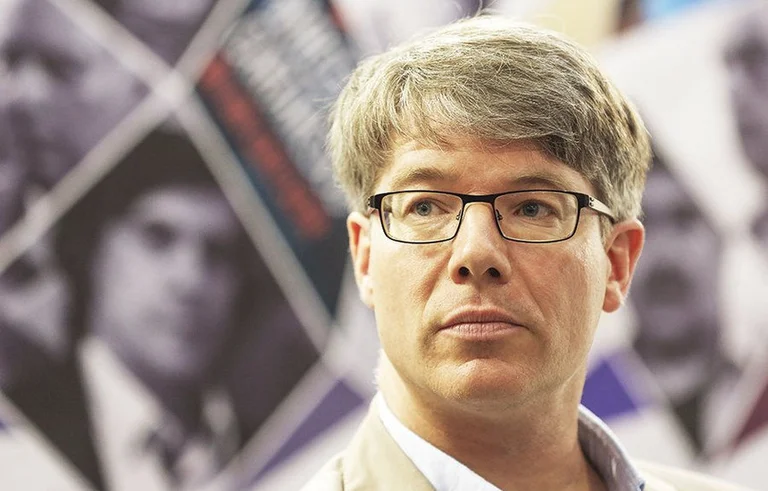
Periskopi(a year ago)
(a year ago)As he monitors the geopolitical situation, answers to Kosovo's identity, what noted Swiss historian Oliver Jens Schmitt says is alarming. It says the state must prepare “for a possible military conflict”. “Would be more important to talk about military protection, civil protection, hospitals, emergency plans and prepare them [...]
As he monitors the geopolitical situation, answers to Kosovo's identity, what noted Swiss historian Oliver Jens Schmitt says is alarming. It says the state must prepare “for a possible military conflict”. “Would be more important to talk about military protection, civil protection, hospitals, emergency plans and to prepare them seriously than language and literature”, Schmitt says in an interview for TIMEN. According to him, along with the Republic of Moldova, Kosovo is one of the most endangered states in Europe. In Kosovo, the danger of war is no longer seriously discussed in other European countries. What is needed now are not identity debates, but serious preparation for a” attack, Schmittt says.
As a stable democracy, Swiss historian Oliver Jens Schmitt described Kosovo on the 17th anniversary of independence. Austrian Academy of Sciences member says that within Albanian culture, Kosovo has its culture, not in the language sense, but in the political one. Schmitt, who, besides studying the past, is also a thin Balkan observer, says Kosovo is markedly different from Albania, where the legacy of Enverist culture continues.
In a written interview for TIME, he says political Islam is progressing in Kosovo and is gaining followers, especially in the new generation. According to him, in this case the question is how Kosovo is positioned between Europe and the Islamic world.
But these questions should be answered by Kosovars” himself, he says. According to Schmittt, American President Donald Trump's administration seems no longer ready to ensure Europe's security.
In such a case for the renowned scientist, Trump's approach has dramatic consequences for the EU. It considers that EU states are not militarily prepared for a conflict with Russia, Time.net reports.
Without American protection, the EU must expect a Russian attack”, he says.
In this case, it also mentions Kosovo as a endangered country. It says that along with the Republic of Moldova, Kosovo is one of the most endangered states in Europe. It suggests that Kosovo should make serious preparations for an attack.
Born in 1973 in Basel, Switzerland, Oliver Jens Schmitt, professor of Southeast European history at Vienna University, says the Serbian government is under great pressure and may try to organise a conflict with Kosovo. Warn that Serbia has been re-armed massively in recent years. He says the American presence in Kosovo has prevented Serbia from using these weapons and that the EU cannot replace the United States of America as the protection power of Kosovo.
It would therefore be important for Kosovo to soon have a stable government that prepares it, with all the important parties, the society for a possible conflict”, says Schmitt, who in popular German-speaking world centres such as Basil, Vienna, Berlin and Munich, has studied Byzantines, Greek philosophy, modern Greek and Eastern European history. Given the geopolitical situation, Schmitt says it is now time to address the preparation of Kosovo as a state for a possible military conflict. Rather than issues of identity, he said, it would be more important to talk about military protection, civil protection, hospitals, emergency plans.
The scholar living in Vienna has long study and legal experience in various European countries. He has legalized the universities of Munich and Bern, and for a time he was also a professor at Colège de France. Since 2017, he has been chairman of the Department of Humanity and Social Science near the Academy of Sciences in Austria, while at the same time heads the research department for Balkan studies at the Institute for Modern History and Contemporary of the highest scientific authority in Austria. His interests in history are vast, with focus especially on the Middle Ages and the Balkan Adriatic trends, as well as Romania. Schmitt's contributions also go to the medieval Albanian world, with titles like “The Venice Arberia”, “Kosovo”, “Scan ederbeu” of “Albanians” In March 2022 at the Kosovo Academy of Sciences and Arts had promoted his work, “Balkan in the XX century é a post-imperial history” and five volumes of archive material publications of the Austrian Academy of Sciences for Kosovo prepared by Schmitt and Eva Anne Frantz. The volume includes reports of the Austro-Hungarian consortiums for Kosovo from 1870 to 1914.
“Kosovo has its culture in political sense”
KOHA: How do you see Kosovo's identity in these 17 years of state?
Schmitt: Kosovo is now a stable democracy, with a now established party system. Unlike Serbia, a government can function for an entire legislative period, and ruling changes are possible through democratic elections. The vast majority of citizens are identified with their country, for which the old generation made great sacrifices. Even though the international community has defined Kosovo as a multiethnic state, Kosovo is largely ethnically homogenous, so Kosovo can be named the second Albanian state in the Balkans. Within Albanian culture, Kosovo has its own culture, not in the language sense, but in the political one. Here Kosovo is markedly different from Albania, where the legacy of the Enverist culture continues, as Kosovo's political culture is shaped by common resistance against Serbian depression. This means that social trust is evidently more developed in Kosovo than in Albania; that political culture is based on the idea of freedom and fighting for freedom. So you can say there are two different political cultures in the Albanian world in the Balkans.
KOHA: What are your councils on Kosovo's identifying journey in the future?
Schmitt: As an external observer, I cannot and should not give advice on this I can only analyze the debates being made by Kosovo citizens themselves and should be made by them themselves. You have to decide for yourself who and what you want to be. When it comes to the issue of identity, there are literary debates, namely, about the moral cultural heritage and how this can be integrated into literary language. Then religion plays an important role, as political Islam is progressing in Kosovo and is gaining followers, especially in the new generation. In this regard, the question of how Kosovo is positioned between Europe and the Islamic world. But these questions should be answered by Kosovars themselves.
“Without American defense, the EU must expect a Russian attack”
KOHA: At a time when nationalism grows and grows in Europe and beyond, is Kosovo at risk of these winds of retaliating?
Schmitt: -The boots are less of a problem than the radical changes in geopoliticals. In fact, Kosovo owes its independence to the US. Donald Trump's government is apparently no longer willing to ensure Europe's security. This has dramatic consequences for the EU, whose states are not militarily prepared for a conflict with Russia. Without American protection, the EU must expect a Russian attack. Besides the Republic of Moldova, Kosovo is one of the most endangered states in Europe. In Kosovo, the danger of war is no longer discussed seriously than in other European countries. What is needed now is, not identity, but serious preparation for an attack. The Serbian government is under great pressure and may try to organise a conflict with Kosovo. Serbia has been massively re-armed in recent years. However, the American presence in Kosovo has prevented Serbia from using these weapons. The EU cannot replace the US as Kosovo protection power. Therefore, it would be important that Kosovo soon have a stable government that prepares it, with all important parties, society for a possible conflict.
COHA: If Kosovo targets its cultural identity ) in Kosovo's “art”, “Does the prospect of a possible union with Albania become more distant, considering that this is an old goal that comes up from time to time? What role does the tongue have in this context?
Schmitt: If you look at the geopolitical situation, it should be about preparing Kosovo as a state for a possible military conflict. It would be more important to talk about military protection, civil protection, hospitals, emergency plans, and to prepare them seriously than language and literature.
“Society must focus on what has in common”
KOHA: With what image should Kosovo be introduced into the European family and how do you see this journey in these 17 years of state?
Schmitt: Kosovars have long been part of this family, as half of them already live in European countries. Kosovo is a transterritorial society that is not only linked to the territory of the Republic of Kosovo. The election campaign has shown this important event occurred in small Swiss towns. As for Kosovo's status as a state, the answer seems clear: Kosovo was founded after a NATO intervention aimed at preventing greater political crime in Europe after 1945 (and prior to the Russian attack on Ukraine). Kosovo as a state is the result of a humanitarian intervention and the will to resist its people. This resistance has contributed to different levels of society - representatives of all major parties today. This is often forgotten by social self-organisation and peaceful resistance, armed resistance, and the self-organization of young generation students have made Kosovo a stable democracy in comparison to regional-Balkans. In other words: LDK, The PDK and Vetevendosje have made their contribution, each in its own way. This is often forgotten in differences between parties. As Kosovo faces difficult times, society must focus on what it has in common.