7 hours ago
Evidence at The Hague: Can Narrative Change for KLA?
Periskopi(7 months ago)
(7 months ago)The Kosovo Liberation Army (UÇK) was an organisation without a literal structure and without a functional chain of command with full hierarchy so the statements of some of Hashim Thaci's leading defence witnesses can be summed up in Kosovo's Specialised Chambers in The Hague, which were asked if the KLA had vertical hierarchy and [...]
The Kosovo Liberation Army (UÇK) was an organisation without a literal structure and without a functional chain of command with full hierarchy so the statements of some of Hashim Thaci's leading defence witnesses can be summed up in Kosovo's Specialised Chambers in The Hague, which were asked whether the KLA had vertical hierarchy and whether Thaci stood at its helm.
Narration that the KLA was a force with an organised and centralised role in the recent war in Kosovo in 1998-1999 is dominant among Albanians now more than a quarter century.
Gezim Sellac, professor of Sociology at the University of Pristina, says the evidence of Thaci's defence witnesses has opened dilemmas and related questions.
“has the potential to change the perception of the society for sodium... Not only for persons, but also for position itself, the role of a liberation war in our turquoise for the recent war in Kosovo”, says Selac for Radio Free Europe.
He adds that over more than two decades, the KLA's KLA war concern contains heroic terms, and says the specific “names of hero fighters” have been distinguished.
“Well, there are recently changes in the political climate, just as a result of statements by KLA fighters, defendants in the Specialised Chambers, where they, former KLA fighters, distance themselves or at least minimize their heroic role in the liberation fight”, Sekac notes.
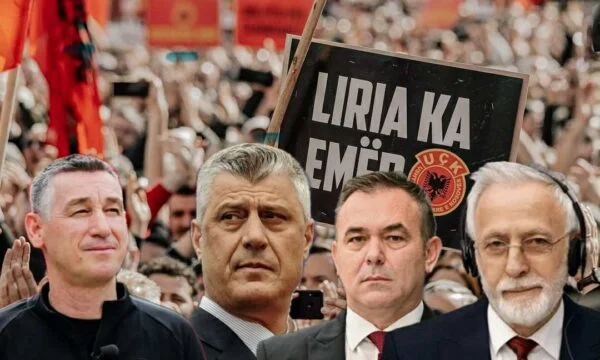
In The Hague, what is also known as the Special Court, the trial against Thaci and three other former KLA superiors are under way: Jakup Krasniqi, Kadri Veselini and Rexhep Selimi.
They have been in custody since November 2020, meanwhile, the trial against them began in April 2023.
The incident, which charges them with responsibility “personale”, but also for “crimes committed by their subordinates”, aims to convict them of crimes against humanity and war crimes, including the murder of more than 100 victims, and for illegally keeping in custody and for torturing hundreds of victims.
The Special Court, founded in 2015 by the Kosovo Assembly, investigates the alleged crimes of KLA members committed against ethnic minorities and political rivals from January 1998 to December 2000.
Thaci, former Kosovo president; Krasniqi's Veselini, former prime speaker; and Selimi, former allies, have been declared innocent of the charges.
During the Kosovo war, Thaci held the role of the KLA political leader, Wessel was the head of the intelligence service, Krasniqi the spokesman, while Selimi was a member of the General Staff.
KLA, according to SPS
The specialised prosecutor claims the KLA was a structured organisation, with a chain of command up to Thaci.
According to legal expert Mark Ellis, the international “law on command responsibility and joint criminal enterprise does not necessarily require a common military hierarchy”.
He says “needs effective control or a functional organisation to implement a joint plan”.
Ellis claims judges will consider whether Thaci and others had effective control over those allegedly committed abuse.
According to him, the exam on the existence of a formal or actual hierarchy é, as well as the definition of each defendant's role within it will be crucial to establishing criminal responsibility.
“was the uprising against occupation”
The role of four KLA representatives who are being tried at the Special Court has not been described in the indictment, which has been brought against them by the Special Prosecution, estimates Ahmet Isufi, former commander The KLA in the Karadaku Operative Zone was one of seven operational areas where the KLA claimed organisation.
No responsibility has been placed in the role of the commandment, command, or manner of the prosecutor”, says Isufi.
According to him, Thaci's defence witnesses have in their testimony presented the reality of the war in Kosovo and its causes.
The KLA war, Isufi says, was organised without the previous experience of a regular army, but it was largely voluntary and protective.
The KLA's organisation and war, he considers it a <x0-prison, which has not endured the occupation that then Serbian power exercised”.
“Normically, as such, could not be at the level of a regular army. But NATO's attacks have also taken place in order to help the people of Kosovo, in this case also the KLA, in order to establish Kosovo's freedom”, Isufi says.
Similar thoughts are shared by Bujar Dugolli, professor of modern Albanian History at Pristina University.
According to him, the four KLA superiors, who are being tried at The Hague, have had certain tasks, but not roles attributed to determining merits for the development of the KLA.
Dugolli takes an example of Thaci, who, according to him, was the leader of a political directorate at the time, he says, the General Staff. The KLA has been more consolidated, at the end of 1998 and early 99.
But, Dugolli claims neither Thaci himself has ever said he is founder or leader of KLA.
This has never been true. Some have written books, to please him, perhaps [due to] his political or institutional position in the state. But the truth has been this way, and history knows this truth”, he says.
Thaci took up the post of Kosovo prime minister in 2007, meanwhile from 2016 to 2020 he served as president of the country.
What the Witnesses said about KLA?
Thaci's defence began presenting evidence this year. Her strategy was to argue that the KLA did not have a clear command structure, and that Thaci's role was political, but without authority over military operations.
In this direction, at least three of Thaci's defence witnesses describe U n CK without a literal hierarchy.
Former US Assistant Secretary of State James Rubin said during his testimony on September 16th that the KLA was without “control and effective command”.
According to his testimony, in June 1999 there was no functional interim government in Kosovo, nor a organised KLA General Staff.
“They often exaggerated it to create the impression that they were more organized than they really were, and to show that they embraced democratic principles”, Ruby said.
US special envoy during the Kosovo war, Christopher Hill, described him in his testimony on October 10th, U n CK is an organization without a vertical structure and no hierarchical organization.
Retired US General Wesley Clark, who led NATO's air campaign against Serb military targets in 1999 in his testimony, October 17th, described it U n CK as independent groups motivated to fight, but without chain of command.
“I had no doubt that the Serbian Army was afraid of them, but [the KLA's] command and control or a co-ordinated force I have not seen”, Clark said.
He also stressed that he was unaware of a KLA General Staff.
However, in closing his testimony, Clark said the KLA was not a terrorist, as Serbian generals had described, but that its members fought for their freedom.
“These are people who fought against an unjust, illegal regime that deserved to leave and replace”, he said.
Narration for KLA facing alternatives
Dugolli does not think that the testimony of Thaci's defence witnesses to the Special Court changes history's KLA organisation and its role in the Kosovo war.
According to him, The KLA was a voluntary army of Kosovo Albanians, who decided to oppose Slobodan Milosevic's Serb regime, which oppressed Kosovo Albanians during the years ' 90s.
Dugolli claims that the thread of The KLA is in the first cells in early 90. But he remembers that this army has its stages of development.
The murder of the first KLA commander, Adem Jashar, in March 1998, by Serb forces, resulted in a major mobilization of Kosovo Albanians to join U n CK and to oppose Milosevic's regime, Dugolli emphasises.
This military structure, as he calls the KLA, has been in construction and consolidation, in particular in late 1998 and early 1999.
There were no stages of construction and consolidation. But about what many say about control... The absolute control could not be in any war, let alone in a war with an army that was guerrilla, was voluntary and was, as it were, small in number”, he says.
He adds that the KLA has managed since several small groups in its beginning to become an organised army, with operational zones, with a command structure, but which was not linked to a name or an individual command.
However, Thaci defence witnesses have a right to their assessments, if they compare U n CK with armies of consolidated states, Dugolli claims.
Absolutely, they don't perceive it that way, because they know what the structure of an army is... This, of course, the military, such as Mr. Clark, is very well discovered because it cannot be considered [ The KLA as an army] literally means, according to the international military criteria”, Dugolli says.
He adds that Kosovo, during the years of 1998 and 99, has been a country with the high presence of Serbian forces, and with very great pressure on their part.
In this direction, according to Dugolli, KLA activity “was very limited in terms of control and hierarchy, as well as communication within” a location and between different areas where it claimed organisation.
The medicine, however, maintains that the testimony of Thaci's defence witnesses, but also the statements of the accused themselves, leaves room for alternative narrators to challenge the heroic “war crimes and deglarification of KLA fighters at war”.
“This could affect the fainting of the uprising and weaken the possibility of its political use on the part of political currents identified with the KLA war”, he points out.
The trial against the KLA four is going to an end.
In mid-February of next year, the parties will present final statements, and then the case will be passed to the judges, who will decide their fate./Periscopi/