15 minutes ago
REL: Working parallel structures work both from home and near border points after their closure
Periskopi(a year ago)
(a year ago)Work both at home and from a border town in Serbia. This is Milos' case from northern Kosovo now and several months after Kosovo authorities have closed the institution where he worked, arguing that his activity, within Serbia's system, has been illegal. Once or twice in [...]
Work both at home and from a border town in Serbia. This is Milos' case from northern Kosovo now and several months after Kosovo authorities have closed the institution where he worked, arguing that his activity, within Serbia's system, has been illegal.
Once or twice a week, Milos goes to work across the border, where official Belgrade has moved its institutions after the closure.
His true identity, his institution where he works and his home in Kosovo are known for Radio Free Europe, but he requires that all remain anonymous, fearing he might be charged with “falsification of documents” The way the Kosovo Prosecutor usually characterises it.
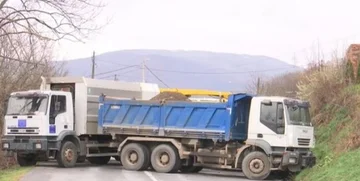
They leave around 7:00 in the morning. Sometimes they are delayed by traffic toll, but the parties look forward to alternative offices, placed in black containers, near border points: Brnjak, Jarinje and Merdare.
Some require certificates or other administrative documents issued by Serbian authorities, and other credit documents in the bank, or similar ones.
During the next three days of work a week, Milos works from house to house in Kosovo.
In September last year, Serbia's president, Aleksandar Vuciq, has said he will not close institutions for Kosovo and has warned of the opening of modern <x0SEr” on the Serbian side of border points.
He has promised more income for those traveling to cover their expenses.
But there are also those who do not go to work after the closure of their institution by Kosovo authorities.
Petri from North Mitrovica is one of them. It only goes to the District of Serbia to get the salary, since the Serbian dinar has been removed from use in Kosovo since February last year.
I don't go to work, but my salary comes up in dinars. Perhaps this too has had to be resolved so that our salary can be raised to”, he says.
*The REL talked to some people in the north. Until local Serbs say these measures made their lives difficult, Albanians returning to their homes in the north 25 years after the war see it differently.
Which institutions have so far closed?
Kosovo authorities have continued this year again with the closure of institutions working in Serbia's system, which the official Pristina considers illegal.
On January 8th, the Tax Administration in North Mitrovica has closed one of the four majority Serb municipalities in northern Kosovo.
The Serbian List ʹ the largest party of Serbs in Kosovo, which has Belgrade's support, has said Kosovo authorities have closed its spaces, but not even the tax administration of the Republic of Serbia operating in Kosovo.
After a meeting with about 80 administration employees, she has said they will continue to receive all benefits from the Republic of Serbia budget normally.
Similar meetings, the party has held with the workers of the Directorate for Urbanism, the Directorate for National and Afarist Space, and the Directorate for Construction Land in North Mitrovica, which were closed in late December 2024.
They are promised that they will continue receiving wages and that any kind of support will be offered.
Kosovo has started shutting down Serbian institutions since January 2024, initially locking up the temporary municipal organs of Dragas, Suhareka, Prizren and Rahovec, located south of the Iber River.
Then the temporary municipal bodies of Peja, Istog, Kline, Skyerwright, as well as those in northern municipalities were closed: Northern Mitrovica, Zvecan, Zubin Potok and Leposaviq.
Meanwhile, the Serbian Post Office in northern Kosovo, the Serbian People's Bank safe in Leposaviq, the Post Savings Bank, the Office for Kosovo of the Government of Serbia, the Directorate of the Fund for Pension Security and Invaldor, the Kosovo-Mitrovica Administrative District and the Centre for Social Affairs in Vushtrri have closed.
All these institutions with thousands of workers have worked on Serbia's system.
Serbian President Vuciq has said in mid-September that their closure has left about 5,800 people without jobs, but that they will continue to receive their salaries.
The Office for Kosovo in the Government of Serbia names the closure of Serbian institutions in Kosovo as “the seizure of Serbian property and the option of”.
During the past year, the Kosovo Privatisation Agency has also adopted several objects in the north, saying it has jurisdiction over them.
Some of them, it has rented to Albanian businessmen who have opened food stores, restaurants, pastry or cafes, but local Serb populations, mainly, boycott them.
Also, at the end of 2023, the Privatisation Agency has taken control of the Riceka Banja Resort, near Zvecan, whose renovation and construction are initiated by the Government of Serbia through its Office for Kosovo in 2015.
Serbian officials have said the Serbian government has invested about sevenm euros in the project.
Zubin Potok's municipality has also taken control of residential objects that have been built by means of the Government of Serbia.
In northern Mitrovica, meanwhile, several projects funded by Serbia have been cut off, building a university that would function within the Serbian system.