23 minutes ago
Hasani: A brutal fraud to citizens is said their right to war crimes will be carried out in Strasbourg
Periskopi(2 years ago)
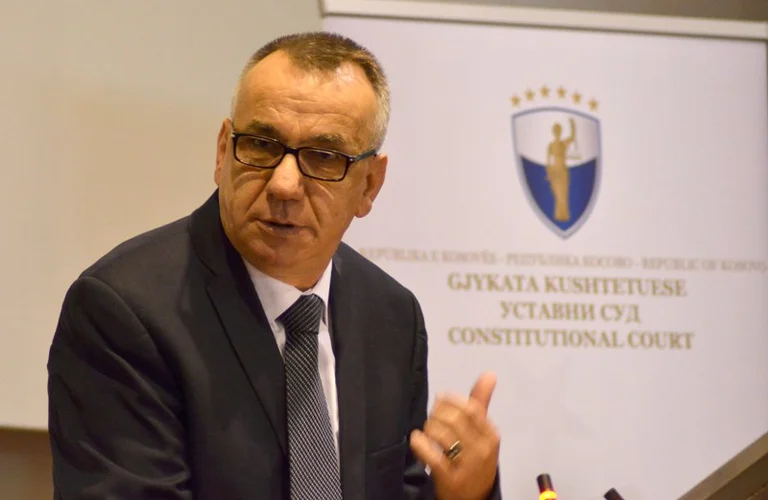
(2 years ago)Law and International Relations Professor Enver Hasani has spoken about recent statements by state officials concerning Kosovo's membership in the Council of Europe. Showing how Kosovars can use membership in the Strasbourg Court, he rejects the possibility of a war crimes indictment there. There is no [...]
This court has no connection to war crimes. Similarly, even the family of the missing cannot sue Serbia for the found persons. That is because this court cannot have jurisdiction for situations and the situation created at the time when Kosovo has not been sovereign and independent”, Hasani points out.
Hasani says Kosovars are being brutally deceived when they are told they can realise their rights in Strasbourg for crimes they have suffered during the war period.
The “is a brutal fraud of people and a game of their feelings when we are said to be promised that after our membership in the Council of Europe, individuals and families hit by war can realise their rights in Strasbourg” he stresses.
Full Interview
Express newspaper: Along with the debate whether or not Kosovo will join the Council of Europe is being discussed on the benefits we will have as a country and as individuals from this institution. The European Court for Human Rights also functions within the Council of Europe. Can you explain how even Kosovars can use this court?
Hasan: Membership in the Council of Europe implies membership in the Strasbourg Court. The benefits are great, both for Kosovo and for individuals. For Kosovo because the Strasbourg Court will serve as an effective reference point for every body and public authority in Kosovo on the occasion of establishing on freedoms and rights guaranteed with the European Convention on Human Rights. As it is known, the Constitution of Kosovo has it in its provisions as a source of law and the European Convention for Human Rights and its protocols, and it obliges all public authorities to, in case of interpretation of freedom and human rights, be based on the practice of the Strasbourg Court. This, however, is quite different from the situation that comes after our membership in the Council of Europe, when the jurisdiction of the Strasbourg Court becomes effective towards all decisions by the Kosovo State public authorities. This court will then serve as a constitutional court Sui Geners in relation to the Kosovo authorities' decisions. To date, the decision-making of Kosovo authorities has been based on the provisions of the European Convention for Human Rights and the practice of the Strasbourg Court. There has been no controlling filter on how to establish European standards for human rights and freedoms.
Individuals, groups of individuals and nongovernmental organisations will also have unique opportunities to address their demands for violations of human freedoms and rights on the part of public authorities in Kosovo. The same applies to Kosovo as a state, which can sue other states if it considers them violating the provisions of the Convention on Freedoms and Human Rights. This procedure, known as interstate procedure, is very rare (in fingers is counted when Council of Europe member states have indicted each other).
In all cases as mentioned above, there are long-term jurisdictional restrictions, hurt, personal and territorial, usually imposed on the states that are associated with the Council of Europe. This means that not every case can be the object of a request to the Strasbourg Court. To be such, the demand must have been submitted by parties with active and passive legitimacy, to have to do with a freedom or a right guaranteed with the European Convention on Human Rights, and to fall under the territorial and time jurisdiction of the contracting parties of this convention.
Express newspaper: Kosovo's president said that with Council of Europe membership the family of the missing would have the right to sue Serbia, and that most of this membership would benefit citizens who have been denied justice for 25 years now? Could this be the war crimes tribunal that has been committed in Kosovo?
Hasan: No. There is no possibility that Kosovo would sue Serbia for war crimes and similar ones committed in Kosovo during the war, for simply not falling under the jurisdiction of the Strasbourg Court. This court has nothing to do with war crimes. Similarly, even the family of the missing cannot sue Serbia for the found persons. That is because this court cannot have jurisdiction for situations and the situation created at the time when Kosovo has not been sovereign and independent state. The key words here are jurisdiction, in four forms as above (compressor, hurt, personal and territorial). This becomes clear that in the first article of the European Convention on Human Rights, which speaks of jurisdiction in all forms of its manifestation. As it is known, this article stipulates that contracting parties should ensure the freedoms and rights guaranteed by the Convention, both for physical and legal persons, who fall under the jurisdiction of one of the contracting parties. The jurisdiction also implies public authority exercised outside sovereign territory but is effectively controlled by any of the contracting parties, such as territories under occupation. There have been cases when Great Britain and several Council of Europe member states have been parties to violating the Convention in territories occupied by them, such as. Iraq.
Kosovo does not fall under any of these situations: Kosovo's independence has been created on February 17th 2008, while events occurred at the time of armed conflict between Serb forces and the Kosovo Liberation Army and the armies of NATO countries through 1998-1999. In this period, Serbia has exercised jurisdiction over the territory of Kosovo and the subjects of law in it. Serbia's indictment for this period can only be made if individuals indictees are represented as Serbian citizens, but even then only after the internal legal means have been exhausted -- namely, after the plaintiffs from Kosovo have indicted the Serbian State through Serbian courts in Serbia. This, however, remains only as a theoretical outlet, because they have spent time and, even if someone wants to, cannot sue Serbia on this basis, namely as Serbian citizens. The indictments and judicial procedures in Kosovo after June 10th 1999 are not considered Serbian jurisdiction, because that jurisdiction has been suspended until February 17th 2008, but after that date, according to international jurisdiction law on Kosovo does not exist at all.
All of this turns out to be a brutal fraud of people and a game of feelings when we are said to be promised that after our membership in the Council of Europe, individuals and family members affected by the disasters of war can realize their rights in Strasbourg.
Express newspaper: The justice minister speaking about the Government's plans to sue Serbia for genocide said she cannot share more information. On the other hand, she stressed that Kosovo's membership in the Council of Europe opens to Kosovo many ways and that after membership actions will also be assessed as the Council of Europe used as a mechanism for establishing justice. How can the state use this Court for Serbia's crimes?
Hasan: As I have said several times these last three years, I repeat here: any genocide indictment against Serbia would be a gift to the regime in Belgrade; such an indictment constitutes a deeply antinational act. This is so about the fact that such an indictment a priority It is tried in failure and, as a result, serves as atoning of Serbian guilt for genocide, war crimes and any other crime committed in Kosovo. Put otherwise, with such an indictment, Serbia will gain an internationally recognised confirmation that it has not committed genocide and war crimes in Kosovo. It's found, it's about Serbia as a state, not individuals who have been Serbia's political and military leaders and who have been convicted of war crimes and crimes against humanity committed in Kosovo.
Of course, the Strasbourg Court is not competent to try and deal with genocide and war crimes committed in Kosovo during 1998-1999. No relief or assistance can offer this court as regards genocide crimes, war crimes, and other crimes against humanity and international humanitarian law. Anyone who says otherwise plays the feelings of unfortunate people who have suffered in the last war in Kosovo.
Express newspaper: Prime Minister Albin Kurti stayed in Germany during the past week, where they urged ways for Kosovo's support to become a member of the Council of Europe. An idea that came out of discussions with German deputies, as reported, was that the draft State for Association assess the Council of Europe lawyers in order to meet the QUINT condition for Kosovo's membership vote. Can these lawyers replace the Constitutional Court? How did you guys see that?
Hasan: Such a step would be unacceptable because it would depreciate any dimension of Kosovo's sovereignty. This is the same as allowing the formation of an arbitrage mechanism for judging disputes between the central power of Kosovo and the authorities of the Community of Serbian municipalities, expected to be created after our membership in the Council of Europe. The community can also be created before our membership in the Council of Europe if Mr. Albin Kurti shows gesture of goodwill. If not, then it is worth his pledge, Vjoussa and Glauk, which they have taken over on behalf of Kosovo State in the case of embracing the Bakoyannis report and the recommendations of the dominant lawyers. Whatever the case, I repeat, any assessment of the constitutionality of the draft-Status of the EU, which was drafted by the authorisation of Albin Kurt by European lawyers, would be deeply unconstitutional, an anti-state act that permanently violates the country's sovereignty. Let me refresh your readers' memory that, according to the 2015 Constitutional Court of the Republic of Kosovo's Constitutional Court, the obligation for constitutional control of the draft-Stitut is a clear constitutional obligation, the obligation that cannot and should not meet anyone other than the Government and Constitutional Court of the Republic of Kosovo.