3 minutes ago
Evidence suggests Russian counteraircrafts hit a passenger plane before it crashed
Periskopi(a year ago)
(a year ago)When a plane of 67 people on board crashed on land on the coast of Kazakhstan on the morning of December 25th, the media and Russian authorities moved quickly to emphasize potential causes: thick fog, bird collision, and an explosion of a oxygen tank in the cabin. However, increasing evidence suggests [...]
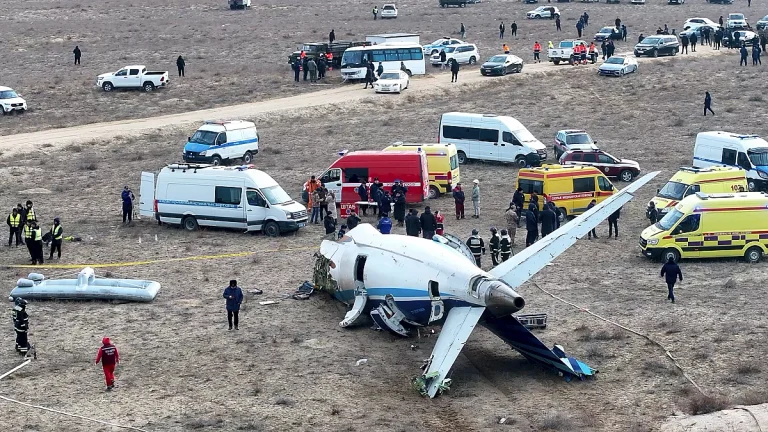
However, more and more evidence suggests that Azerbaijani Airlines, which was bearing fruit from Baku to Grozni, capital of the Russian region of Chechnya, may have been hit by a rocket in an antiaircraft that was being protected against an alleged Ukrainian attack on Chechnya before crossing the Caspian Sea and crash near Aktau in Kazakhstan, leaving 38 travelers and crew members dead.
The evidence, most of which were not confirmed by authorities in Azerbaijan, Kazakhstan or Russia, includes images from the inside of the plane before its crash, photographs showing holes in the plane's tail after the crash, comments of a survivor, and evidence suggesting that he was suspected of an attack with fear at the time when the plane tried to land at Grozni.
If confirmed that the ground-air missile is the cause of the crash, then it would be the second time a Russian missile has crashed a passenger plane since the beginning of Moscow's war in Ukraine with the invasion of the Crime Peninsula and the conflict in Donba a decade ago, reports Radio Free Europe
A Russian missile that had been brought to territory controlled by forces based in Moscow in Donjeck crashed Malaysia Airlines' MH17 aircraft on July 17, 2014, killing all 298 travelers and crews.
After the fall, Russia issued a hail of false claims and strange theories due to the trigger.
Military analyst Yan Matveyev told Cohort Time that the explosion of a Russian missile Pantsir S-1 at a distance from the body of the aircraft could have caused these damage.
In addition, the inside images of the plane before crash indicate considerable damage.
According to The Wall Street Journal, the headquarters aviation safety firm in Great Britain, Oprey Flight Solutions, said at an alarm for airlines that the plane “was probably crashed by a Russian military air defence system”.
“The video of the plane crashed and the circumstances about the air space safety environment in southwestern Russia indicate that it is possible that the plane has been hit by some kind of antiaircraft fire”, The Journal quoted Osprey's intelligence chief, Matt Borie.
The plane “crashed by a Russian air defence system”, wrote Andriy Kovalenko, head of the Anti-Dezinformation Centre at the Ukraine National Security and Protection Council, in an X post on December 25th.
It provided no evidence beyond images, media reports and information from existing open sources.