 an hour ago
Hasani: Outgoing leadership of mayors conflicts with Kosovo Constitution
Periskopi(3 years ago)
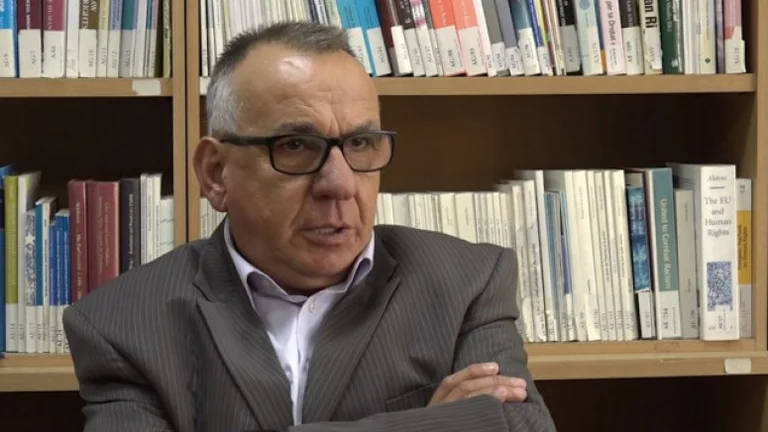
(3 years ago)The former head of the Constitutional Court of Kosovo, Enver Hasani, has said an administrative guide issued by the Ministry of Management of Local Power for the removal of mayors from office is contrary to the Kosovo Constitution. He relies on the lack of a Civil Initiative Law or referendum. Among other things, Hasani, currently [...]
The former head of the Constitutional Court of Kosovo, Enver Hasani, has said an administrative guide issued by the Ministry of Management of Local Power for the removal of mayors from office is contrary to the Kosovo Constitution.
He relies on the lack of a Civil Initiative Law or referendum.
Among other things, Hasani, currently professor of Law and International Relations at the University of Pristina, has said that power is showing a lack of will for resolving the situation in northern Kosovo, and that the resignation of the mayors of four Serb-run municipalities in that part would be the most appropriate decision.
Mr. Hasani, is the new administrative directive for the removal of a mayor in accordance with the Kosovo Constitution?
Enver Hasani: No, for establishing rights and obligations and making them must first be determined by law. The constitution requires law. This is about direct democracy, which is a constitutional category, and the way its implementation is determined by law, is usually called the Law for Civil Initiative, Law for Referendum, or Law for Referendum and Civil Initiative. The constitution shows what it can be and what it cannot be subject to. Then the lawmaker is free to determine these two issues. But these two issues have not been regulated by the Assembly of Kosovo, and as a result, this directive has usurped a Parliament's legal authorisation, and has rated an issue that had to be rated with the Law for Civil Initiative.
What can happen now?
Enver Hasani: I'm pretty sure that if you end up in the Constitutional Court, this law goes down for the reasons I told it, but for the next reason, that the administrative directive with the deep content of legal norms has released the administrative body, which is a ministerial dictatorship. This is an open conflict of interest, because this is not about specifying the implementation procedures of a right, but being appointed additional rights by the deputy prime minister's authorisation, then mandated by the Central Election Commission for Election Organising, which can only be done by law, not administrative instruction.
In your opinion, can the CEC proceed with this direction if asked to evacuate a mayor?
Enver Hasani: The CEC, with this directive, cannot proceed because it cannot give orders for the administrative body to proceed, the Ministry of Management of Local Power, because it can only be done by the lawmaker. Nets 70 and 71 [of the Law on Local Self-Government] have legal authorisation, and initiatives for norms and municipal policies are legally established. There are legal provisions for them, for Article 72, and therefore there is no authorisation for administrative instruction. Instructions are issued to enforce a law, a legal standard, and must be authorized by law. Article 72 doesn't speak at all of ministry authorisation, nor government, nor anyone. It's about the law, and the law doesn't exist.
Article 72.
72.1 citizens of the municipality can take initiative to evacuate the mayor.
72.2 Such demand must be signed by 20 per cent of registered voters and handed over to the mayor of the municipality assembly, which presents the issue to the relevant institution for voting management.
72.3 If the majority of registered voters vote for the mayor's departure, the new mayoral elections must be made in accordance with the Law on Elections.
Under the Law on Local Self - Rule, early elections for mayors are held on three occasions: if the mayor resigns, if citizens ask for his dismissal through petition, and if the mayor doesn't appear in the workplace for more than a month, for no reason.
Enver Hasani: The departure through the petition has two stages. The first phase is 20 percent initiative, and the second phase is the phase of election organisation. Where they are organized, the question should be asked: Yes or Jo” That's how it is formulated. This formulation cannot be made by the administrative body, the Ministry of Management of Local Power. It's just the law, it has to be the law. This can't be done with guidance.
“Directions apply to all Kosovo municipalities”
What, though, if this instruction is advanced, can it have an impact on other municipalities?
Enver Hasani: That directive is seen as being made by people who know justice, despite being unconstitutional and illegal. It does not apply only to northern municipalities, it applies to all of Kosovo. Through such instruction, for six months all election results can be reversed, which is forbidden, is totally unconstitutional. That's 45 days. Why is that deadline mentioned, right? There should be legal authorization. Then where is the logic of the CEC's authorisation through the ministry's administrative instruction? The CEC is a organ, it's an administrative body itself. They and the Ministry of Management of Local Power are equal before the law. They apply the law directly. They get guidance from the law, not from one another.
What do you think is the right way out of the situation in the north?
Enver Hasani: This is the issue of lack of political will on the part of power. If power wanted to fix this, the matter would be forgotten. He could sit down with the opposition and say we made a choice, we held elections as Constitution and law told us, and as our international friends supported us. Our friends don't consider, according to the standards of their states, this result, and we're being delegated.
I think Kosovo is not doing itself a favor. You may be told [the mayors], or don't go to work for a month or quit. Much more dignified is to resign from work than to leave with a signature. For in that way, power is only opposing its subjects for five to six months, that they are legitimate. They're not legitimate in there. They are legal, according to Kosovo's laws and Constitution, but the legitimacy there is zero. / REL











