4 minutes ago
Confusion as much as possible: Kosovo institutions still without clarification if NATO has new demand for sending police to the north
Periskopi(3 years ago)
(3 years ago)None of Kosovo's institutions have yet clarified whether NATO and its peacekeeping mission in Kosovo, KFOR, have eventually any new requests regarding the sending of Kosovo special police to the north -- the Serb majority populated area. The dilemma if this police should get KFOR's approval for dislocation [...]
The dilemma if this police should get KFOR's approval for deployment there, was set up the day before, following a statement by NATO Secretary General Jens Stoltenberg.
Referring to a 2013 document in which the Government of Kosovo vows to NATO that it will not locate the Kosovo Security Force in the north without consultations with KFOR, Stoltenberg has said:
“We expect consultations on any action of Kosovo security forces, the Kosovo Police, which may have an impact on security. Every Special Forces landing requires KFOR's approval and needs close consultation between Pristina authorities and KFOR”.
Asked by journalists whether this implies new conditions for Kosovo, Stoltenberg has denied it.
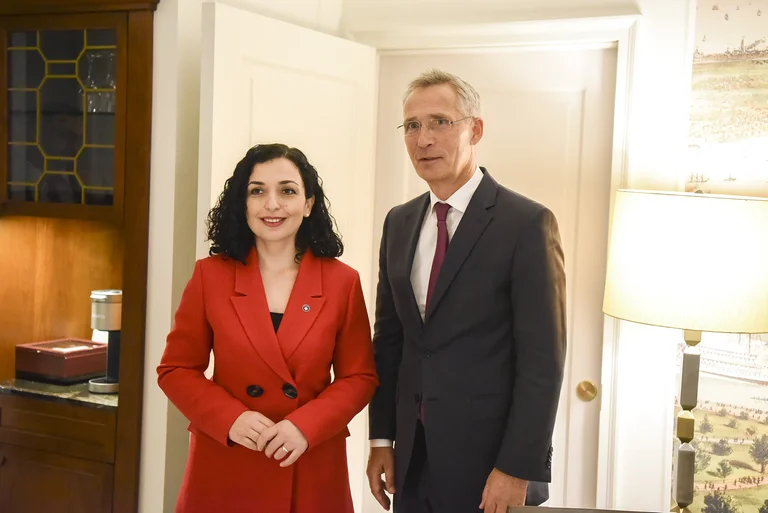
He has made comments at a joint media conference with Kosovo President Vjosa Osmani in Brussels.
For more clarification, REL contacted NATO and an official, in their written response, has said the secretary-general has made it clear that “has no new request”.
“needs close co-ordination and consultations between authorities in Pristina and KFOR for any delocation that could affect our position and security in Kosovo”, he has said.
Stoltenberg has also made it clear that “we expect timely and meaningful consultations on any action of the Kosovo Security Force or the Kosovo Police that could affect the security environment”, this NATO official has said.
With a request for additional clarification, The REL has also turned to the Office of the President of Kosovo, the Office of the Prime Minister of Kosovo and the Ministry of Internal Affairs of Kosovo, but no institution has received answers.
The President's office suggested it. The REL to be referring to Osman's statement during the Media Conference with Stoltenberg, as well as to the president's chief of staff interview, Blerim Vela, for the Kosovo Clan Television.
Osman in Brussels has said that the 2013 document “focuses only on the Kosovo Security Force”.
Similarly, Vela has confirmed that “Osman has clarified to Stoltenberg that the 2013 document focuses only on the Kosovo Security Force”.
I cannot judge whether Stoltenberg's statement was confusing or deliberately involved. But there has been an agreement that this [document] applies only in relation to KSF”, Vela has said.
Official Belgrade, which continues to reject Kosovo's independence, declared in 2008, has commented on Stoltenberg's statement. President Aleksandar Vuciq has said he hopes it “will have influence, if not [Kosovo Prime Minister Albin] Kurti, then at least some others, to EULEX [EU Commission in Kosovo] and to KFOR's behaviour”.
KFOR has been deployed in Kosovo after the war in 1999, and is responsible for security in the country.
What does the 2013 document say?
In the letter-off that then Kosovo Prime Minister Hashim Thaci has sent to then-NATO chief Anders Fogh Rasmussen, he, on behalf of the Kosovo government, has offered “garan that the Kosovo Security Force will have the opportunity to take action in northern Kosovo only in co-operation with KFOR”.
Letters from 2013 between then Prime Minister Hashim Thaci and former NATO Secretary-General Andreas Fogh Rasmussen, where Thaci promised that the KSF will not go north without KFOR's consent.
This “pledge reportedly agrees fully with Kosovo's existing obligations against NATO, which the Government of the Republic of Kosovo is seriously implementing”.
Also, the document notes that the Government of Kosovo is clear that KFOR, in fulfilling its mandate, could engage with legitimate representatives of the local community in northern Kosovo, as part of a regular co-operation process.
Warning for a new request?
Shkat Balaj, an researcher at the Kosovar Centre for Security Studies, believes that Stoltenberg's statement, taken into account the level of the organisation he runs, “has nothing to do with anything”.
I think this [declaration] is in the wake of the international community's migration in general, for the situation that was created in the north of the country in recent years. It is no longer secret that they are not satisfied and that they do not support the deployment of Kosovo Police Special Forces to maintain order and security in the country's north”, Balaj tells Radio Free Europe.
According to him, Stoltenberg's statement is a message for Kosovo institutions to withdraw special police forces from the country's north.
Balaj says he sees the NATO chief's statement more as a kind of warning of a broader co-ordination of Kosovo institutions with KFOR when it comes to actions and commitments in the north.
This can be read more as a message or request that is potentially intended to represent NATO either, in general, the international community. But, to do something concrete, I think a concrete deal is needed, such as paper exchange.
[of 2013]
, who has then continued to be recognised as an official agreement”, Balaj says.
Tensions in the North
The Kosovo north, inhabited by Serb majority, is constantly the hearth of the riots.
Residents there do not obey the decisions of Kosovo institutions, but those of Serbia, operating in the area through parallel structures.
Tensions are now high due to local power taking over from representatives of Albanian parties.
Albanian leaders have emerged from the extraordinary April elections, which the local Serb population has boycotted.
They have entered municipal offices in late May, under the escort of Kosovo special police.
Local Serbs have rejected this, and in some cases, they have protested violently.
In an effort to relax the situation, Kosovo authorities have made an agreement with EU representatives on July 10th.
The agreement envisions the withdrawal of Kosovo special police from municipal facilities in the north and organising new elections in the four municipalities there: Northern Mitrovica, Zvecan, Zubin Potok and Leposaviq.
So far, the Government of Kosovo has said it has withdrawn half of the special police forces from municipal facilities, as well as is in the process of organising elections.