
“Endidia is now on Monday”, said India's prime minister, Narendra Modi.
All past missions in the moon have arrived at the equator, but exploring the southern political is the key to finding water.
India also became the fourth country in history to go to a successful moon after the United States, the Soviet Union, and China.
India's successful landing comes just a few days after Russia's Luna-25, which was headed towards the same lunar surface, lost control and collapsed.
India will now explore part of the moon, which scientists believe can contain frozen water and valuable elements.
Russia's renowned spatial programme again shames
An earlier Indian attempt on this mission had failed in 2019.
Speaking hours before successful landing Wednesday, former Indian space chief K. Sivan, said the latest photos aired by the ship had shown signs that even the last leg of the trip towards the southern moon policy would succeed.
“is giving us some encouragement that we will be able to achieve the landing mission without any problems”, he told the AFP news agency.
Sivan added that the Indian Space Research Organisation (ISRO) had made corrections following the failure of four years ago, when scientists lost contact with the spacecraft some moments before the planned landing.
Mission to launch India Space Ship Fails
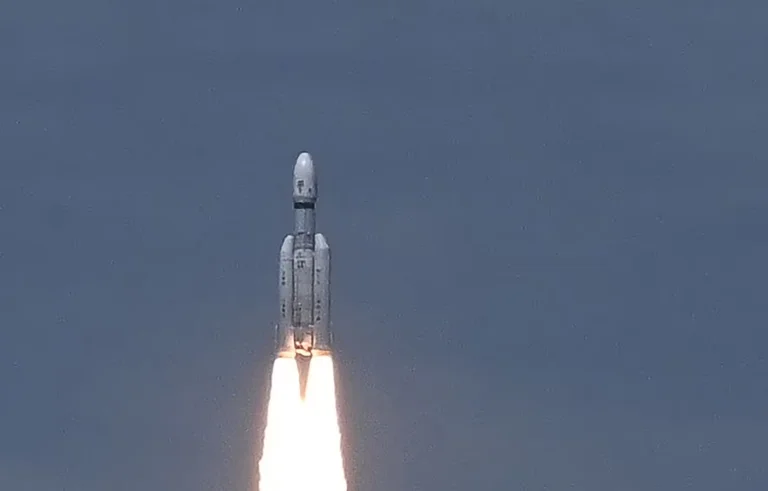
The mission was launched nearly six weeks ago before thousands of spectators, but it took much longer to reach the moon than those of Apollo missions from 1960 and 1970 that arrived in a few days.
India is using missiles far less powerful than those used by the United States at that time, which means that the probe must turn several times on Earth to gain speed before starting its month - long lunar trajectory.
The space ship's groundman, Vikram, broke out of its driving module last week and sent images of the moon's surface since entering lunar orbit on August 5th.
The day before the landing, I The SRO said on social networks that the landing was continuing according to plan.
“The quiet trend is continuing”, the agency posted on the X platform, previously known as Twitter.
India has a relatively small airspace programme, but this programme has increased significantly since the country first sent a probe into the orbit of the moon in 2008.
This last mission cost India 74.6 million dollars, much less than other countries.
India Prepares for Moon's Historic Mission
Experts say India can maintain low costs by copying and adapting existing spatial technology, and thanks to the large number of very skilled engineers paid less than their foreign counterparts.
In 2014, India became the first Asian country to put a satellite in orbit around Mars and plan to launch a three-day mission of people in orbit of Earth until next year.
Sivan, former head of ISRO, said India's efforts to explore the southern lunar pole would make a very, very important “contribution to scientific knowledge”.
Only Russia, the United States and China have achieved a controlled decline in the lunar surface in the past.
Russia launched its lunar probe earlier in August, the first for almost half a century. If it were successful, Chandrayan-3 would have defeated him for just a few days in the mission to become the world's first country to make a controlled landing around the southern lunar policy. Russia engages in race for moon water
But, the Luna-25 probe collapsed on August 19th following an undeserved incident while preparing for a discount.
Sanctions since the beginning of the war in Ukraine have affected Russia's space industry, which has also been surrounded by corruption and lack of innovation and partnership. / REL/