16 minutes ago
DW: Western Balkans, unfulfilled promise of EU membership
Periskopi(3 years ago)
(3 years ago)20 years ago The EU promised membership to Western Balkan countries. That promise has not yet been realized. Brussels is tired of expanding and political elites in candidate countries lack the will for reforms. When the heads of state and government of EU countries in June 2003 met in the Greek tourist town of Porto [...]
20 years ago The EU promised membership to Western Balkan countries. That promise has not yet been realized. Brussels is tired of expanding and political elites in candidate countries lack the will for reforms.
When the heads of state and government of EU countries in June 2003 met in the Greek tourist town of Porto Carras, they were very much aware of the peaceful Balkans. The Union supports “without any reserve” the membership of Albania, Bosnia and Herzegovina, Kosovo, Montenegro and Serbia, says in the final statement: “The future of Balkan states is in Europe.” This “pressation of Thessaloniki”, which bears the name of the port city near the site where the summit was held, has not been fulfilled today after two decades.
Current importance: In June of last year, EU states made the decision according to historic ones, which despite negative experiences with Western Balkan states, to officially support Ukraine and Moldova as EU candidate countries.
A dinner for the 20th anniversary
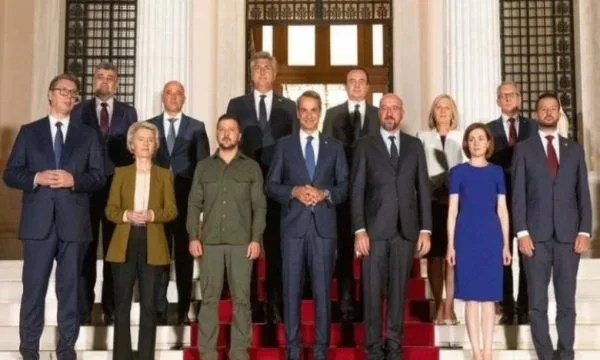
On the evening of August 21st, 2023, Greek Prime Minister Kyriakos Mitsotakis hosted the heads of state and government of six Western Balkan countries, along with EU Commission President Ursula von der Leyeen, to a dinner in Athens. The trigger was exactly “Thessaloniki's default” 20 years ago. Albania's important and influential Prime Minister Edi Rama, according to Greek media, was not invited, because Albania and Greece are currently arguing again hard for the Greek minority in Albania.
This example makes clear why the countries of the Western Balkan region are not EU members for so long. EU member states occasionally exploit bilateral problems to prevent the membership process. Bulgaria once questions Macedonian language and requires involvement in the Bulgarian minority constitution in northern Macedonia. Before that, Greece for decades blocked Macedonia by forcing it to change its name to northern Macedonia so that the neighbouring state could be singled out by the Greek province by the same name, Makedonija. Next time Croatia tries to solve bilateral problems by preventing candidate countries like Serbia, Montenegro or Bosnia and Herzegovina by threatening to veto the EU.
EU enthusiasm in more and more contraction
The situation has long been pending in terms of EU membership. Especially in Serbia, the biggest and most important strategic country in the region, has left deep traces: In a representative survey of the summer 2023, only 44 per cent of respondents prefer their country's EU membership, 47 per cent oppose it. In another poll by the Demostat Institute in June 2023, only 23 per cent of citizens agree with Brussels' request that Serbia as an EU candidate should join sanctions against Russia. While 42 per cent say, their country should maintain good relations with Russia, even if it cannot afford EU membership.
German Chancellor Olaf Scholz and France's President Emmanuel Macron last year launched a major initiative to reach a compromise in the ongoing dispute between Serbia and Kosovo. Even the EU Commission committed itself with all its political burden to mediating between the two sides. EU External Policy Commissioner Josep Borrell after continuing talks even declared: “We have a deal!” But the opposite actually happened. Both sides escalated the conflict, which again threatened to escalate into armed clashes.
Even after two decades, reforms have remained as an open site in the countries of the region as well as 20 years ago. Desensed and centralised media, instrumentising justice, destroying independent state institutions, widespread dramatic corruption and organised criminality. However: How can the EU act against these circumstances, at a time that within the EU's own ranks is difficult to halt control over media, justice and opposition, as found in Hungary and Poland, EU member states?
So it is no apparent coincidence that Hungarian Prime Minister Viktor Orban the Western Balkans in general and especially Serbia has chosen as partners. Serbia's president, who decides on everything Aleksandar Vucic, openly expresses his assessment of the Hungarian prime minister's style of government and political concepts. Both politicians in more than 40 meetings maintain close contact. Vuciq expects Hungary to ease Brussels' pressure on Serbia for reforms. Orban, in turn, expects Serbia to help Serbia take a key role in the region.
Failure to keep the promise of bringing Western Balkan states to Brussels has been replaced for rounds of new conferences. Example is Balkan summit - The EU, which has been held annually since 2014 under the slogan “The Berlin Process”. Or the initiative, established since June of this year by Austria in the format named “