8 hours ago
Osman meets Hovenier, talk about Kosovo-Serbia dialogue and extension of situation in the north
Periskopi(3 years ago)
(3 years ago)As the President's Office reports, the process of Kosovo-Serbia dialogue was discussed at the meeting, the situation in the north and the continuation of co-ordination with international partners. Not rarely, the dialogue between the Republic of Kosovo and Serbia, as well as the extension of the situation in the north, were the topics discussed between the President of the Republic of Kosovo, Vjosa [...]
As the President's Office reports, the process of Kosovo-Serbia dialogue was discussed at the meeting, the situation in the north and the continuation of co-ordination with international partners.
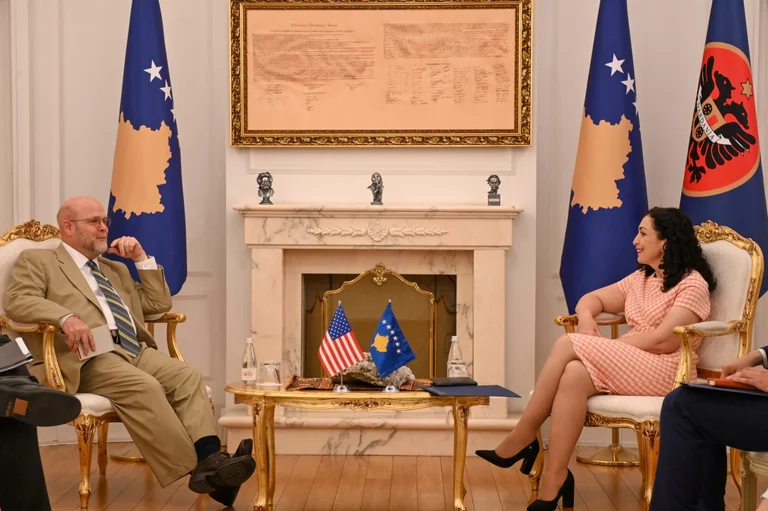
Not rarely, the dialogue between the Republic of Kosovo and Serbia, as well as the extension of the situation in the north, were the topics discussed between the President of the Republic of Kosovo, Vjosa Osmani- Sadriu and US Ambassador to Kosovo Havenier.
As the President's Office reports, continued co-ordination with international partners was discussed at the meeting.
The president of the Republic of Kosovo, Vjosa Osmani, has been hosting today's regular meeting of United States Ambassador Jeffrey Havenier, with whom she talked about developments in the country, with particular focus on the process of dialogue between Kosovo and Serbia. The meeting also discussed continuing co-ordination with partners, knowing that both our institutions and the United States have the same goal of extending the situation north of the country”, the report says.
The EU has submitted three key requirements to Kurti: calming the situation in the north, holding new elections in four northern municipalities, and returning to dialogue for normalising Kosovo-Serbia reports.
Meanwhile, Belgrade is required to ensure that Serbs take part unconditionally in local evental elections.
Kurti has presented a five-point plan, envisioning even holding new elections, but holding them he has said legal state is needed
We remember that, since the end of May, tensions in Kosovo's predominantly Serb-inhabited north have increased after the new Albanian mayors of municipalities entered the municipal buildings with the assistance of the Kosovo Police.
The new leaders were opposed by local Serbs, who have since been holding ongoing protests in three northern municipalities in Zvecan, Leposaviq and Zubin Potok.
On May 29th, a clash occurred between local Serbs and members of NATO's peacekeeping mission in Kosovo, KFOR.
The situation between Kosovo and Serbia has deteriorated further on June 14th, following the kidnapping of three Kosovo police officials, who were released after 13 days from Serbia.
Serbia has said they “were arrested deep within its territory”, but Kosovo has announced they were patrolling on Kosovo's territory, near the border line with Serbia on Leposaviq.
Currently, the same have been released from Serbia.
On the other hand, Deputy Prime Minister Bislimi has held a meeting with emissar Lajcak on Tuesday.
EU Emisari for Kosovo-Serbia dialogue Miroslav Lajcak, according to Kosovo Deputy Prime Minister Besnik Bislim, decided not to have a trilateral meeting in Brussels
In some statements after meeting with Lajcak, Bislimi has said the Kosovo side remains interested in such a meeting.
The “has been what Lajcak's attitude looks like since right now, the trilateral meeting would not necessarily contribute to the finalisation of the documents, because he thinks he still needs additional pre-coordination before that happens, and there are ideas that the sequence plan [of the Base Agreement] requires a high-level meeting, according to him, because clearly the chief negotiators cannot successfully complete this process”, he stated.
According to Bislim, Lajcak's plan, more pays attention to Serbia's requirements and that according to it does not guarantee full implementation of the agreement.
Bislimin has stressed that it has been evident at the meeting the need for working further on concreteising documents, documents that according to him provide a full implementation of the basic agreement.