a minute ago
Documents showing previous US-Russia reports
Periskopi(3 years ago)
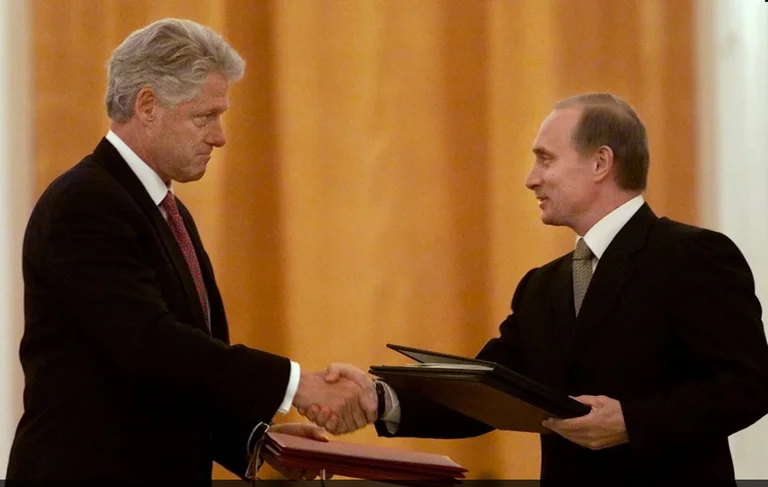
(3 years ago)A day after the Russians voted in a national referendum that served as a vote of confidence for Boris Yeltsin's wavering presidency, his American counterpart made a call. Bill Clinton's conversation with Yeltsin on April 26, 1993, one of several direct conversations and meetings the two leaders had in the months [...]
Bill Clinton's conversation with Yeltsin on April 26, 1993, one of several direct conversations and meetings the two leaders had in the first months of Clinton's presidency was friendly, supportive, and optimistic.
“
“I am really grateful for your smart policy”, Yeltsin replied.
Thank you for calling. It's very important to me personally. Thank you not only for me and my wife, but for all the Russian people”, he said.
The memorandum is the latest in a series of declassified and published by the US National Security Archive.
The documents provide another US-Russia view of relations, which began to deteriorate especially under Yeltsin's successor, Vladimir Putin.
A nongovernmental organisation located at George Washington University in Washington, the National Security Archive, published other declassified documents that shed light on the internal discussions of past presidential administrations.
Along with other files published by former White House advisors, the documents provide information about how US politics evolved and CHA in some cases as well as where the American administrations were wrong in connection with Moscow.
“E has the sense of a lost opportunity on the part of the current Russian leadership”, says Jonathan Elklind, who served as director of the Russian, Ukrainian and Eurasian programme at the US National Security Council in later years of Clinton's presidency.
“... raising complaints, which seem to motivate Putin's policies, ignores the fact that there has been a very co-ordinated effort by President Clinton and his administration to build a better, more peaceful and more stable relationship between the United States and Russia”, says Elklind, now researcher at the Columbia University Centre for Global Energy Policy.
The “la was worth, absolutely, the effort made by the Clinton administration. The success of that venture has been guaranteed, and you can see in some of those documents the uncertainty that has conveyed the whole process: How can someone carefully defend US interests and, at the same time, find a different and better way of engagement with Russia?
Yugoslavia Wars
Yelstin was elected president in June 1991, while Russia was still part of the Soviet Union. In December of that year, when the Soviet Union officially ceased to exist, he became president of Russia.
American officials, including Clinton's predecessor, George Bush, welcomed Yeltsin as a democratic reformer, capable of removing Russia from communism and ensuring the security of the country's nuclear arsenal.
Chosen in November 1992, Clinton was the second president of the United States to whom Yelts interacted with and with whom he developed an extremely warm relationship.
Clinton and Yelts held a call on February 10, 1993, about three weeks after the inauguration of the US president.
The crisis in the former Yugoslavia was the most important in Clinton's agenda. Russia's historic ally, Serbia, was a key war player.
I know this is a very difficult problem for you; I appreciate Russia's historical ties with Serbia and I don't want to cause you trouble at home”, Clinton said, according to the declassified document.
However, if ethnic cleansing is seen as a successful way to address minority problems, then ethnic Russians outside Russia may also be at risk”, Clinton said.
“
Let me tell you again we'll do our best to exploit our influence to convince Serbs. I, simply, want to promise that we will do our best, to pressure the Serbs, especially on [Serbian leader Slobodan] Milosevic”, Yeltsin said.
There is no more sin in our soul”
The Russian leader saw US support as important and began to leave the Soviet economy towards a market economy.
Politics removed price controls and industrial subsidies, but also led to ruble collapse, hyperinflation, loss of pension savings, and, for millions of Russians, misery and discontent.
This led to a deep unpopularness for Yelsin and, in March 1993, the Russian Parliament's Lower Chamber nearly did not vote for distrust against him.
Less than a week later, Yelts traveled to Vancouver to meet with Clinton, their first face - to - face meeting since Clinton's election.
Before the meeting, US Secretary of State Warren Christopher wrote a document to prepare Clinton for the meeting. According to the declassified document, he warned Clinton that the most difficult and important foreign policy problem of your presidency “is Russia's ongoing “transformation and implications on the national security of the United States”.
The crisis in Bosnia was a politically sensitive “issue”, on which Clinton should focus, Christopher wrote. As another concern, he cited “raditional technology reports” and “bringing forces [result] into some of the new independent states of the former Soviet Union”.
Western officials feared that Soviet disintegration and Russian instability would lead to the smuggling or stealing of nuclear technologies. The United States and other allies also worried about the conflicts that erupted in countries such as Nagorno Karabaku, Abkhazia and Transdnistria, and the roles Russian forces can play.
The Russian political crisis is certain to limit Yeltsin's ability to reach new agreements, even when they are clearly to benefit Russia”, Christopher wrote.
At their first meeting in Vancouver at a work dinner on April 3, 1993, warm relations between the two presidents and their optimism appeared. Yeltsin called for US assistance to improve oil infrastructure and Russian pipelines.
If that happens, Yelstin said: “I am sure that, after five years, we will compete in art, jazz, oil and we will reach you. I'm really sorry about jazz, I'm not sure about this”.
“Possibly not in jazz”, Clinton, an amateur jazz saxophonist answered. But we must reach you in your rich culture”, he said.