31 minutes ago
The tender for Podujevo: MPHI chief procurement and deputy minister are recommended for contracts

Periskopi(3 years ago)
(3 years ago)The Ministry of Environment, Space Planning and Infrastructure, led by Lieburn Aliu, has announced the winners of the tender that will pave the way for expansion of the national Pristina route é Besi Podujevo. Periscope, has found that companies that are recommended for the contract are close to the ministry's authorities. Days ago, Periscop has [...]
The MMPHI procurement, led by Nexhat Krasniqi, has brought out the winners of the tender “expansion of the national road, Pristina, besie Podujevo”. The winners are owners and managers of several companies with which the official Krasniqi is seen in cafes almost every day.
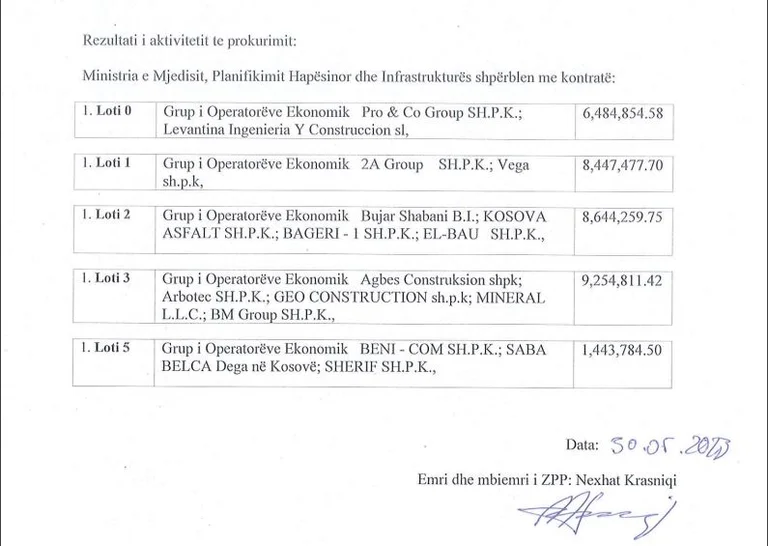
The amount of recommended bids totals 34.2m euros.
For tears 0 is recommended The Economic Operator Group: “Pro& Co Group” Spec; “484, 854, 58 euros.
For tears 1, Group Economic Operators “2 A Group” Exp; “Vega” shpk, worth 8, 447, 477.70 euros.
For tears, 2 Economic Operator Group “Buyar Shaban B. I”; “Kosovo Asfalt” shpk '%; “Bagher-1” far; “El-Bau” Shrik, worth 8, 644, 259.75 euros.
For tears 3 Group Economic Operators “Agbes Building” shpk; “Arbotec” Sharp; “Geo Construction” shpk; “Mineral L.L. C”; “MB Group” Short, worth 9, 254, 811. 42 euros.
For tears 5 Group Economic Operators “Beni-Com” Apple; “Saba Belca” -Dega in Kosovo; “Sherif” Exp, worth 1, 443, 784. 50 euros.
About 25 subjects, mainly companies in the consortium, have been in the race.
Owner of the company recommended for Lot O, “Pro& Co Group”, company “2 A Group” recommended for tear 1, and company manager “Arbotec”, recommended for tears 3, are seen in the cafe in Pristina face-to-face with the MMPHI procurement manager, Nexhat Krasniqi. Even, sometimes all together at a table. They've been seen since this tender was re-evaluated.
It is now no secret that businessman Bujar Shabani is a friend to Deputy Prime Minister Hysen Dumirish. That's Durmish himself. For tears, Shaban company “Buyar Shaban B has been recommended. I”; “Kosovo Asfalt” shpk '%; “Bagher-1” Go.
Selecting Lawless criteria
Unlike at other times, tender Economically more favourable The criteria rarely applied in Kosovo, defined as Thirty-eight million contracting criteria, in which the Infrastructure Ministry in candidate selection claimed for a cost-fixing approach instead of just the price for reward of a contract.
So, the ministry has decided to proceed with the most economically favourable tender (TEMF) and go directly with me. The Value of BidingBut the criteria that he set on Appreciation for Negotiating, are criteria that have to do with another selection process.
The difference between Selective criteria i n Giving Criteria It must be clear, since the two types of criteria are used in different stages of assessment, which serve various purposes.
Criteria should be measured with relative importance, with percentages where all constituent subcreators reach 100 %. So has the ministry.
As seen by The tender file, For the evaluation of contracting, 5 more tangible criteria have been set.
The ministry has defined the reward criteria: 1. Price Which will be valued at 60 points, 2. Experiences of Similar Work - Ten points. 3 Experience of Proposed Main Staff4 points Equipment and Mechanization - Ten points and five. Dynamic Plan - Ten points.
And the subcreators that we're going to clear down.
Periscope found that Three out of five criteria for contract assessment, have to do with selection criteria and as such, did not have to decide for assessmentAfter the Ministry has set the record of contract giving.
What assessment criteria are contrary to the law?
Request: “ It was in accordance with the law.
Request “Company experience (references)” Sets under Article 69 of the Public Procurement Law, it's a criterion of qualifications, and not criteria for contracting.
“ Even this is determined in the 69th article in the LPP and is the qualification criterion.
“ ) is determined in the 69th article at the LPP.
Request for %s “The Dynamic Plan” It was okay.
Selective criteria They apply to determine which economic operators (the bidders or candidates) are qualified and potentially able to meet the contract. They answer the question: “Who can do the job?”
Giving Criteria They apply to determine which tender which meets specifications and requirements (from those qualified and potentially able to conduct the contract) offers the best solution.
Difference in the middleSelective criteria) and Reward Critters It's very important.
Selective criteria focus on “ferator” and input criteria focus on “ference”. A clear distinction between the two criteria should be maintained throughout the procurement process.
What does the law say?
At Article 65, 71 of the Public Procurement Law, there are provisions of the law that link to the company's qualifications.
According to Article 25.5 of the procurement rule, Selective criteria In no way could they use contract - giving criteria, no specific weight, and no evaluation requirements.
Giving Criteria It's defined in Article 52 of this law and it links with quality, price, technical, aesthetic merits, and functional characteristics, environmental characteristics, current spending, cost efficiency, post-species services and technical assistance.
Minimum criteria for qualification (choice criteria) are not used as criteria in the contract-making process. So, as we explained earlier, the Ministry of Infrastructure has used Selective criteria for delivery criteria.
SQARATIONS:
LPP-Deposits Article 51 of the LPP: Recognition Criteria Report
The contracting authority should highlight in announcing the contract and determine in the overall tender file all the selection criteria an interested economic operator must meet to consider as qualified: (i) in case of open procedures and price quota procedures for making a contract; or (ii) in case of limited procedures or competitive negotiations procedures, to accept an invitation to tender. All selection criteria should be limited to the necessary criteria to ensure that only economic operators possessing the necessary professional, financial and technical skills to meet the terms of the corresponding contract will be considered qualified to obtain such a contract or receive a tender invitation. In no case, the contracting authority should include, correct or use selection criteria based on considerations other than those allowed by provisions of the 65-70 articles of this law.
LPP's Article 52: Proliferation Criterations
Only the measurable and preset criteria in the tender file can be used for evaluation. The contracting authority can only use criteria that are directly relevant to contract subjects. Such criteria are but are not limited to: quality, price, technical, aesthetic merits, and functional characteristics, environmental characteristics, current spending, cost efficiency, post-species services and technical assistance.
Procurement Adjusts: Article 25 Selective Criteria
25.1 According to LPP Article 56, an OE will be considered qualified for participation in procurement activity if:
- An OE proves appropriate according to LPP's 65th article by offering required evidence from contracting authority and
- Such an OE, in the event the AK has set the minimum requirement for qualifications, meets such requirements and testifies to it by providing required evidence from the contracting authority in compliance with the articles 64 to 69 of the LPP.
25.2 Observation requirements should always be met by OE.
25.3 The minimum requirements of qualification can be determined by the AK when the AK finds it necessary to ensure that only OE, who possess certain professional, financial or technical skills, will participate in contract competition.
25.4 “Criterity adaptation” and “minimum qualifications” together are characterised as “rs of selection”. The Selection criteria are the requirements an OE must meet to consider qualified to give the public contract.
25.6 all minimum qualifications requirements will be direct relevant and proportional to the contract object in question.
25.5. Selective criteria:
- could not be used as contract-giving criteria.
- can't have certain weights;
- Those are assessment requests, Kalon/Do not pass.
27,3 If the criteria are economically more favourable, the contract should be given to the tender, which best meets the relevant criteria. Besides the AK price may include other relevant contract subject criteria, such as:
- Quality Characteristics
- Operative costs, maintenance and other costs of length
- Functional, technical, environmental, aesthetic or similar characteristics
- Post-Sitage and Technical Assistance Service
27.10 minimum criteria for qualification (choice criteria) did not apply as criteria in the contract-making process. The tenders will be considered to have met the minimum requirements in terms of their capacity to perform the contract, which means that the criteria regarding the company's preliminary and historical experiences will not be seen as criteria in the contract-making process.
D KA UNPTURE EXPLAY?
So, as the Ministry of Infrastructure has seen, Selective criteria and no Giving criteria of: “Experience for similar jobs”, “Experience of the proposed main staff”. In the DT the experience of the best valued bidder and leading professional staff after graduation for the highly esteemed bidder.
The question can be put forward here, even if this criterion is allowed to assess points, By what criterion would it be valued? Which one is best valued?
Also, in the criteria that will have 10 points “Pajises and mechanization”, which is opposed to the 69 LPP article, the DT checks Pass and mechanization of the most owned bidder. Even if this criterion was allowed to be valued, for what devices?
So criteria are defined contrary to the provisions of the Law and the regulation of procurement.
If the law has been violated, it has enabled the ministry to be very subjective.
Although companies have had many requests for clarification regarding the criteria set out in the tender file, none of them have complained about the contract-giving criteria. That's probably because companies don't have much knowledge about the criteria- the reward “The most economically favourable Tent”.
But in other complaints, which mainly concern the machine, the ministry has responded positively, making the required changes.
After declaring the winners, there is expected to be many complaints in the Procureing Organisation O The EPS because only after the assessment/reward will companies understand the ministry's game.
Accounting Authority - MMPHI has also placed subcreators, which have also been weighed and finally collected.
It's about the qualifications of the proposed main staff: Project manager -30 points, head of the workshop -25 points, hydrotechnics Engineer - 15 points, Geodesti -15 points, communications engineer - 10 points, electrotechnics Engineer, 5 points. All personnel have been asked: References to previous jobs in the required permit issued by employers specifying business wine and time period. In either of the points, the number of references, the value of reference, the time period has not been highlighted.
Who would take points in this case?
More than ten procurement experts had given Periscope's findings for violations by the Ministry of Libun Ali.
Unless the law has been violated because illegal criteria for assessment of bids have been set in the tender file, the ministry has violated the legal deadline for assessing the bids. The tender's opening report has been in charge since 24 August, where 68 bids have resulted from about 25 consortiums of companies.
The Public Procure Law has clearly determined when the bidding assessment for a tender expires. In fact, this is defined in secondary legislation at “Rules No. 0012022 for public procurement”. Article 40 of this regulation speaks of the Eczamination, assessment and comparison of the Tenders.
Point 40.3 says the “Procedure for testing, assessment and comparison of tenders, and the release of the announcement on the AK decision, will be carried out by the AK within the shortest possible time period and no more than 30 days from the opening of bids. Only in extraordinary and rational cases, in particular for contracts of a complex nature, can this period be extended for an additional 20-day term. The tender assessment process will begin immediately after the end of the tender opening process”.
So, as we have mentioned earlier, the opening of offers has been made since February 24, or about 90 days.
What's very disturbing is that the institution responsible that oversees the implementation of the LPP, the Public Procureing Regulatory Commission - KCPP has not intervened in this case, even though it is responsible if a Contract Authority sets criteria that are contrary to the LPP, or with secondary legislation
It is inevitable that this institution has not observed this violation on the part of the Ministry, as the tender weighed over 38m euros, and the KCPP has a legal obligation in the event of discriminatory criteria being established to intervene with the Accounting Authority.
This is the first phase of training for use of criteria T EMF, while KCPP, this year will continue to hold the same training, for officials of the Accounting Authorities who are not involved in this training phase. /Mentor Buzhala -Periskopi/