an hour ago
A month of silence over death, of which nothing is known in Serbia
Periskopi(3 years ago)
(3 years ago)His name was Shoib Tasal, and he was 21. He came from Afghanistan. Shoib has lost his life exactly a month ago in Serbia. His death was revealed through a social networking post. There are not yet many details about the case. The organisation “No name kicken”, which helps people move, announced that [...]
His name was Shoib Tasal, and he was 21. He came from Afghanistan.
Shoib has lost his life exactly a month ago in Serbia.
His death was revealed through a social networking post. There are not yet many details about the case.
The organisation “No name kicken”, which helps people move, announced that Shoib Tasal died on the border with Croatia after being hit by a train on April 11th.
Activists urged the followers to help Shoib's parents collect money to cover his body's transport expenses.
“This is the harsh reality of moving life and life at European borders, where people return by force and illegally”, says the post description.
Serbia is located on the so-called Balkan Route, through which people move, fled from war and poverty, hoping to reach European Union countries.
Irina Fehr, a volunteer of “No name kitchen”, told Radio Free Europe that they received information about the death of a young man from Afghanistan from people who were also on the move and that they were later contacted by Shoib Tasal's family.
“We were in close contact with them and helped to organise the body's repatriation and support we could offer to family members mainly included translation, contact with [the community that offers] funeral service and the distribution of the campaign to collect funds on our social networks”, Fer said.
Meanwhile, on the website “Go found at”, the call for donations has been published, in which it is confirmed that most of the collected tools will be used to cover body transport expenses in Afghanistan, while the rest will be sent to the parents of the 21-year-old.
Together we can ensure that Shoib's family can give him a real farewell and find comfort in these difficult times”, says the campaign description.
Irina Ferr explained to Radio Free Europe that the body's return to parents in Afghanistan has been successful, which is not always so, because there are never many deaths of immigrants.
A relative of Shoib Tasal, Faridullah Khorsheid, told Radio Free Europe that Shoib first went to Turkey after finishing the 12th education class in Afghanistan, and then came to Serbia several months ago.
He was aiming for a better life in Europe. Unfortunately, his journey did not go according to plan, and he suffered a tragic death of”, Korsid said, stressing that the family itself does not have much information on Shoib Tasal's death.
It is unknown how the 21-year-old lost his life.
There are various stories about the events that led to his death and we don't know what really happened”, Irina Fehr stressed, in the interview for Radio Free Europe.
The Interior Ministry, as well as the Commissioner for Refugees and Migration, failed to respond to REL's request to confirm and provide more information about Shoib Tasal's death.
Irina Fehr said the organisation “No name Kitchen” has not been in direct contact with police, but that of course [the police] is informed about the case.
Belgrade Centre for Protection and Assistant of Asylums Executive Director Rados Djurovic admits that if death were to occur as a result of a train's crackdown, police would have to conduct an investigation.
Unforgettable Deaths in Serbia
Rados Djurovic said the Centre for Protection and Assistance of Asylum seekers has no record of the death toll along the border and within Serbia's territory. He stresses that it is impossible to know their exact number.
We think that a certain number of people who have changed lives are unknown. They have been reported missing, or friends, relatives from the country of origin or from several European countries where [those relatives] have gone, ask about them, but it has never been proven what happened to them”, Djurovic said.
As he further explained, it is possible that the number of victims will be much larger and that it will never be determined.
“Danub, Drina, Tiza ) these are large rivers in which people can drown when they try to cross the border and such cases have happened, so it is possible that a number of people have never been identified”, Djurovic said.
In addition to drowning in rivers, however, death can be a current, hypothermia, or traffic accident.
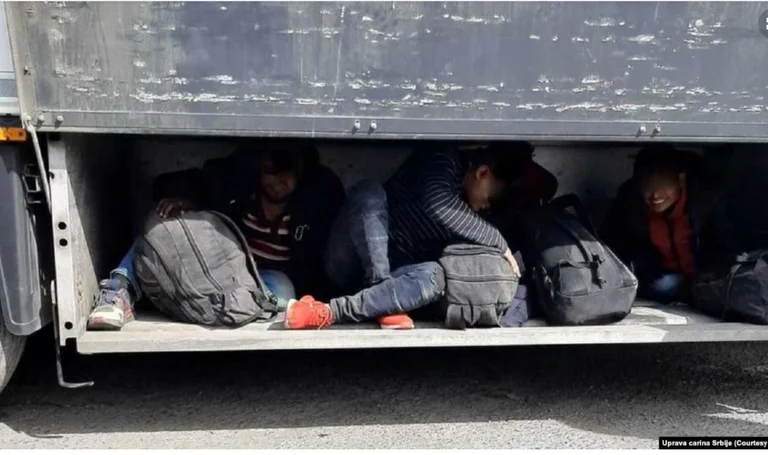
“They have suffered even during transport, standing in closed trucks, in tankers as well as in the same way that people get enough air and get hurt”, Djurovic said.
Milica Schvabiq from the non-governmental organisation “ikactiv” said there is an official procedure in cases of death that must be followed but not respected in practice.
“According to official procedure, with the body being found, it must be transferred to the morgue of the nearest hospital, where the autopsy will take place and if the person does not have ID documents with him, DNA will be taken for analysis and, for comparison later,”, Schvabiq noted.
Then the deceased is buried as an unknown person, with a certain number.
However, in the summer of 2020, we received informal information over the telephone, that very often, when they see it's about migrants or refugees, and that's determined only by physical appearance and skin color, they don't send the body at all for autopsys, they don't take the DNA material, they just send it directly to the cemetery and it becomes a” burial, Schvabiq said.
The Commissioner for Refugees and Migration did not answer the REL question of how many migrants have officially died on Serbia's territory since the beginning of the crisis in 2015.
According to the latest data available from October 2021, about 70 refugees and migrants have been killed or died in Serbia since 2015.
Although there is no new data, activists from the region have created a database “4D”, in which they document immigrant deaths on the so-called Balkan Route.
In 2020, <x0 “lactive” was involved in managing this database. Milica Shvabiq, from this organisation, said the most common data is collected by the media, which does not represent the actual number of victims.
“We recorded the news that was in the media, but also what we learned during field work by other refugees, cases of deaths they reported to us and cases we worked with”, Schvabiq points out.
Over 80 deaths in Serbia have been recorded in the database “4D” until January 2022.
When it comes to global data, according to information from the International Organisation for Migration, the number of victims and disappearances since 2014 is over 55 thousand.
Migrant setbacks do not halt efforts to cross borders
The practices of people returning (from the country they have entered) from countries that cross the Balkan Route are often very violent, Rados Djurovic notes.
Because they are by no means able to return to the country from which they came, a few thousand miles away, often driven by violence, these people are in fact increasingly at risk of success at one moment crossing Serbia's border and continuing on their way to the European Union”, Djurdovic explained.
He underlined that violence does not prevent people from moving forward, but because of violence, immigrants are increasingly at risk and are finding even more dangerous ways to cross the border, often putting their lives at risk. / REL