 39 minutes ago
Women get educated, men get hired

Periskopi(3 years ago)
(3 years ago)In Kosovo's university system, students girls and women make up the largest number, but when it comes to employment, the opposite gender benefits. According to data from the Kosovo Statistics Agency on the labour market, unemployment in Kosovo is higher for women for 25 percent, compared to men [...]
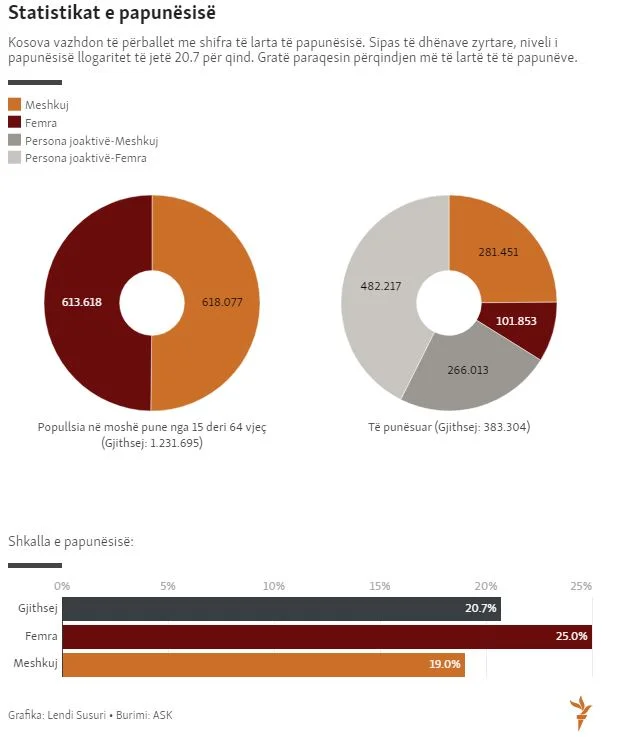
According to data from the Kosovo Statistics Agency on the labour market, unemployment in Kosovo is higher for women for 25 percent, compared to men for 19 percent.
Unemployed is Liridona Ademi of Fushe Kosova, who in 2017 completed studies in management and Business at a private college.
For six years now, 31-year-old shows she has applied several times to private companies, but has so far failed to secure a job.
In all the companies I applied, the criteria were the work experience. I haven't been able to have experience since I haven't. This criteria have constantly penalized me. In the public sector, I have never applied, because it has been established to believe that you must have relatives or family members to ensure such a position,” says Liridona.
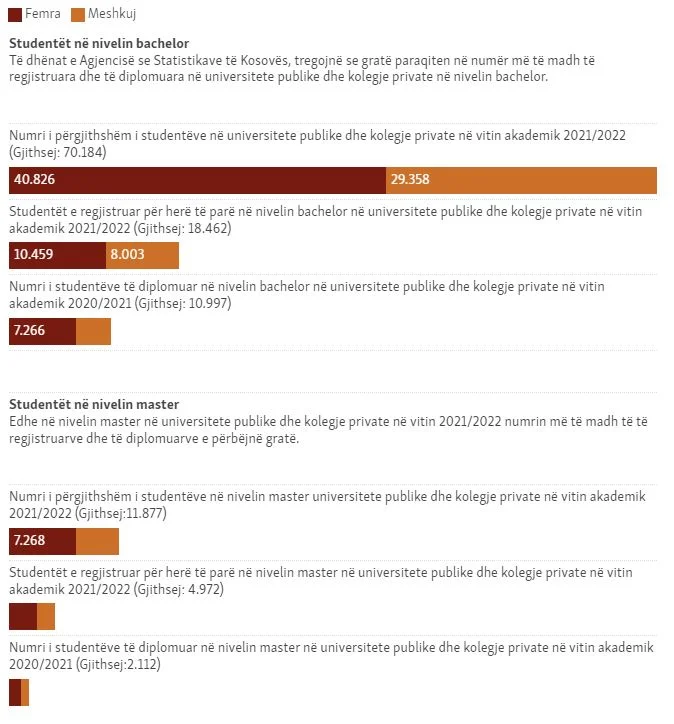
During the 2021/2022 academic year, the total number of students in all high educational institutions was over 70,000. More than half of this number is made up of girls and women, 40,826, and 29.358 are male.
During the 2021/2022 academic year, the total number of students in all high educational institutions was over 70,000. More than half of this number is made up of girls and women, 40,826, and 29.358 are male.
Among the students at the Jurydical Faculty at the Serbian Public University “Hasan Pristina” in Pristina, Bachelor studies are also attended by Arbenita Bytyci and Shkrinije Behe.
They do not believe that the fate of unemployed Liridona can be met.
After the completion of the studies, I think there will be free jobs. That's why I'm committed to having a family well-being in the future”, Arbenita said.
Easy access to the job market, after studies, is also aimed at Shkendija from Pristina. She wants the jury profession to exercise in public institutions.
“Already is easier to obtain a job. Things have begun to be adjusted in Kosovo. I think I'm going to be easily involved in the 15x1nd).
The problem with providing a job has not been Gojart Medici.
He works at a call centre (Call Center) in Pristina.
“Only will be needed and application in each competition. At first, I applied in many jobs until I found work in my research, literature, and German. And I'm happy with my” work, says 25-year-old.
In Kosovo, he says there are currently enough jobs and does not believe there may be gender differences in employment.
Otherwise, women in Kosovo make up nearly half the population. Of the approximately 1.8 million people in Kosovo, more than 905 thousand are males and about 900 thousand women.
The largest number of women are shown in working - age population data.
According to ASC's 2021 data, of more than 1.2 million working-age citizens (from 15 to 64), 613 thousand are males and 618 thousand women.
D4D: Women considered family principals
Gender differences in the employment sector are present, and the patriarchal environment is presented as one of the main reasons for women's low participation in the labour market, said a research conducted last year by the Kosovo Institute for Development, (D4D) called “ ( Without the economic impact of women on the labour market in the Western Balkans”.
According to the D4D, women are regarded as the family's leading caretakers, including full responsibility for child rearing.
In addition, Drenushe Canolli from this organisation tells Radio Free Europe that other reasons are low wages, lack of childcare centers, or inability to cope with their prices, public transportation, and others.
Women end up performing an average of 5-6 hours a day in care, and this prevents them from actively getting involved in the job market, which is equivalent to unpaid jobs.
This category of women is considered inactive, according to the D4D, since they are neither employed nor busy looking for work.
Such fate has been experienced by the Voice, now 60 years old. After completing high school, in the 1980 ' s, he had been working as a reference for nearly four years in the Sxahright Community.
After marriage and childbirth, she recalls, things changed.
The search for work has been huge, but the world's options were limited, not regular transportation. Then she gave birth to her children, and I ended up taking care of the children and chores of the house”, she says.
Since the end of the war, she points out, she has spent each year hoping that she would already provide a job.
I've got a lot of worries left to work, any job. I wanted to be financially independent-but I didn't make it, because the nursery didn't have enough and the price was”, she said.
In Kosovo, according to the Statistics Agency, 49 public nurserys and 177 private centres operate.
The number of these pre-school institutions, in relation to needs, seems to be insufficient.
Monthly payment in public nests is between 40 and 50 euros, while in private ones range from 80 to 250 euros.
The average salary in Kosovo so late has been around 480 euros.
In early February the new Law on Salaries has been enacted, which has brought growth to nearly all public sector employees. Authorities have said that by this law, the average salary will reach up to 730 euros.











