11 minutes ago
Vuciqi's Kurt to Surrender a draft Alex for Implementation of the Agreement in Ohrid
Periskopi(3 years ago)
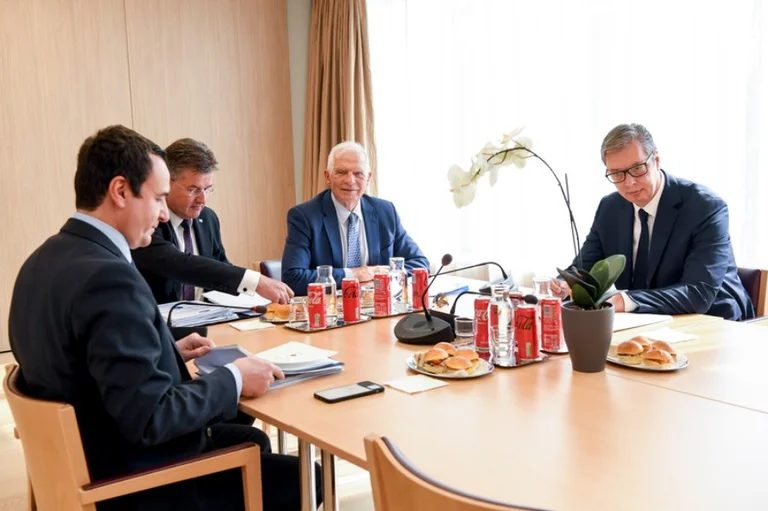
(3 years ago)On February 27th, Kosovo Prime Minister Albin Kurti and Serbian President Aleksandar Vuciq have accepted a European Union proposal in Brussels, titled “Agreement towards Kosovo-Serbia normalisation”. The agreement, for which preparations have been made since the fall of 2022, covers many aspects in relations between the two countries has not yet been signed, but has been officially published [...]
On February 27th, Kosovo Prime Minister Albin Kurti and Serbian President Aleksandar Vuciq have accepted a European Union proposal in Brussels, titled “Agreement towards Kosovo-Serbia normalisation”.
The agreement, for which preparations have been made since the fall of 2022, covers many aspects in relations between the two countries, but is officially published by the European Union.
It is worth mentioning some of its points.
A senior EU official, close to these developments, has told Free Europe Radio that the text lacks a currency without an annex, which the parties are expected to prepare before their next meeting, to be held in Ohrid, North Macedonia, on March 18th.
This fact makes the 11th point of the agreement, which stresses that the “both sides should respect the implementation guide of this” agreement, the most important part.
The plan for this guide, which includes the timing of implementation of the agreement, exists, but there is still work to be done.
The agreement is essentially an addition to the agreement reached in 2013 in Brussels, between Pristina and Belgrade, which has preceded normalising relations, as Kosovo has declared independence in 2008 action Serbia has never accepted.
Kosovo, Serbia and the EU are trying to update the deal a decade ago to unblock the way towards European integration, without an official obligation to Belgrade to recognise Kosovo's independence at least for now.
Although Serbia has opened negotiations with the EU a year after the Brussels Agreement, so in 2014, it has so far harmonised its policy with the EU in only two areas, up from 34 total.
While five EU countries still do not recognise Kosovo's independence, this state remains the only one in the Western Balkans who is not a candidate for EU membership, and its application, submitted last year, has not yet been seriously addressed by the European bloc.
This suggests that Pristina cannot even start working towards harmonisation of policies.
Other Important Faces
One of the most important provisions of the 2013 agreement is the establishment of the Association of Serb-run municipalities in Kosovo.
Prime Minister Kurti has built a large part of the political success on refusing to form this association, arguing that such a structure would create problems similar to those of Bosnia and Herzegovina, where ethnic-based entities make reforms difficult to implement.
The current agreement does not mention association literally, but stresses that “Belgrade and Pristina should ensure a proper level of self-management for the Serb community in Kosovo and the possibility of providing services in certain areas, including providing financial support from Serbia and a direct channel of communication to the Serb community with the Government of Kosovo”.
The question is whether such a vague language can function.
Perhaps Kurti can sell this point to the public as something else and not as the Association of Serb majority municipalities, although the dough is the same, while Vuciq, on the other hand, argue that Belgrade still has the potential to support Kosovo Serbs politically and financially.
From publishing the last document, Vucic has insisted that he will never recognise Kosovo's independence, nor will he accept membership in the United Nations.
However, this stance is contrary to the provisions of the new agreement, especially by point 4, which clears that “Serbia will not oppose Kosovo's membership in any international organisation”.
The real progress test can be presented to the parties this spring.
Initially, Kosovo is aiming to become part of the Council of Europe, and secondly, the 27 EU member states will understand whether they will reach consensus to submit Kosovo's EU membership application to the European Council.
In both cases, Belgrade is believed to have worked in the background to prevent progress in these two directions, some European officials who have knowledge of these developments have said, but are not authorised to discuss this topic in the media.
It is also noteworthy that although the agreement does not force Belgrade to legally recognise Kosovo citizenship, the agreement mentions what is considered de facto recognition, including the need for mutual recognition of national documents and symbols, including passports, diplomas, license plates and customs stamps”, as well as the exchange of permanent missions in respective capitals. / REL