 7 hours ago
Russian symbols, Serbian rightists protest agreement with Kosovo
Periskopi(3 years ago)
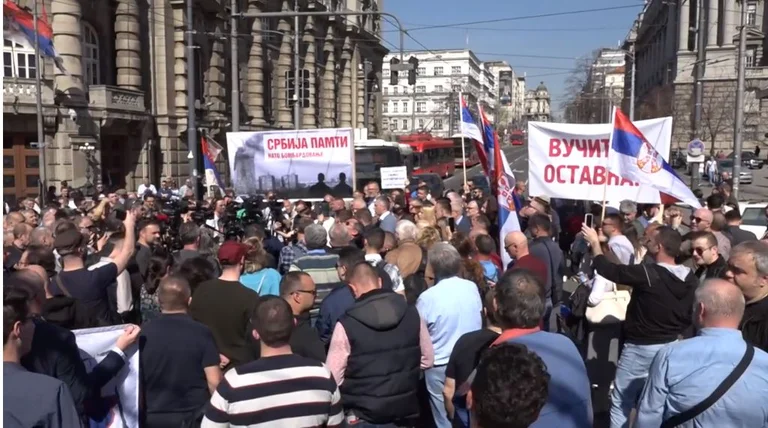
(3 years ago)On March 24th, supporters of the four right-wing parliamentary parties blocked traffic for an hour in front of the Serbian Government building in downtown Belgrade, demanding the rejection of the Agreement on normalising relations with Kosovo. The Dveri Movement, Zavetnici (Religions), the New Democratic Party of Serbia and the Movement for Kingdom Recovery [...]
The Dveri Movement, Zavetnici (Responding), the New Democratic Party of Serbia and the Movement for Recuperation of the Kingdom of Serbia demanded Serbian President Aleksandar Vuciq's resignation for what they called “quadhti” and announcing early elections.
The rally participants held banners “no capitulation” and “Vuchici resigned”, while some wore T-shirts with Z letter, the symbol of Russian aggression against Ukraine.
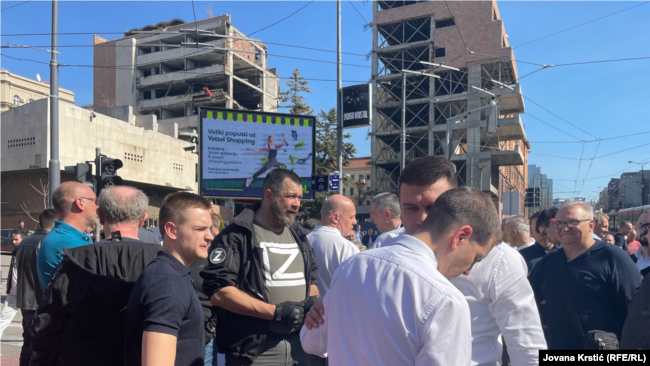
The protest was also Radomir Pocuca, who as a mercenary from Serbia in 2014, fought with pro-Russian separatists in Ukraine.
In 2016, Poçuca struck a deal with the Supreme Court in Belgrade and was sentenced to a year and a half in prison, as well as five on bail.
Today he is a member of the right parliamentary party Zavetnici.
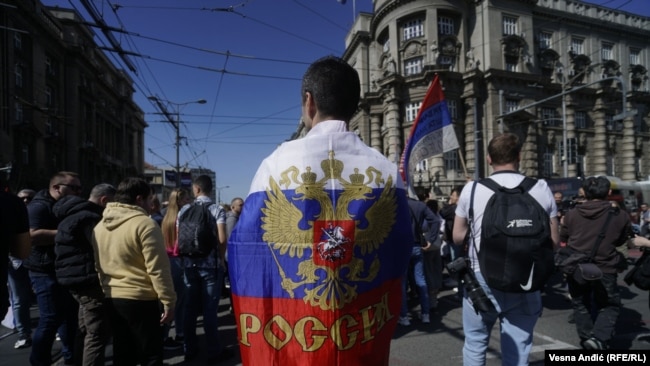
The Dveri Movement, Zavetnici, the New Democratic Party of Serbia and the Movement for Regeneration of the Kingdom of Serbia announced in protest that even in other towns “for Serbia”, gatherings have been organised and “unblocking” of institutions' headquarters.
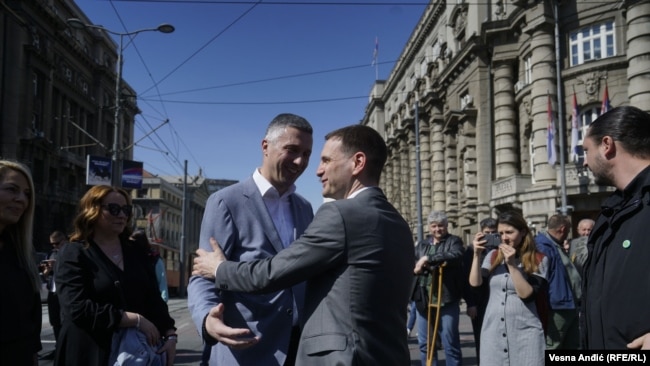
“If there is no revocation of the acceptance of the new Western ultimatum, then the only solution is the resignation of the president of the Republic and Government of Serbia, as well as of having extraordinary elections at all levels”, said the leader of the Dveri movement, Bosko Obradovic, in a speech to journalists during the pre-government protest in Belgrade.
He has also warned of presenting criminal outcry against Serbia's president for, as he has said, “criminal recognition of the occupation and collapse of constitutional order” and that the Constitutional Court will also address it.
The protest in downtown Belgrade, with the motto “no chaptering”, began at 12 and 44 minutes, as an audition for UN Resolution 1244 for Kosovo and the day the NATO bombings began in the Federal Republic of then Yugoslavia in 1999.
On March 24, 1999, NATO began its intervention because of the exodus and war crimes committed by Serbian forces against the Albanian population during the war in Kosovo.
On March 23rd, Dveri, Zavetnici, the New Democratic Party of Serbia and the Movement for the restoration of the Kingdom of Serbia sent a letter to European Union officials (BE) and embassies of countries that have not recognised Kosovo, in which they voiced their opposition to the European agreement and estimated it to be the invalid “”.
The letter was addressed to EU representatives Josep Borrell and Miroslav Lajcak, the MEPs and embassies of Spain, Romania, Greece, Cyprus and Slovakia. The four right-wing opposition parties also staged a protest on 17 March, a day before the meeting between Serbian President Aleksandar Vuciq and Kosovo Prime Minister Albin Kurti in Ohrid in northern Macedonia.
Several thousand people have then walked from the Church of St. Sava to the Serbian Presidency building, with the request that Vuciq refuse in Ohrid the European plan for normalising relations with Kosovo, calling this agreement “traffic”.
Among the participants in the protest was a group of men who carried clothes with signs of Russian paramilitary formation Wagner.
The parties that called for the protest preserve close ties with Russia, meanwhile, their representatives have travelled to Moscow in recent months.
The right-wing parties and movements that organised the protest have 28 out of 250 parliamentary seats in Serbia's Parliamentary Assembly.
Representatives of this group consider the agreement with Kosovo an ultimatum for recognition.
At a meeting in Ohrid on March 18th, leaders of Serbia and Kosovo agreed to Aneks for implementation of the Agreement on the road towards normalising relations between Kosovo and Serbia.
Although Serbia's president and Kosovo Prime Minister Albin Kurti have not signed any documents in Ohrid, European mediators expect the parties to implement everything leaders have agreed on.
Serbia and Kosovo agreed not to block implementation of any provisions of the Agreement.
Serbian President Aleksandar Vuciq said on March 21st that Belgrade will not implement parts of the agreement dealing with Kosovo's membership in the United Nations and that it is not about recognition.
With this agreement, Kosovo pledged to start providing a proper level of self-government for the Serb community in Kosovo, in line with previous agreements from dialogue.
The agreement does not mention mutual recognition, but stresses that parties should respect independence, autonomy and territorial integrity.
In Ohrid, it was agreed that these documents would become integral part of the process of integration of Serbia and Kosovo into the European Union.
The EU's special representative for dialogue, Miroslav Lajcak, explained in an interview for Radio Free Europe (REL) that the parties did not sign the agreement, because the Serbian president declared he had <x1 constitutional definitions” and therefore was unable to sign the document.
According to Lajcak, despite lack of signing, the agreement is legally binding for both sides, because they have agreed that this document be formalised through a statement by the EU high representative.











