26 minutes ago
New “Progress” or towards a historical “agreement”, German press writes about accepting the EU plan in Brussels
Periskopi(3 years ago)
(3 years ago)German press has paid close attention to Monday's developments in Brussels under the Kosovo-Serbia dialogue. The value of the importance of what has been achieved is different from the small <x0-progress” until the presentation of a “historical agreement”. On page of “Tageschau” ARD, you can read a reportage [...]
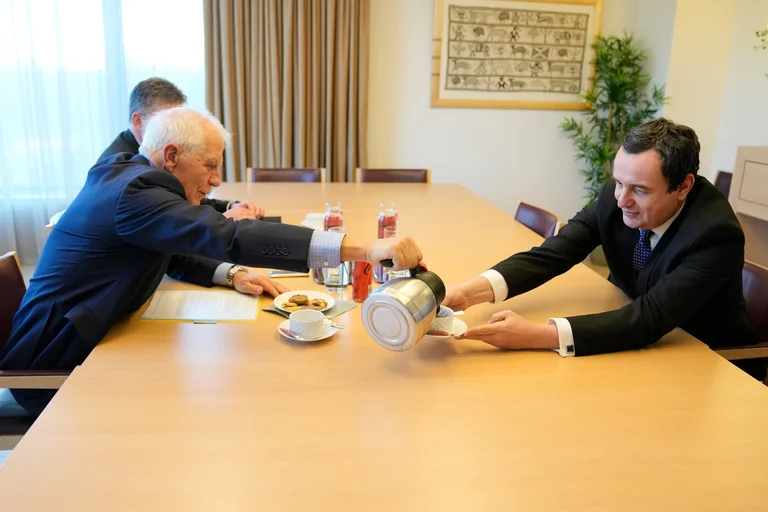
On page of “Tabeschau” of the public service ARD, you can read a report from Brussels titled “Kosovo and Serbia are approaching”. The text says that Vuciq and Kurti have accepted a plan for normalising relations, whose goal, according to Brussels, is free cross-border flow and economic co-operation.
The main characteristics of the agreement are described as follows: “It envisions that people with passports, IDs and license plates can freely move to Kosovo and Serbia”. This could open new economic opportunities and attract additional investments in Serbia and Kosovo. In addition, it will promote trade, as the previously required import and export certificates will no longer be required.
Modeled under contract between two Germanys
Munich daily newspaper Swedish Zeitung also briefed its readers that in Brussels the issue between Belgrade and Pristina began somewhat by a deadlock: Article title says: “The EU has achieved little progress on the Kosovo issue”, and it says: “The fact that both politicians were sitting at the same table could be considered a success of Western diplomacy. Serbia's President, Aleksandar Vuciq and neighbouring Kosovo Prime Minister Albin Kurti, so recently did not miss the opportunity to publicly express their mutual distrust and raise tensions at the borders. The meeting in Brussels, which took place Monday, was the result of long and intense pressure mainly from Berlin and Paris. And it was a success with even half the heart”.
The weekly Die Zeit published a story titled: “Serbia and Kosovo want to normalise their relations”. The author reminds us that the basis of the Brussels agreement is an idea similar to the fundamental treaty between the two Germanys: “ide of a fundamental treaty, such as it is between the Federal Republic of Germany and the GDR, envisions that issues such as mutual recognition should initially be isolated so that both governments can negotiate. Also planned is the opening of diplomatic representatives in capitals. The EU and the US have given time to Kosovo and Serbia by March to link a key agreement”.
Starting a real calming zone of conflict?
Even the daily newspaper Sueddeutsche Zeitung holds an article with the title “Nothing is considered to be good” written by journalist Tobas Zick: “The fact that this meeting is causing so much excitement already shows how far Kosovo and Serbia have been so far from the abnormalisation of their bilateral relations”, the author notes.
He recalls that European Union members have not long held a common policy in that area, but that Paris and Berlin have now made progress with a joint proposal. The proposal, according to the author, requires much from both Belgrade and Pristina: “the Serbian government must recognise de facto Kosovo's independence and thus necessarily turn hardline nationalists in the country against itself, as well as its partner Moscow”. And the Kosovo government must comply with the Association of Serbian municipalities in the north of the country, a step which fears it, because Belgrade can abuse such an impact structure in the neighbouring state of”.
“Europeans and Americans, who brought conflicting parties to the negotiating table with more than mild pressure, have a huge responsibility: they must make sure neither side later regrets their readiness for compromise. If it is necessary for Serbia to be separated permanently from Moscow, Serbia needs a concrete perspective for membership in the European Union. And Kosovo needs guarantees that Kosovo's north will not become the area of institutionalised Serbian separatism, such as Republika Srpska in Bosnia and Herzegovina”.
“However, the agreement could go down as the beginning of a real calming of a conflict zone in Southeast Europe. This would prove that, when necessary, the EU can develop foreign policy. If these two countries reach an agreement, that will also help Europe”, Tobias Zick concludes in his comment on Zeitung.