2 hours ago
Lajcak: Self - management implies the creation of association
Periskopi(3 years ago)
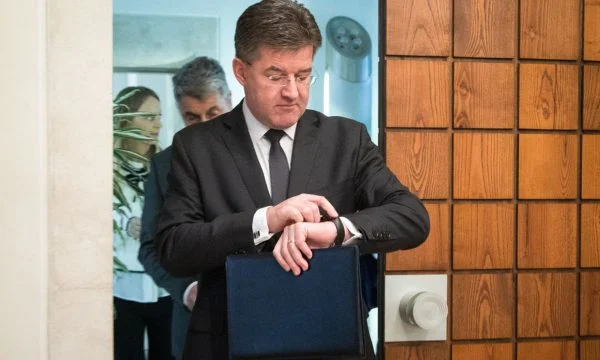
(3 years ago)The European Union's special representative for Kosovo-Serbia dialogue, Miroslav Lajcak, said the agreement between Kosovo Prime Minister Albin Kurti and Serbia's president, Aleksandar Vuciq, represents a turning point in the process of normalising their relations. In an interview Lajcak gave to Radio Free Europe and Euronews Serbia first [...]
The European Union's special representative for Kosovo-Serbia dialogue, Miroslav Lajcak, said the agreement between Kosovo Prime Minister Albin Kurti and Serbia's president, Aleksandar Vuciq, represents a turning point in the process of normalising their relations.
In an interview Lajcak gave for Radio Free Europe and Euronews Serbia first since Kurti and Vuciq agreed to implement the EU Agreement, on March 18th in Ohrid he underlined that both sides should implement all provisions of the Agreement towards normalising relations.
Article 4, which says Serbia will not oppose Kosovo's membership in any international organisation, is also part of it.
Lajcak stressed that Kosovo has the obligation to start immediately with implementation of part of the agreement related to the formation of the Serb majority municipalities in Kosovo.
He acknowledged that the EU had a more ambitious plan: signing the agreement on normalisation and a draft of timelines and clear tasks.
But, he said the leaders of the two countries have failed to agree on each point and that the Serbian president has refused to sign the document. So the proposal has changed.
Lajcak warned a meeting of Kosovo and Serbia's chief negotiators soon to begin, as he said, work on implementing the provisions of the Agreement.
In the interview, he first spoke of reconciliation achieved in Ohrid and the Agreement implementation Anex:
Miroslav Lajcak: I mean, the deal reached in Ohrid last Saturday is an important historical moment. It creates a new quality of the process of normalising relations between Kosovo and Serbia. It raises dialogue to a higher level and will pave the way for normalisation, as well as accelerating the EU membership process for both Serbia and Kosovo.
As the phrase “suggests, the powder test is in its eating”, and the test of the agreement is in its implementation. So the focus is now in effect.
It is no secret that we, as facilitators [of dialogue], have originally prepared a more detailed annex of implementation. With a sequence of steps, with clear deadlines, it would be easier to measure. However, after several hours of negotiations, the parties have managed to agree on 12 out of 18 points. It has been impossible to overcome differences for the remaining six points. We've tried many, many ways to overcome those differences, but it's obviously not going to work.
And for this reason, we've presented a new annex, which is more general and less concrete. But the main provisions are there, especially the fact that the parties will keep all provisions of the Agreement and the Anex in full and in trust.
We have also mentioned another very important part that this agreement is now becoming part of Serbia's [EU] membership path through chapter 35, and for Kosovo through the special normalisation commission. That's what we're gonna do now.
As a next step, we have already launched internal procedures in the European Union to formalise this factor -- [so] -- to make this part of the EU agenda for Serbia and for Kosovo.
As the next step in the dialogue, I will invite the chief negotiators to Brussels and discuss steps for implementation [of the Agreement] to ensure that we have a reconciliation on how to continue with implementation. This is very important.
The issue that has been widely discussed in public discourse has been the issue of signing the agreement. Here I mean that our preference, as a facilitator to the EU, has been for the document to be signed. That was our proposal for the parties. [Serbia's President Aleksandar] Vucin has made it quite clear that he is not in position to sign this document. He has cited constitutional restrictions. We have again made some proposals on how to handle the issue, but they are rejected.
Finally, we agreed that this document would be formalised through the announcement of the High Representative [Joseph Borrell] something that happened on Saturday. This is fully in line with international law practice. So that means this document is mandatory, it's official, it's formal. Any speculation that it is valid and compulsory is meaningless.
I want to add another observation. When we look at past agreements, we don't judge them from the point of view of what they signed and which they didn't. But we always see which ones are applied and which are not. So I really don't think we should get involved in signing discussions. This is reality.
The document is mandatory in two ways. The first through the High Representative's announcement, and second, by making it part of the EU membership process, or the EU agenda for Serbia and Kosovo. Now the focus is on implementation.
And, finally, we, as a facilitator, will regularly report to member states on a monthly basis for progress. Of course, we will continue to work very closely with the United States and we are very grateful that they have been very, very loyal to us and have supported our efforts before Ohrid in Ohrid, and will continue after Ohrid.
And, of course, European Union member states are very interested in making this agreement and this Anex come true.
Radio Free Europe: What authority establishes the hierarchy, or manner, of [the observance of] the provisions of this agreement? I have to say this because we have two contradictions in Anex. The first says Kosovo immediately starts creating specific arrangements and guarantees to provide an adequate self-defence for the Serb community. And the second contradiction is that “rend of the paragraphs of this Annex does not prejudge their implementation order”. Now, according to the European officials' initiative, including Mr. Borrell, self-awareness of the Serb community is of high priority. What is the authority that will determine which provision goes first, and which one then?
Miroslav Lajcak: The authority that will monitor, assess and report on [the Agreement's] implementation is the Joint Monitoring Committee, led by the European Union. This is one of the elements of Annex, where it says the Joint Monitoring Committee will be established within 30 days. Now we are working intensively to determine the objectives of this Joint Monitoring Committee. It will be the authority.
As for your first observation, there is no contradiction. I mean that the statement concerning Article 7 of the Agreement simply refers to our long-term dedication to Kosovo, which stems from the 2013 and 2015 agreement. And since this is such a long issue, it is clear that it should be handled as a priority issue.
And what we have said in the rest of this Annex is that the parties should not pay for their share of the responsibility with the other side.
It is up to [the dialogue] facilitators to report to member states. But, as I said, the Joint Monitoring Committee is a platform, where we're going to discuss things. It will be established as agreed, within 30 days of the adoption of this Annex.
Radio Free Europe: So, it is fair to say that the self-advancing of the Serb community is initially going, and then we can talk about other provisions...
Miroslav Lajcak: No, we should start with putting these on the agenda. And [then] we will continue with implementation.
Our initial proposal has reflected our approach and logic that we must progress step by step. Because it wouldn't be right to believe that a country must do everything first, and then the other side will do its part.
But I believe that I consider the very low level of mutual trust that is far more right to have a process where one side takes the first step and the second side takes that first step. And then we go to step two and step three.
That is why we know that both sides will have to apply what is written and have accepted.
Radio Free Europe: I wanted to ask you about the joint monitoring you mentioned. You said it would be led by the EU, but who would also be part of that committee? And who will guarantee that things will go the way you say, by fulfilling the same things on both sides?
Miroslav Lajcak: It's too early to answer that question, because, as I said, the Joint Monitoring Committee will be established within 30 days. We're working on answering these exact questions. Our suggestions will go into consultation and so on. But it is clear that Kosovo, Serbia and the EU will be there. The EU will head him for this has also agreed. The EU will be what informs member states.
Let us not forget that the progress of Kosovo and Serbia on the road to the EU will, from now on, depend on implementation of the provisions of this agreement and dynamics.
Radio Free Europe: But how attractive is this incentive, considering how far both countries are in the process of European integrations? It is true, Serbia is a leader, Kosovo is nowhere in this process. However, even without the problem of sanctions, for example for Serbia, it remains far apart. How can you offer a much sweeter <x0carot”?
Miroslav Lajcak: I won't comment on the attraction categories. I don't think there's a more attractive offer. I am not aware of any more attractive offer, either for Serbia or Kosovo, of their strategic future. Serbia and Kosovo have made their EU membership their strategic priority. It has also been said long before their path towards the European future passes through normalisation of relations. It's not the only condition. Of course, there are conditions that must be met, but without normalisation, there is no future in the EU. That's very clear.
Radio Free Europe: But, in Kosovo's case, there is no European future if the five non-recognising states [of its independence] do not make any moves...
Miroslav Lajcak: This agreement and its implementation will put many things in motion. Therefore, let us not think of what will happen as a fourth or a fifth step without making sure that we have taken the first or the second step.
Radio Free Europe: But when it comes to Chapter 35 and the European route of both sides, it is important to clarify whether, for example, Serbia meets one of the pieces of implementation Anex. Does this mean improving its European path, opening some parts of the negotiation process?
Miroslav Lajcak: Chapter 35, of course, is a chapter dealing with normalisation of the reports with Kosovo. And through Chapter 35 and the Special Committee for Normalisation, we will monitor and report on implementing the commitments of each side coming out of the deal. At the same time, they have relations with each other, which is normalisation. As I said, the European integration process is more complicated, this is not the only element, but it is the important element of progress on the European road and member states are certainly monitoring progress in normalisation.
Radio Free Europe: We want to ask you about Article 4. That article has left much room for misunderstandings and various interpretations, since there is no specific mention of any international organization. Therefore, I want to ask you if the part in which it writes that Serbia will not oppose Kosovo's membership in international organisations implies membership in the United Nations, because we have heard from many Serbian officials that this is a red line for them, which will not be violated in dialogue?
Miroslav Lajcak: I mean, the text of our agreement is very clear. At the same time, as happens very often, public discourse focuses on something that is not objective, because membership in the United Nations is a bigger problem than Kosovo-Serbia reports. Of course, when it comes to UN membership, people should also think about procedures regarding the role of the Security Council, about the role of five permanent members, and it is necessary to invest in that relationship.
Therefore, the belief that this depends solely on Kosovo and Serbia means that the complexity of the process is not understood. At the same time, our agreement determines what Kosovo and Serbia should do. The sides have pledged to observe or respect all provisions of this agreement and its annex.
Radio Free Europe: However, key Serbian officials, including the president and foreign minister, insist they will implement this agreement as long as they do not touch their red lines, leaving space for the possibility of not implementing certain provisions. Are the parties obliged to fully implement every article of the agreement towards normalisation?
Miroslav Lajcak: Yeah. The answer to your second question is yes. If you read the deal, if you read the anx, they make it quite clear that the parties have pledged, and at the same time, we should not pull the cart in front of the horse. We are focusing on starting with issues that can be carried out by Serbia and Kosovo and what issues can now be done. Like I said, this will affect many other things.
We are still speculating about something that does not depend on the EU, Serbia and Kosovo, we can only determine what Kosovo and Serbia should do. But why are we not focusing on matters that are completely under our control and our range of action? We are distracting ourselves from focusing on issues that can be carried out and should be carried out as priority issues. And we don't need the UN Security Council or permanent members to implement this.
Radio Free Europe: When it comes to issues that are priorities, where and when to start. If I understand it correctly, for Kosovo is the Association of Serb majority municipalities, and for Serbia, who do you expect to be the first priority?
Miroslav Lajcak: In Anex's draft, which we first presented, the alignment was very clear. But this draft has not been approved by the parties. This will be on the agenda of chief negotiators. We are preparing our proposal, I expect them to have their proposals too, and for me the best approach to moving forward is to proceed step-by-step: one side takes one step, another side another. I don't want to talk about these steps right now, because there's no official platform, an official document and we have to agree on that. But I assure you that we are very focused, determined and we will make sure that what we agreed to will be implemented.
Radio Free Europe: After Saturday's meeting, there is a heated debate in Kosovo. Can you tell us about the similarities or differences between the self-awareness of the Serb community and the Association of Serb majority municipalities in Kosovo?
Miroslav Lajcak: I want to be clear, Article 7 does not include new pledges for Kosovo. Article 7 speaks of the need to implement what Kosovo and Serbia have already agreed to. That means the 2013 and 2015 agreements, which speak of establishing a kind of association of Serb majority municipalities. Otherwise, that would mean Article 10, which says all previous agreements, plus Article 7, so additional arrangements, that would have no logic.
Radio Free Europe: So that means creating the majority Serb municipalities in Kosovo...
Miroslav Lajcak: Yeah.
Radio Free Europe: By the same name, as the parties agreed on in the 2013 and 2015 agreements?
Miroslav Lajcak: I don't insist on the name. I insist on what serves both sides. But this is very important that all preliminary agreements must be fully implemented. So we cannot choose the agreement that we like; which we observe and which we ignore, because the serious process will turn into a mockery.
Radio Free Europe: When it comes to normalisation, normally that this is the key word, but both sides do not primarily pledge to each other but separately towards the EU. The rhetoric is still as harsh as it was before the agreement. How do these types of situations affect you, and how do you view normalization in such circumstances?
Miroslav Lajcak: I mean, the normalisation process is led by the EU, not by partners. It would be nice to be the opposite. However, thanks to the fact that we are very busy normalizing, the situation on the ground has stabilised.
The second half of last year was filled with crisis management. We had six crises. We had to reduce tensions, and we couldn't think of normalisation. But since December, since the beginning of this year, we are totally focused on a positive agenda, the agenda that looks forward. So now I am very sure that continuing to implement this agreement will keep us on the positive path.
What's extremely important, and I want to make this clear, is that neither side should take unilateral action that has the capacity to destabilise the atmosphere and the normalisation process. Really, I believe that this agreement, with a new platform, things will be done in coordination and partnership, so that we can make sure that we move forward and not take steps back.
Radio Free Europe: The implementation issue falls to the level of chief negotiators. Do you expect in the future to need another meeting of leaders?
Miroslav Lajcak: I disagree with your statement. We need both levels and leaders to agree on the strategic way forward and the chief negotiators discuss the details of the implementation in line with what leaders have agreed on.
Last year and the early years we had many meetings of the chief negotiators, which led to criticism that the process has been reduced to a technical process, but it is not true. The process takes place at both levels. Therefore, it is logical now to discuss the implementation of what we agreed in Brussels on February 27th and in Ohrid on March 18th, this requires two negotiators and experience to discuss.
But whenever there is a need for a high-level meeting, the meeting will be held with the president and prime minister, and they have shown that they are willing to meet and discuss things in the future. Let leaders discuss major political issues and chief negotiators on practical issues.
Radio Free Europe: One more question about deadlines. We have heard that there are no specific deadlines, but that in the coming days and months we can hear from the EU and its partners that they want the parties to implement issues [from the agreement] by the end of the year because next year there will be elections and other important issues. Do you expect things to happen this year and what you expect to be implemented this year?
Miroslav Lajcak: Again, we had planned many concrete time terms on the original document. Now, we don't want the parties to impose deadlines. We have to agree on this when we meet. But that's not a secret.
We've said many times that we want to complete this process during the current mandate of the European Commission leadership, but also the American administration. There will be a new political reality next year. There are elections in Europe, in the United States, there will be less attention, less commitment. We believe we have enough time to complete this process successfully and implement the provisions of this agreement. But all of this depends on commitment.