 3 hours ago
Kosovo seeks Serbia's international penalisation
Periskopi(3 years ago)
(3 years ago)Implementation of the Ohrid Agreement paves the way for the recognition of Kosovo by the five EU nations. But Belgrade will not implement parts of the agreement related to Kosovo's UN membership. Official Pristina urged the international community to penalise Serbia for violating the Ohrid Agreement after Serbian President Vuciq said [...]
Implementation of the Ohrid Agreement paves the way for the recognition of Kosovo by the five EU nations. But Belgrade will not implement parts of the agreement related to Kosovo's UN membership.
Official Pristina urged the international community to penalise Serbia for violating the Ohrid Agreement, after Serbian President Vuciq said that “would not implement parts of the agreement dealing with Kosovo's membership in the United Nations”, while others would.
US Secretary of State Antony Blinken has said that if the agreement between Kosovo and Serbia is implemented, it would pave the way for the recognition of Kosovo by the five European Union countries that have not recognised it. The Secretary Blinken made this statement before the US Senate, following a question he was asked about his efforts to convince the five EU nations that do not recognise Kosovo.
“Of course it's a matter that we continue to raise, but I also think that this agreement, if it actually moves forward put us on a path towards recognition from these countries”, Secretary Blinken said. According to him, since the two countries have agreed in principle to do so, it is that these commitments are part of the two countries' plans for membership in the European Union, so I hope this will be an incentive for them to implement” allegations.
Blinken: Kosovo recognition from Serbia to take time
Secretary Blinken, acknowledged that recognising Kosovo from Serbia is another matter that will take time, “but if they reach a normal relationship, it would have a positive effect and I believe that in time we will get to that point, but I think that for the five countries that do not recognise Kosovo's independence, the fact that these countries (Kosovo and Serbia) have reached the agreement and that they are supposed to implement it, this will push them towards recognition<1>.
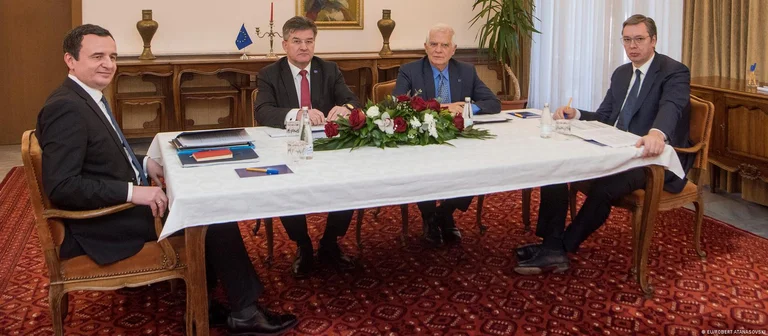
After the March 18th meeting in Ohrid, just as soon as European diplomacy chief Josep Borrell and senior American officials said that implementing the annex of the normalisation agreement that Kosovo and Serbia agreed on in Ohrid is legally binding, the long-term clashes between Pristina and Belgrade began.
It was a statement by Serbian President Aleksandar Vuciq, who said his stance on normalising the reports with Kosovo has not changed, but reiterated that Belgrade “will not implement parts of the agreement concerning Kosovo's membership at the United Nations”.
Is there a deal or no deal?
There are no talks on UN membership and no recognition. Anything else meaning true normalisation of reports, without tensions and without conflicts, Serbia will implement”, Vuciq said in Belgrade. This statement prompted Kosovo President Vjosa Osmani's reaction, which said that “immediately passed 24 hours from the reconciliation for the Agreement's implementation Agreement towards normalisation between Kosovo and Serbia, Belgrade said it would not implement it”. The president urged the “international community to run “expected on Serbia” to respect the obligations it received from the basic agreement reached in Brussels on February 27th and from the annex, which the parties agreed on in Ohrid on March 18th.
I think all the efforts, all the pressure, the commitment of the international community, should be exactly to Vuciqi that what he agreed on, which in essence constitutes the de facto recognition of Kosovo, because when he recognizes someone's sovereignty, when he recognizes them as equal in interstate relations, when he recognizes someone's territorial integrity, these are the state elements of citizenship. The only one missing is a letter of recognition that has not signed”, Osmani said. According to her, “while Vuciqi refuses to implement these, then this really endangers everything”.
Kurti: Now the EU must show itself
Even Prime Minister Albin Kurti, commenting on statements by Serbia's president, Aleksandar Vuciq, who declared that “will not implement part of the agreement saying Kosovo's membership in international organisation”, said the EU “should now be proven” for the agreement to be respected.
We have agreements, we have agreements on February 27th, we have a deal again on March 18th, and both are agreements. The EU is saying it's an agreement, on the other hand you have statements of the Serbian side which shows how it does not intend to implement something or how it is already violating something else. But we can't do that, so there is no intercessors. Now, the EU is what should ensure that agreed agreements should be implemented on the ground”, Kurti said. So far, none of the international authorities have commented on the Serbian president's statements about the implementation of the agreement. But, European Union foreign policy chief Josep Borrell, shortly after the Ohrid meeting, said during reporting to EU foreign ministers that “implementation of the Kosovo-Serbia agreement would be monitored by a commission consisting of both countries and the European Union”. According to him, “it is legally binding”.
These agreements come into effect with the statement I issued. It was not signed for legal reasons, but the two sides agreed that my declaration is commitment on their part to fully fulfill the obligations that come out of this agreement and the annex of implementation”, Borrell said.
However, among the points the European proposal that Kosovo and Serbia agreed on is that all previous agreements -- so 39 Sosh -- must be respected. Among them is the agreement that Pristina must establish the Association of Serb-run municipalities.
Serbian majority municipalities association
In Article 7 of the agreement, the provision of a “relevant self-awareness to the Serb community is required. International authorities are interpreting this article as “the implementation of the obligations Kosovo received in 2013”, respectively, for the agreement to establish the Association of Serb majority municipalities.
For this, President Vjosa Osmani said: “This for me as president of the Republic implies full respect for the Constitutional Court decision, as I have said from 2015 onward. Joining municipalities or citizens in association is right that Kosovo already recognises with its” Constitution. Osmani added that “ky article could be implemented only through the Kosovo Constitutional Court's decision of 2015”.
Compulsory Agreement
Kosovo and Serbia fell on March 18th, in Ohrid, North Macedonia, agreeing to the Annex implementation of the Agreement towards normalisation. The parties did not sign the agreement, but the EU and the United States said that, despite not being signed, it is a binding agreement for the parties. The agreement, released by the European Union on February 27th in Brussels, has 11 articles, but does not specifically mention mutual recognition. However, the document requires both sides to accept each other's documents and symbols, including passports, diplomas and license plates. / DW











